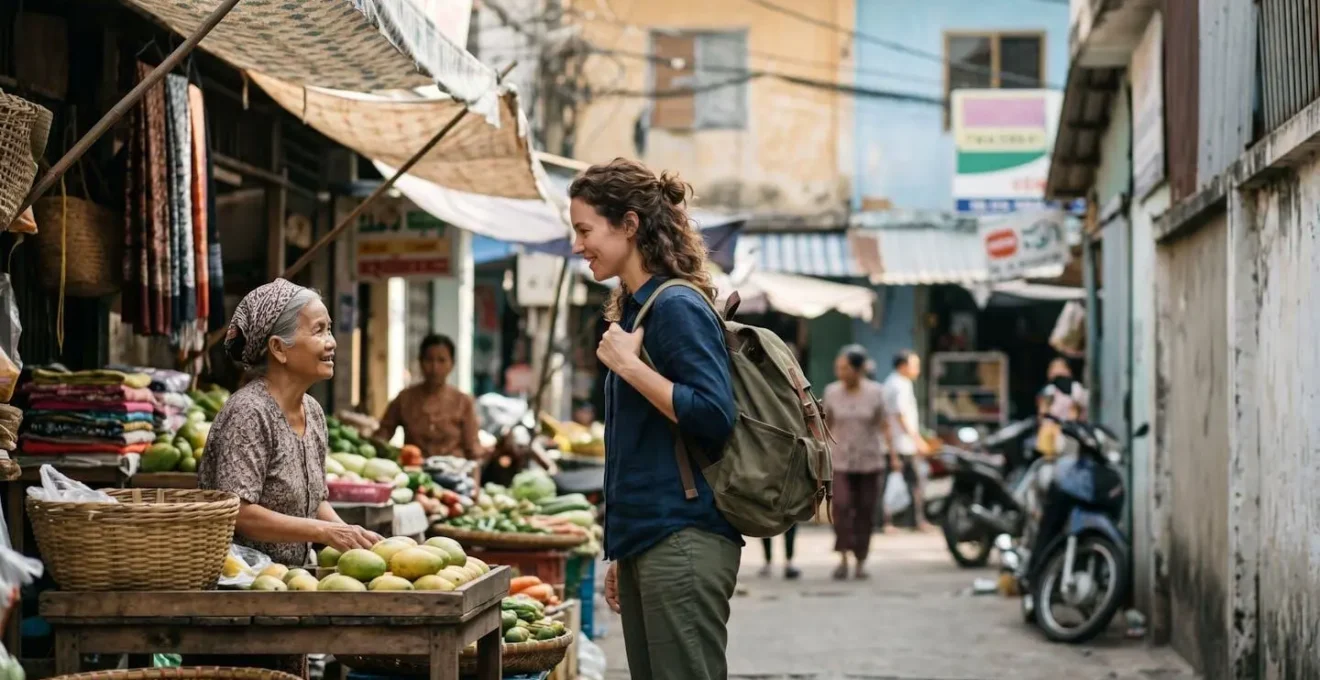
True travel authenticity is not an aesthetic; it’s a verifiable outcome of local ownership and genuine community benefit.
- Digital forensics (reverse image search, host analysis) can unmask large corporate operators hiding behind a single, charming listing.
- Authenticity is measured by economic integration—where the money, food, and jobs originate and, most importantly, where they stay.
Recommendation: Stop looking for « charming decor » and start auditing the property’s entire supply chain and ownership structure before you book.
It’s a familiar, sinking feeling for the discerning traveler. You book what’s marketed as a « genuinely authentic stay »—a villa with rustic charm, a loft in a historic building—only to arrive and discover it’s a soulless, cookie-cutter rental managed by a faceless international property firm. The furniture is from a global big-box store, the « local » art is a mass-produced print, and the host is a chatbot. You’ve been sold a carefully constructed marketing gimmick, a hollow facade of authenticity designed to extract maximum profit with minimum local connection.
The standard advice for avoiding this trap has become a collection of tired platitudes. « Read the reviews, » they say, ignoring that many are fake or from travelers who don’t know what to look for. « Choose a place with traditional architecture, » they advise, forgetting that aesthetics are the easiest thing for a corporation to copy. This surface-level approach fails to address the core of the issue. Authenticity isn’t about how a place looks; it’s about its very substance: who owns it, who profits from it, and how deeply it’s woven into the fabric of the local community.
But what if the key wasn’t just to look harder, but to look *smarter*? What if you could adopt the mindset of an investigator, using a clear framework to conduct a forensic audit before you even click « book »? This guide moves beyond the superficial to provide an actionable toolkit. It will equip you to dissect listings, verify claims, and distinguish true community-integrated stays from the polished, profitable illusions that dominate the market. We’ll explore how to investigate ownership, analyze neighborhood DNA, and assess the ethical implications of your stay, ensuring your travel investment supports the culture you’ve come to experience.
This article provides a complete investigative framework for the skeptical traveler. From defining what true authenticity means to verifying ownership and assessing a neighborhood’s character, each section offers a new tool for your verification toolkit. The following summary outlines the key areas we will dissect.
Summary: An Investigator’s Guide to Verifying Authentic Stays
- What Defines an Authentic Stay Beyond Just Traditional Architecture?
- How to Verify Your Authentic Stay Is Locally Owned, Not Foreign Investment?
- Authentic Stay or 4-Star Hotel: Which Delivers More Meaningful Cultural Connection?
- The Authentic Stay That’s Too Authentic: No Heating, WiFi, or Hot Water
- Which Neighborhoods Offer Authentic Stays in Real Communities, Not Tourist Bubbles?
- Community-Led or Commercial Tour: Which Local Culture Experience Is More Ethical?
- Why Do Urban Centers Hide Their Real Culture 2 Miles From the City Centre?
- How Deep Should You Engage With Local Culture to Be Respectful, Not Intrusive?
What Defines an Authentic Stay Beyond Just Traditional Architecture?
The travel industry has successfully sold « authenticity » as an aesthetic. Exposed brick walls, handcrafted textiles, and reclaimed wood furniture are now standard features in corporate-owned rentals designed to mimic a local feel. This focus on visual cues is a deliberate distraction. True authenticity is not a design style; it’s a measure of socio-cultural and economic integration. It answers the questions: « Who benefits from my stay? » and « Is this space a genuine part of the community’s life or a performance for tourists? »
This distinction is becoming more critical as savvy travelers grow increasingly wary. Indeed, according to recent tourism accommodation research, there is a rising awareness of how tourism can lead to a loss of socio-cultural authenticity in host communities. A truly authentic stay actively counteracts this by creating positive local ripple effects. The money you spend should primarily benefit a local family, not a distant investment fund. The breakfast served should come from the neighborhood baker, not a global food supplier. The stories shared by the host should be personal and rooted in place, not a scripted narrative from a property management playbook.
To cut through the marketing noise, you must conduct a « Provenance Audit. » This investigative mindset shifts your focus from aesthetics to origins. Instead of asking « Does it look authentic? », you ask « Where did this come from? ». This applies to everything from the business model to the bed linens. An authentic stay can prove its local supply chain, demonstrate its host’s personal motivation, and integrate travelers into the community through participatory experiences rather than passive observation. It’s a living, breathing part of the local ecosystem, not an isolated, sterilized box designed for transient visitors.
How to Verify Your Authentic Stay Is Locally Owned, Not Foreign Investment?
The most significant red flag for an inauthentic stay is abstract corporate ownership masquerading as a personal hosting experience. Large property management companies and foreign investment firms are adept at creating listings that feel personal, often using stock photos of « hosts » and crafting compelling but fake backstories. To penetrate this facade, you must employ a form of digital forensics. This proactive investigation uses publicly available tools to verify the claims made in a listing before you commit your money.
This process is less about suspicion and more about due diligence. Your goal is to find evidence that confirms you are dealing with an individual homeowner rather than a large-scale commercial operator. A single property listed by a host with deep roots in the community is a green flag. In contrast, a « host » who manages dozens of properties across multiple cities is almost certainly a front for a larger business where profits are extracted from the local economy. Your investigation should focus on tracing the digital footprint of the property and its host across the internet.
The following checklist, based on principles from research into digital tourism platforms, provides a systematic way to conduct this verification. It’s your primary tool for unmasking corporate operators and identifying genuinely local stays.
Your Action Plan: The Digital Forensics Checklist for Ownership Verification
- Reverse Image Search: Upload key property photos to Google Images or TinEye. A genuine homestay’s photos should be unique. If they appear on stock photo sites or across dozens of different rental platforms under different names, it’s a major red flag for a generic, commercially managed property.
- Host Profile Investigation: Search the host’s name on professional networks like LinkedIn. Does their profile match the story? Are they an architect living in the city as claimed, or are they listed as a « Portfolio Manager » for a large real estate company?
- Portfolio Analysis: On the rental platform, check the host’s profile to see how many properties they list. While a host might own two or three properties, a portfolio of 10 or more listings is a clear indicator of a commercial operation, not an authentic homestay.
- Direct Questioning: Send a polite but direct message. Ask, « Are you the direct owner of this property or a manager for a company? » and « Can you confirm the majority of the profit from my stay remains within the immediate local community? » A genuine host will answer clearly and proudly; a corporate manager will often deflect or give a vague, corporate-approved response.
- Negative Review Analysis: Don’t just read the 5-star reviews. Scour the 1, 2, and 3-star reviews for keywords like « management company, » « unresponsive, » « call center, » or « different from photos. » These are tell-tale signs of dissatisfied customers who dealt with an impersonal corporate structure, not a real host.
Authentic Stay or 4-Star Hotel: Which Delivers More Meaningful Cultural Connection?
The debate between a boutique hotel and an authentic homestay often misses a crucial point: not all hotels are sterile corporate chains, and not all « homestays » are genuinely local. The key differentiator for a meaningful cultural connection isn’t the building type but its level of community integration. A locally-owned boutique hotel that hires local staff, sources its food from nearby farms, and hosts events for neighborhood artists can offer a far richer cultural experience than a foreign-owned Airbnb that contributes nothing to the community.
To make an informed choice, you must compare potential accommodations across several dimensions of connection, moving beyond simple amenities. These dimensions include direct interaction with locals, immersion in a real neighborhood, the provenance of food, the nature of cultural programming, and, most importantly, the final destination of your money. A corporate chain hotel is designed for standardized comfort and efficiency, often creating an isolating bubble where the primary economic benefit is extracted from the community. A true authentic stay, whether it’s a homestay or a locally-owned hotel, functions as a portal into the community.
The following framework, drawing from a comparative analysis of accommodation types, breaks down these connection points to help you decide which option best aligns with your goal of a meaningful cultural experience.
| Connection Dimension | Locally-Owned Boutique Hotel | Authentic Homestay | Corporate Chain Hotel |
|---|---|---|---|
| Direct Host Interaction | Moderate (staff intermediaries) | High (daily personal contact) | Low (standardized service) |
| Neighborhood Immersion | High (embedded in community) | Very High (residential area) | Low (isolated tourist zone) |
| Local Food Sourcing | High (100% local partnerships) | Very High (home-cooked) | Low (global supply chains) |
| Cultural Programming | Curated (local artists, events) | Organic (family traditions) | Generic (tourist entertainment) |
| Economic Benefit to Community | High (local staff, suppliers) | Very High (direct to family) | Low (profit extraction) |
| Comfort & Amenities | High (professional standards) | Variable (authentic experience) | Very High (standardized) |
The Authentic Stay That’s Too Authentic: No Heating, WiFi, or Hot Water
In the pursuit of authenticity, there’s a risk of overcorrection: booking a stay that is so rustic it becomes uncomfortable or impractical. The romance of a remote cabin or a historic stone house can quickly fade when you discover « rustic charm » is a euphemism for no reliable hot water, non-existent WiFi, or a nightly battle with local insects. The key to avoiding this disappointment is not to abandon the search for authenticity, but to conduct an honest self-assessment of your personal tolerance levels before you book.
Marketing language is designed to be aspirational. Terms like « digital detox, » « back to nature, » or « historic character » sound appealing but often obscure the practical realities. « Digital detox » means the WiFi is unusable for a work video call. « Embrace nature » might mean sharing your bathroom with spiders. True authenticity doesn’t have to mean a complete lack of modern comfort, but you must be clear about your own non-negotiables. Are you genuinely happy with a cold shower and a composting toilet, or is that a step too far? Being honest with yourself is the most important step.
This self-assessment scorecard helps you quantify your needs. By rating your tolerance for common rustic features, you can generate a score that guides you toward the right *level* of authenticity for you. This prevents the kind of mismatch that leads to a miserable trip and a negative review for a host who was simply offering exactly what they advertised.
Your Action Plan: The Authenticity Tolerance Self-Assessment
- Rate your WiFi limitations (1-5): 1 = I must have stable, high-speed internet for work or streaming; 5 = I welcome a complete digital detox and no connectivity.
- Rate your need for climate control (1-5): 1 = I require modern air conditioning or central heating for comfort; 5 = I am comfortable with natural temperatures, drafts, and using fans or blankets.
- Rate your hot water expectations (1-5): 1 = A long, hot shower is an essential daily ritual; 5 = I can accept limited hot water availability, solar-heated water, or even cold showers.
- Rate your modern plumbing requirement (1-5): 1 = I need a modern, Western-style flush toilet; 5 = I am open to and comfortable with composting toilets or basic outdoor facilities.
- Rate your insect and wildlife tolerance (1-5): 1 = I cannot sleep if there’s a single bug in the room; 5 = I accept that insects, geckos, and other small creatures are a normal part of a natural environment.
Total your score to filter listings: A score of 5-10 means you should stick to modern hotels with full amenities. 11-18 suggests you’re a good fit for well-appointed or upgraded homestays with character. A score of 19-25 indicates you’re ready to embrace fully rustic, off-grid authentic experiences.
Which Neighborhoods Offer Authentic Stays in Real Communities, Not Tourist Bubbles?
Finding an authentic stay is not just about the house; it’s about the street, the block, and the neighborhood. Many booking platforms guide travelers toward « tourist bubbles »—sanitized districts packed with souvenir shops, international chain restaurants, and other tourists. These areas are often shells of their former selves, where real community life has been pushed out by high rents and commercialization. A truly authentic experience is found in a living, breathing residential neighborhood, where your temporary neighbors are locals, not other travelers.
The challenge is how to assess a neighborhood’s character from thousands of miles away. You cannot rely on the listing’s description, which will almost invariably describe the area as « vibrant » and « charming. » Instead, you must become a remote urban explorer, using digital tools to look for signs of real community life. The presence of everyday infrastructure—bakeries, laundromats, schools, and hardware stores—is a powerful indicator of an authentic neighborhood. Conversely, a high density of currency exchanges, tour bus stops, and luggage storage services signals a tourist bubble.
The trick is to use tools like Google Maps Street View not just for navigation, but as an ethnographic tool. « Walk » the streets at different times of day. A real neighborhood is bustling in the morning with people going to work and school. A tourist bubble is often quiet until mid-morning. Look for people carrying grocery bags, not selfie sticks. These small visual cues are the data points that reveal the true nature of a place.
Your Action Plan: Remote Neighborhood Authenticity Assessment
- The Street View Test: Virtually walk the streets around your potential stay. Count the number of businesses that serve locals (grocery stores, pharmacies, local diners) versus tourists (souvenir shops, ticket offices). A healthy ratio in favor of local services is a strong green flag.
- The Social Infrastructure Search: Use a map tool to search for « schools, » « public libraries, » and « playgrounds » within a 500-meter radius. Their presence is a definitive sign that families actually live there, making it a genuine residential community.
- The Non-Tourist Restaurant Scan: Ignore the top-rated restaurants on tourist sites. Instead, search for local food blogs or search Instagram for geotags in the local language. Where are the locals posting about their favorite cheap eats? A high density of beloved, affordable eateries indicates a real neighborhood.
- The Retail Mix Analysis: Look at the types of shops. Is it a mix of everyday necessities like banks, hardware stores, and small repair shops? Or is it dominated by high-end fashion brands and stores selling tourist trinkets? The former points to a living community, the latter to a commercialized zone.
Community-Led or Commercial Tour: Which Local Culture Experience Is More Ethical?
Once you’ve found an authentic stay, the next challenge is choosing ethical cultural experiences. The line between genuine cultural exchange and human exploitation can be thin. A commercial tour, run by an outside company, often packages culture as a product to be consumed. The narrative is controlled by outsiders, interactions can feel like a performance, and a significant portion of the revenue never reaches the community members themselves. This model risks turning people and their traditions into a spectacle.
In contrast, a community-led or community-based tourism (CBT) initiative puts the local people in control. They decide what stories to share, how to share them, and how the income is managed and distributed. This approach fosters empowerment, ensures the cultural narrative is self-determined, and provides a more dignified and authentic interaction for both the host and the guest. The experience shifts from a one-way performance to a two-way exchange, where travelers are welcomed as respectful participants rather than just spectators.
The goal is to support models that prioritize community agency and equitable benefit. Before booking any tour or experience, ask critical questions: « Who is telling the story? » and « Who is getting the money? » Transparent, ethical operators will have clear answers.
Case Study: The TourDure Program in South Korea
A powerful example of ethical CBT is South Korea’s TourDure program. This initiative specifically empowers local women’s cooperatives to develop and manage their own tourism enterprises. By enabling community members to pool resources and share risks, the model ensures they maintain full control over their cultural narrative and that profits are distributed equitably. This structure not only prevents economic leakage but also promotes financial independence and sustainable growth, demonstrating how tourism can be a force for positive community development when led from within.
Why Do Urban Centers Hide Their Real Culture 2 Miles From the City Centre?
Travelers often flock to historic city centers assuming they are the epicenters of local culture. The reality is often the opposite. In many popular cities, the historic core has been transformed into a sanitized theme park for tourists, a phenomenon known as tourism-driven gentrification. As tourism intensifies, commercial rents skyrocket, pushing out the very things that made the neighborhood authentic in the first place: small, family-run businesses, independent artisans, and long-term residents.
This process hollows out the cultural heart of a city. The local bakery that served the community for generations is replaced by a global coffee chain. The quirky, independent bookstore is replaced by a souvenir shop. As research on gentrification in Seville and Cádiz demonstrates, there is a strong correlation between the increase in tourist apartments and the loss of the resident population. The real, living culture doesn’t just disappear; it is displaced. It migrates, following the local population to more affordable residential neighborhoods located a few miles outside the tourist-saturated core.
This is why the most authentic urban experiences are often found just beyond the main tourist map. In these « second-line » neighborhoods, you find the businesses and communities that constitute the city’s true, contemporary cultural identity. Here, the economy is oriented around the needs of residents, not tourists, which paradoxically creates the exact authentic environment that discerning travelers seek.
Case Study: Cultural Displacement in Barcelona’s Historic Center
Barcelona’s city center is a classic example of this dynamic. The immense pressure from mass tourism created an economic environment where only large, international chains and tourist-focused businesses could afford the escalating rents. This systematically displaced the small, independent, family-run shops that formed the authentic heart of Catalan culture. Consequently, the city’s genuine cultural life—the places where locals shop, eat, and socialize—relocated to surrounding residential neighborhoods like Gràcia or Poblenou, following the city’s natural demographic and economic evolution away from the over-touristed center.
Key Takeaways
- Authenticity is not an aesthetic; it’s a verifiable measure of local ownership, economic benefit, and community integration.
- Employ digital forensics—like reverse image searches and host portfolio analysis—to unmask corporate operators disguised as local hosts.
- The most authentic neighborhoods are « living communities » identified by their everyday infrastructure (schools, laundromats) rather than tourist services.
How Deep Should You Engage With Local Culture to Be Respectful, Not Intrusive?
The final piece of the authenticity puzzle lies in your own behavior. An authentic experience requires more than just finding the right place; it demands the right mindset—one of respect, humility, and awareness. The goal is to be a respectful observer and occasional participant, not an intrusive consumer. Crossing the line from appreciative guest to entitled tourist can happen unintentionally, often stemming from a lack of understanding of personal and cultural boundaries. A structured approach can help navigate these sensitive interactions gracefully.
The key is to wait for an invitation, whether verbal or through body language. Never assume you have the right to enter a space, take a photograph, or join a conversation. The most meaningful interactions are those that are freely offered by the host community, not those that are demanded or expected by the traveler. As a guiding principle, think of your engagement in tiers, starting with simple, non-intrusive observation and only progressing to deeper participation when explicitly welcomed. This tiered approach ensures you are always acting with consent and respect.
This framework helps calibrate your actions to the situation, ensuring you engage in a way that is always respectful and never intrusive.
Your Action Plan: The Four-Tier Cultural Engagement Framework
- Tier 1 – Observation: The default mode. Respectfully watch public life from an appropriate distance. Observe festivals, markets, and daily routines without inserting yourself. Photography of general scenes is usually acceptable, but avoid close-ups of individuals, especially children, without clear permission.
- Tier 2 – Transaction: Engage in polite, human-centered interactions during commerce. When you buy from a local shop or market, extend basic courtesies. Learn a few words of greeting in the local language, make eye contact, and treat vendors as people, not just service providers.
- Tier 3 – Conversation: Initiate extended dialogue only when you receive clear signs of openness, such as a smile, a question, or inviting body language. Be prepared to read the signs when someone is busy, uninterested, or uncomfortable, and respectfully disengage.
- Tier 4 – Participation: This is the deepest level and requires an explicit invitation. Never assume access. This includes being invited into a private home, asked to share a family meal, or welcomed to join a local ceremony or activity. Always wait to be asked.
Tourists are cultivating more ethical and sustainable profiles to enhance social responsibility in their travels
– Veloso et al., Community-Based Tourism and Best Practices with the Sustainable Development Goals
By adopting this investigative mindset and these respectful practices, you transform your role from a passive tourist into a conscious traveler. You are no longer just a consumer of places, but a temporary, positive contributor to them. Start your next travel search not just by asking where you want to go, but by investigating what kind of impact you want to have when you get there.
Frequently Asked Questions on Identifying Authentic Stays
What does ‘rustic charm’ actually mean?
Rustic charm typically indicates older buildings with original features, which may include drafts, creaky wooden floors, uneven surfaces, and minimal soundproofing. Expect character over modern comfort.
What should I expect from a ‘digital detox retreat’?
Digital detox explicitly means no WiFi or extremely limited connectivity. This is intentional, not a service failure. If you need internet for work emergencies, this is not the right option.
What does ’embrace nature’ imply about accommodations?
Embrace nature suggests outdoor or semi-outdoor facilities, potential wildlife encounters including insects, and minimal barriers between indoor and outdoor spaces. Expect an immersive natural environment.
How can I politely verify amenities before booking?
Instead of ‘Is there WiFi?’, ask ‘I occasionally need to check emails for work; could you describe the internet reliability and speed?’ This clarifies expectations without seeming demanding and tests host responsiveness.
How can I verify who controls the cultural narrative on a tour?
Ask the tour operator: ‘Who will be telling the stories and leading the tour – community members themselves or external guides?’ Community-led tours prioritize self-representation, where locals control how their culture is presented.
What questions reveal how tour revenue benefits the community?
Ask directly: ‘What percentage of the ticket price goes directly to community members we’ll interact with?’ and ‘How does this tour contribute to community development projects?’ Transparent operators will answer specifically with numbers and examples.
What are red flags that distinguish genuine exchange from exploitation?
Warning signs include: tours feeling like performances rather than conversations, lack of genuine two-way interaction, intrusive photography especially of children, narratives that sensationalize poverty or ‘primitiveness’, and locals who appear uncomfortable with visitors.
Is non-profit status alone sufficient to ensure ethical tourism?
No. Non-profit status doesn’t guarantee ethical practices. Focus instead on transparency about benefit distribution, community ownership, and whether local people have decision-making power in how tourism operates, regardless of organizational structure.