In summary:
- Stop planning your port day from arrival; instead, reverse-engineer your entire itinerary from the non-negotiable « all-aboard » time.
- Identify one « Anchor Activity » as your main goal and treat everything else as a flexible bonus, protecting your experience from overscheduling.
- Treat your physical and mental energy like a budget, allocating the most to your primary activity and reserving a large portion for a stress-free return.
- The most powerful time-saving move is sometimes staying on the ship to enjoy empty amenities, especially on redundant or high-hassle port days.
The moment the gangway opens, a silent clock starts ticking. For many cruise passengers, a six-hour port of call represents a paradox of opportunity and anxiety. There’s a city to explore, culture to absorb, and memories to make, but it’s all shadowed by the one cardinal sin of cruising: missing the ship. The conventional wisdom presents a stark choice: either pay a premium for the cruise line’s « safe » excursions, which are often crowded and generic, or venture out alone, constantly glancing at your watch in a state of low-grade panic.
This approach is fundamentally flawed because it focuses on fear rather than strategy. What if the secret to a perfect port day wasn’t just about watching the time, but about fundamentally redesigning your relationship with it? The key isn’t to cram more in, but to build a robust system of time buffers that transforms anxiety into controlled confidence. It’s about becoming a port-day strategist, not just a tourist.
This guide will walk you through that strategic shift. We will deconstruct the costs and benefits of different tour types, provide a foolproof method for itinerary design that guarantees an on-time return, and offer frameworks for deciding what to do—and, just as importantly, what *not* to do. By the end, you’ll have a complete system for making every six-hour stop a meaningful and relaxing highlight of your voyage.
Summary: How to Master Your 6-Hour Cruise Port Stop
- Why Do Cruise Ship Port of Call Tours Cost £80 When Local Tours Cost £50?
- How to Design Port of Call Itineraries With Enough Margin to Never Miss Departure?
- Port of Call Depth or Breadth: Which Cities Warrant Intensive Time?
- The Overscheduling Mistake That Leaves 60% of Cruisers Exhausted at Every Port of Call
- Which Port of Call Stops Are Skippable for Onboard Relaxation Days?
- Self-Guided Walk or Organized Tour: Which Saves You More Time at Sightseeing Spots?
- How to Master Public Transport in Urban Centers Within Your First 48 Hours?
- What Do First-Time Cruise Travel Passengers Need to Know to Avoid Rookie Mistakes?
Why Do Cruise Ship Port of Call Tours Cost £80 When Local Tours Cost £50?
The price difference between a cruise line’s official excursion and a seemingly identical tour from a local operator isn’t arbitrary; you’re paying for a « safety premium. » Ship-sponsored tours come with one ironclad guarantee: the ship will not leave without you if the tour is delayed. This peace of mind is the primary product being sold. In contrast, independent tours can often be 30-50% less expensive because they operate without that direct logistical link to the cruise line. They pass the savings of lower overhead and direct booking on to you.
However, choosing an independent tour doesn’t have to mean embracing risk. It means replacing the cruise line’s safety net with your own due diligence. Reputable independent operators who cater to cruisers have built their businesses on reliability. Many offer their own « back-to-ship » guarantees, promising to get you to the next port of call at their expense if a delay causes you to miss departure. The key is to vet these operators thoroughly. By asking the right questions and checking for specific credentials, you can confidently capture the cost savings without sacrificing your peace of mind.
Checklist for Vetting Independent Tour Operators:
- Verify the operator offers a ‘back-to-ship guarantee’ and ask specific questions about their policy if delays occur.
- Check online reviews specifically from cruise passengers (not general tourists) on platforms like Cruise Critic forums.
- Confirm pickup/drop-off locations are at or very close to the cruise terminal.
- Ask about their contingency plans for traffic delays, weather issues, or unexpected closures.
- Verify they monitor your specific ship’s departure time and adjust tour duration accordingly.
- Request evidence of proper licensing, insurance, and safety certifications.
- Ensure communication channels are established (phone number, WhatsApp) for day-of coordination.
How to Design Port of Call Itineraries With Enough Margin to Never Miss Departure?
The single most effective way to eliminate the fear of missing the ship is to stop planning your day forward from your arrival time. Instead, you must adopt Exit-First Planning. This method treats your « all-aboard » time as the central, non-negotiable anchor of your entire day. Everything else is reverse-engineered from that single point. While many cruise experts recommend a 30-60 minute buffer, this system builds that buffer in systematically, turning vague hope into a concrete schedule.
The process starts by defining your « Must-Be-At-Port » time and then working backward, layering in generous buffers for travel, transitions, and unexpected delays. Your furthest point of exploration is determined not by what you want to see, but by the non-negotiable time you must begin your return journey. This creates a psychological shift: your focus is no longer on « how much can I see? » but on « how can I guarantee a stress-free return? »
This approach may sound restrictive, but it is liberating. By creating a firm structure around your exit, you free up your mental energy during the « explore » phase of the day. You can immerse yourself in your chosen activity, knowing with certainty that your return is already planned and protected by multiple layers of buffer time. The pocket watch isn’t a tyrant; it’s the tool that grants you permission to relax.
Your Action Plan: The Exit-First Planning Method
- Identify Deadline: Note the official ‘all-aboard’ time from your cruise app or daily newsletter.
- Set Personal Buffer: Subtract 60 minutes to determine your personal ‘must-be-at-port-security’ deadline.
- Research Return Travel: From your furthest planned destination, research typical return travel time (e.g., Google Maps for transit), factoring in potential traffic.
- Add Travel Buffer: Add a 50% buffer to that travel duration (e.g., if the return is 40 minutes, budget 60 minutes).
- Calculate ‘Must-Leave’ Time: Work backward from your port deadline to calculate your ‘must-leave-destination-by’ time. This is your most important time of the day.
Port of Call Depth or Breadth: Which Cities Warrant Intensive Time?
With a limited six-hour window, the « depth versus breadth » dilemma is critical. Should you sample a little of everything (breadth) or immerse yourself in one significant experience (depth)? The answer depends entirely on the port’s archetype. Not all ports are created equal, and understanding their logistical DNA is key to setting realistic expectations and avoiding frustration. The primary factor to consider is the Travel Pain Index: the amount of time and effort required just to get from the ship to the main area of interest.
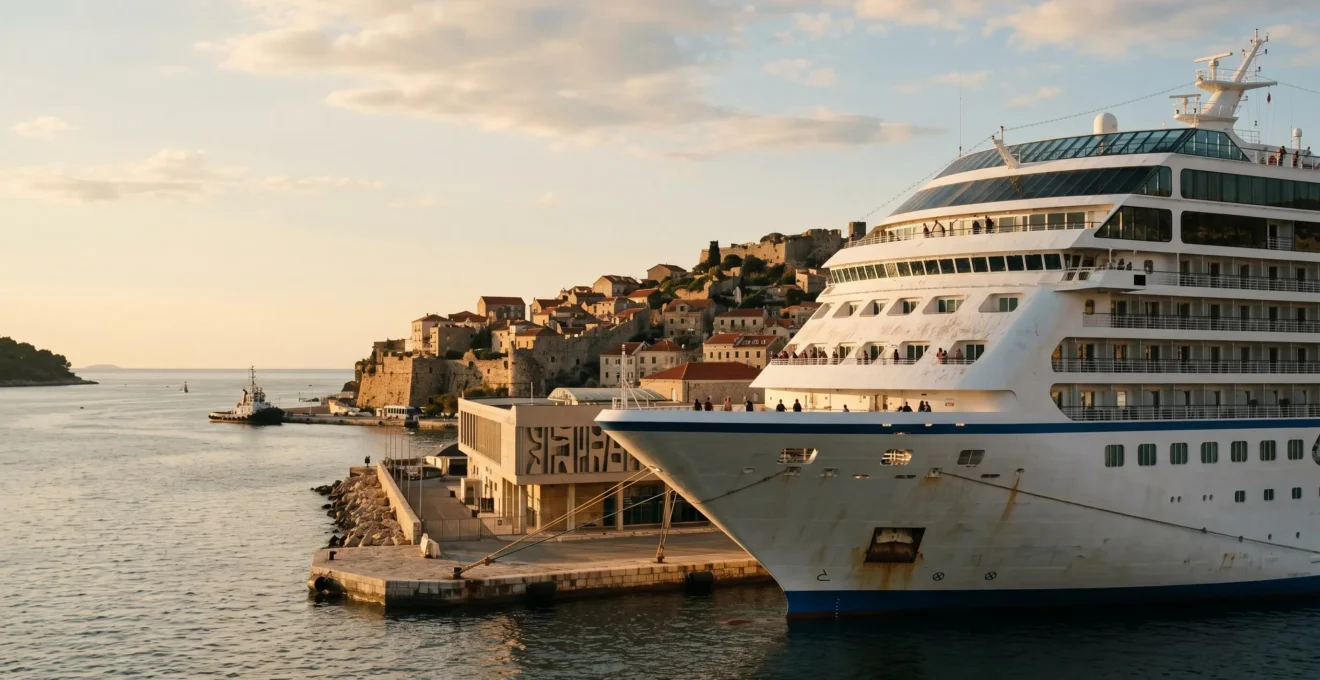
A low Travel Pain Index port, like Dubrovnik’s Old Town, is just a short walk or shuttle from the dock. These ports are ideal for a « breadth » strategy. You can wander through multiple neighborhoods, browse a market, and enjoy a leisurely lunch without feeling rushed. Conversely, a Metropolis Gateway Port like Civitavecchia (for Rome) has a very high Travel Pain Index, often requiring a 60-90 minute train or bus ride each way. Attempting a « breadth » strategy here is a recipe for disaster. The only logical approach is « depth »: choose one single, high-value experience—like a pre-booked tour of the Colosseum or a specific culinary class—and devote your entire time budget to it.
This framework allows you to make strategic decisions before you even step off the ship, aligning your plan with the physical reality of the destination and ensuring your precious time is spent on enjoyment, not just transit.
The following table provides a strategic framework for deciding whether to pursue a « depth » or « breadth » approach based on the type of port you’re visiting. As a recent analysis of port types shows, matching your strategy to the port’s logistics is critical.
| Port Archetype | Examples | Travel Pain Index | Recommended Strategy | Optimal Activity Count |
|---|---|---|---|---|
| Walking Old Town Port | Dubrovnik, Tallinn, Kotor | Low (5-15 min walk) | Breadth – explore multiple areas | 2-3 neighborhoods, market, lunch |
| Beach/Resort Port | Cozumel, Grand Cayman, Mykonos | Low-Medium (15-30 min) | Breadth or hybrid | Beach + 1-2 casual activities |
| Metropolis Gateway Port | Rome via Civitavecchia, Florence via Livorno | High (60-90 min each way) | Depth – one quality experience | 1 major site + 1 meal |
| Natural Wonder Port | Norwegian Fjords, Glacier Bay | Varies (often low) | Depth – immersive nature | 1 scenic experience (hike or cruise) |
| Multi-attraction Compact Port | Barcelona, Naples, Valletta | Medium (30-45 min) | Hybrid – 1 anchor + 1 flexible | 1-2 major sites |
The Overscheduling Mistake That Leaves 60% of Cruisers Exhausted at Every Port of Call
The most common source of port day disappointment isn’t missing the ship; it’s returning to it utterly exhausted and feeling like you didn’t truly enjoy anything. This is the direct result of overscheduling, the misguided attempt to « see it all. » As the experts at CruiseDirect caution in their Port of Call Pro Tips Guide:
Without proper planning, you risk feeling rushed and overwhelmed, trying to cram too much into a short window.
– CruiseDirect Travel Experts, Port of Call Pro Tips Guide
The antidote to overscheduling is to treat your personal energy like a finite budget. You start the day with 100% of your energy—both physical and mental. Your goal should be to allocate this energy strategically, not deplete it by lunchtime. This means identifying one single Anchor Activity that represents your top priority for the day. This is where you « spend » the bulk of your morning energy, when you are fresh and focused.
Everything after that anchor activity should be lower intensity and, crucially, optional. A leisurely lunch, some light shopping, or simply finding a bench in a pleasant square are perfect « midday energy » activities. The afternoon should be almost entirely reserved for the return journey, with a massive buffer. If your itinerary requires running between locations or has no breaks longer than 30 minutes, it is not a plan; it is a recipe for exhaustion. A truly successful port day is one where you return to the ship feeling energized and satisfied, not drained and defeated.
The Energy Budgeting System:
- Morning Energy (100%): Allocate to your single most important ‘anchor’ activity requiring focus and mobility.
- Midday Energy (60-70%): Reserve for a lower-intensity secondary activity like lunch at a local restaurant or light shopping.
- Afternoon Energy (40-50%): Plan only buffer time for the return journey or a spontaneous, low-key discovery near the port.
- Red Flags of Over-scheduling: An itinerary that requires running between locations, has no meal breaks longer than 30 minutes, or relies on ‘everything going perfectly’.
Which Port of Call Stops Are Skippable for Onboard Relaxation Days?
The most radical and often wisest port-day optimization strategy is choosing not to get off the ship at all. This may sound counterintuitive—you paid to see the world—but strategically skipping a port can be the most luxurious and restorative experience of your entire cruise. The key is to identify which ports are strong candidates for a « skip day. » These are often ports with a high Travel Pain Index, low alignment with your personal interests, or high redundancy with other stops on your itinerary (e.g., the third Caribbean beach town in a row).
When you choose to stay onboard while everyone else rushes ashore, the ship transforms. It becomes your own semi-private resort. This « Empty Ship Advantage » is a well-documented phenomenon among experienced cruisers, allowing for a completely different kind of vacation experience.
The Empty Ship Advantage: A Real Cruiser’s Experience
When most passengers disembark at popular ports, staying onboard transforms the cruise experience. One cruiser documented their experience staying aboard during a Cozumel port day: they enjoyed the pool deck with only 5-10 other guests (versus the typical 200+ crowd), secured a same-day spa appointment at a 40% discount (port day special pricing), had no wait times for the water slide or rock climbing wall, easily got prime seating at the buffet with no lines, and accessed premium loungers on adult-only decks without the usual 7 AM towel reservation race. The cruise staff was noticeably more relaxed and engaging with the smaller guest count.
To make this decision strategically, use a simple scorecard. Evaluate each port against criteria like travel hassle, personal interest, and your own fatigue level. A high score signals a strong candidate for a blissful, crowd-free day enjoying the ship’s best amenities without the queues.
| Evaluation Factor | Skip Candidate (Score 2-3) | Keep on Itinerary (Score 0-1) |
|---|---|---|
| Travel Pain Index | High: 60+ min to attractions, industrial port area, complex logistics | Low: Walking distance or under 20 min to main sites |
| Personal Interest Alignment | Low: Port focus doesn’t match your interests (e.g., beach port for culture lovers) | High: Perfect match for your priorities |
| Itinerary Redundancy | Third similar port in a row (e.g., Caribbean beach town #3) | Unique destination or first of its type on cruise |
| Weather/Season Concerns | Extreme heat, rainy season peak, or uncomfortable conditions predicted | Ideal season or weather forecast excellent |
| Previous Visit History | You’ve spent significant time there on past trips | First-time visit or unfinished exploration from before |
| Rest Deficit Level | You’re exhausted from previous port days | You’re well-rested and energized |
| Scoring Guide: 6-9 points = Strong skip candidate | 3-5 points = Consider skipping if tired | 0-2 points = Worth going ashore | ||
Self-Guided Walk or Organized Tour: Which Saves You More Time at Sightseeing Spots?
When time is your most precious currency, the choice between a self-guided walk and an organized tour becomes a complex equation. The common assumption is that organized tours save time, but this is only true in specific circumstances. The real time-saver with an organized tour isn’t the bus ride; it’s the « skip-the-line » privilege at major, perpetually crowded attractions like the Colosseum in Rome or the Uffizi Gallery in Florence. Paying for a tour here is essentially paying to bypass a multi-hour queue, a massive win in a six-hour window.
However, for most other scenarios, a well-planned self-guided walk is far more time-efficient. Organized tours have significant built-in time sinks: gathering the group, headcount after every stop, and scheduled bathroom breaks that may not align with your needs. A self-guided approach eliminates all of this overhead. You depart the moment you’re ready, move at your own pace, and spend 100% of your « time-on-target » focusing on what interests you, not waiting for 30 other people to take photos.
The optimal strategy is often a hybrid: plan a self-guided walk, but pre-purchase a timed-entry ticket for your one anchor attraction. This gives you the line-skipping benefit of a tour with the freedom and efficiency of independent exploration.
| Time Component | Organized Tour | Self-Guided Walk | Audio Guide Hybrid |
|---|---|---|---|
| Transportation Setup | 15-25 min (group gathering, headcount) | 0-5 min (immediate departure) | 0-5 min (immediate departure) |
| Actual Travel Time | Standard duration | Standard duration (same route) | Standard duration + flexibility |
| Queue/Line Time at Attraction | 5-15 min (skip-the-line access common) | 30-90 min (general admission queue) | 30-90 min (general admission) |
| Time-on-Target at Sights | 60-70% (set stops, group pace) | 85-95% (your pace, your priorities) | 85-95% (your pace with context) |
| Bathroom/Photo Breaks | 20-30 min total (scheduled group stops) | As needed (your control) | As needed (your control) |
| Mental Energy Required | Low (navigation outsourced) | High (constant decision-making) | Medium (route pre-planned) |
| Best for Time Savings When… | Line-skipping privilege is significant (Colosseum, Uffizi, etc.) | Attraction has short/no lines and is walking distance from port | Moderate crowds and you want context without group constraints |
How to Master Public Transport in Urban Centers Within Your First 48 Hours?
For the independent cruiser, mastering a city’s public transport is a superpower. It unlocks access to authentic, non-touristy neighborhoods and saves a fortune on taxis. The thought of navigating a foreign metro or bus system can be intimidating, but a focused, 30-minute preparation session before you even leave the ship can make you feel like a local. The key is to simplify ruthlessly. You do not need to understand the entire network; you only need to master the single route from the port to your anchor destination and back.
Before your cruise, use tools like Google Maps to identify the exact bus or metro line you need. Use Street View to virtually « walk » the path from the ship terminal to the nearest station, and from your destination station to the attraction. This simple visualization removes a huge amount of day-of uncertainty. Download an offline map of the city to your phone so you have navigation even without a data plan. Once you’re at the station, buy a day pass rather than single tickets; it saves time and mental energy for the return trip.
The final step is cognitive offloading: on the train or bus, ignore the complex system map. Your only job is to know the name of your stop and the name of the stop just before it. That’s your signal to get ready. This minimalist approach reduces cognitive load, freeing you to enjoy the journey and observe the city like a confident traveler, not a nervous tourist.
The 30-Minute Transit Mastery System:
- Pre-Cruise Prep: Download Google Maps offline map for the port city and research the single transit line you need.
- Virtual Walkthrough: Use Google Street View to virtually ‘walk’ from the ship to the transit stop and from the destination stop to your attraction.
- Morning Of: While on ship Wi-Fi, confirm operating hours and any service disruptions for your chosen line.
- At The Station: Purchase a day pass or rechargeable card to avoid fumbling with tickets for your return.
- On The Vehicle: Memorize only three stops: your starting stop, your destination stop, and the stop immediately before your destination as your « get ready » cue.
Key takeaways
- Plan Backwards, Not Forwards: Your entire itinerary should be reverse-engineered from the « all-aboard » time. This is the non-negotiable anchor that dictates all other choices.
- Budget Your Energy, Not Just Your Time: Avoid port-day exhaustion by selecting one high-priority « Anchor Activity » and treating all other plans as flexible, low-intensity options.
- Embrace the Strategic « Skip »: The most powerful time-management tool is recognizing when to stay on the ship. A planned day of relaxation on an empty vessel is often more valuable than a rushed day ashore.
What Do First-Time Cruise Travel Passengers Need to Know to Avoid Rookie Mistakes?
The fundamental mistake first-time cruise passengers make on port days is viewing themselves as passive tourists with a time limit. They see a city, a list of sights, and a ticking clock, leading to a frantic and often unsatisfying race. The shift to a seasoned cruiser mindset involves a crucial change in identity: you are not a tourist; you are a Port Time Optimization Specialist. Your goal is not to « see everything, » but to execute a single, well-designed mission with precision and confidence.
This means embracing the principles we’ve discussed. A rookie gets off the ship and then decides what to do. The specialist has already used the Port Archetype Framework to determine if a « depth » or « breadth » strategy is appropriate. A rookie tries to cram four major sights into six hours. The specialist has selected one Anchor Activity and budgeted their energy for a peak experience, followed by low-intensity relaxation. A rookie fears public transport and defaults to an expensive taxi. The specialist has spent 30 minutes mastering their one required route and moves through the city with ease.
Most importantly, the rookie plans their day forwards from arrival and spends the entire time worried about the departure. The specialist, armed with Exit-First Planning, has already solved the return journey before they even step on the pier. This frees them to be fully present, to savor the meal, to linger in the museum, to truly experience the port, all with the calm assurance that their stress-free return is already locked in.
By adopting this strategic mindset, you transform port days from a source of anxiety into the highlight of your cruise. Start applying this systematic approach to your next voyage itinerary to maximize every moment ashore.