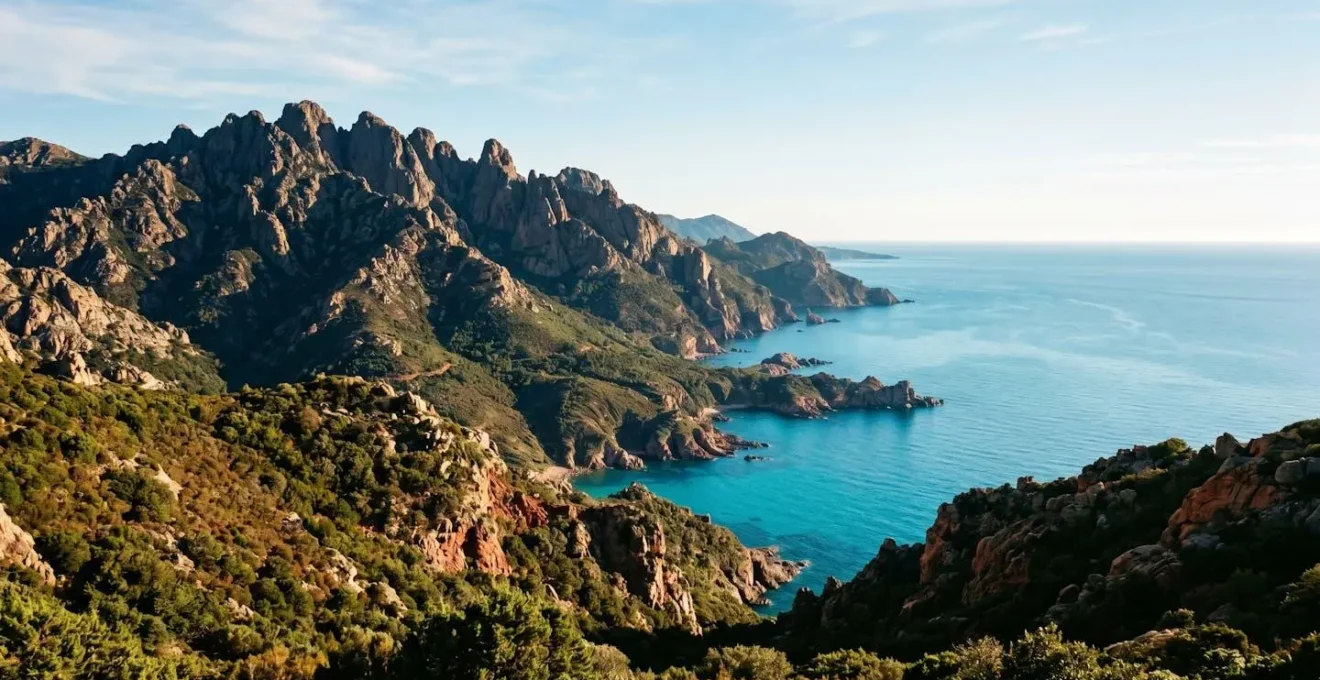
The secret to a profound Corsican journey isn’t choosing between north and south, but in understanding how the island’s geology and culture dictate your entire itinerary.
- Plan your bases strategically around mountain-coast combinations, not just beaches.
- Master the driving by understanding road types and etiquette, or bypass it entirely with the scenic train.
- Time your visit for May, June, or September to sync with the island’s natural rhythms and avoid crowds.
Recommendation: Stop planning a beach holiday with mountain day-trips; start planning an integrated island expedition.
For many, Corsica conjures a singular image: a string of idyllic beaches and glamorous resorts lapped by turquoise water. It’s a vision heavily promoted and easily consumed. Travelers arrive, plant their towel on Palombaggia beach, and believe they have « done » Corsica. They may have heard whispers of a rugged interior or a fiercely independent local culture, often dismissed as background colour or an obstacle to a relaxing holiday. The common advice is to pick a coast, rent a car, and brace for difficult roads, treating the island like any other Mediterranean sun-spot.
But what if this approach misses the point entirely? What if the key to unlocking the island’s soul isn’t found in choosing between the north and south coasts, but in understanding the deep, unbreakable connection between its people, its mountains, and its very rock? The true Corsica, the one that lingers in memory long after the suntan fades, is not a list of disconnected sights. It’s a living ecosystem where 500 million years of geology have carved a landscape that, in turn, has forged one of Europe’s most distinct cultural identities.
This guide abandons the simplistic coastal view. Instead, it offers a new framework for exploring the « Island of Beauty. » We will delve into its nation-like identity, teach you how to design a strategic itinerary that marries mountains and coast, decode its geological DNA, and reveal how to access its wild heart without needing extreme survival skills. Prepare to see Corsica not as a destination, but as a world unto itself.
To navigate this complex and rewarding island, we’ve structured this guide to help you think like a strategist, a geologist, and a cultural explorer. Follow along to craft a journey that goes far beyond the coastline.
Summary: A Deeper Journey into Corsica’s Heart
- Why Does Corsica Feel More Like an Independent Nation Than a French Island?
- Beach Week or Mountain-Coast Combination: How to Structure Your Corsica Holiday?
- North or South Corsica: Which Coast Matches Your Beach and Scenery Preferences?
- The Driving Assumption That Puts Nervous Drivers on Corsica’s Hairpin Mountain Roads
- When Should You Visit Corsica for Warm Weather Without Peak French Tourist Crowds?
- How to Recognize 5 Million Years of Geology in Seascapes’ Rock Formations?
- Guided Expedition or Self-Drive Adventure: Which Suits Remote Locations Best?
- How to Reach Remote Locations Without a 4×4 or Wilderness Survival Skills?
Why Does Corsica Feel More Like an Independent Nation Than a French Island?
The first sense that Corsica is different isn’t visual; it’s cultural. Road signs are in two languages, French and Corsu. The flag, a stark Moor’s head (U Moru), is flown with more passion than the French Tricolour. This isn’t a mere regional quirk; it’s the surface layer of a deep-seated identity forged by centuries of struggle and geographic isolation. Unlike mainland French regions, Corsica was an independent republic before being annexed by France in 1769. This memory of independence is not just history; it’s a living part of the island’s psyche, fueling a persistent nationalist movement. Polling data confirms this sentiment, showing that over 51% of Corsicans favour increased devolution within France.
This unique identity was powerfully reasserted during a period known as the *Riacquistu*, or « reacquisition. » It was more than just a linguistic revival; it was a profound cultural awakening. As the World Autonomies Research Team notes in their analysis, this movement was a key part of the island’s modern political story.
The Corsican struggle for self-government gained momentum in the 1960s, coinciding with the cultural and linguistic revival known as the Reacquisition (Riacquistu)—a period of cultural ferment marked by the evolution, reconceptualization, revitalization, and valorization of the Corsican cultural heritage.
– World Autonomies Research Team, Corsica’s struggle for autonomy
This fierce sense of self, from the polyphonic chants that echo in village churches to the concept of family honour, shapes every interaction. To travel here is to be a guest in a land that sees itself as a nation apart. Understanding this cultural topography is the first step to moving beyond a superficial tourist experience and appreciating the island on its own terms.
Beach Week or Mountain-Coast Combination: How to Structure Your Corsica Holiday?
The most common mistake visitors make is structuring their trip around a single coastal base, treating the mountains as an optional, and often distant, day trip. This « beach-first » logic fundamentally misunderstands Corsica’s geography. The island’s true character lies in the constant, dramatic interplay between its towering peaks and the sea. The most rewarding journeys are not linear coastal drives, but thoughtfully planned combinations that embrace this duality. This requires strategic itinerary design, where you choose your bases not just for their proximity to a beach, but for their access to a whole micro-region.
Instead of a one-week stay in one place, consider a multi-base approach. For a week, you might split your time between a northern hub like Saint-Florent, offering access to Cap Corse and the Agriates desert, and a southern one like Porto-Vecchio for its famous beaches and proximity to the Alta Rocca mountains. With more time, you can adopt a « hub-and-spoke » model. Basing yourself in the central mountain town of Corte, the historic heart of Corsican independence, allows for incredible day trips into different valleys and forests with minimal packing and unpacking.
As this conceptual layout suggests, planning a Corsican trip is about connecting different natural elements. A critical rule for this planning is to budget your driving time realistically. Forget GPS estimates; the golden rule is one minute of driving time per one kilometre on winding roads. An average speed of 30-40 km/h is common. Planning more than three hours of driving in a single day is a recipe for exhaustion, not enjoyment. The island’s rhythm is slow, and your itinerary must respect it.
North or South Corsica: Which Coast Matches Your Beach and Scenery Preferences?
The « North vs. South » debate is the most common, and most limiting, way to frame a Corsican holiday. The south is typically painted as glamorous and crowded, with white-sand beaches and a see-and-be-seen atmosphere around Bonifacio and Porto-Vecchio. The north is branded as wilder and more authentic, with the dramatic cliffs of Cap Corse and the charming Italianate villages of the Balagne. While there is a kernel of truth in this, it ignores the immense diversity within each half of the island. The « south » also contains the rugged granite peaks and deep forests of the Alta Rocca, while the « north » is home to both the remote white sands of the Agriates desert and the gentle, family-friendly beaches of the east coast.
A better approach is to think in terms of micro-regions, each with its own distinct character, beach type, and landscape. This allows you to match your travel style to a specific place, rather than an entire half of the island. Are you a solitude-seeking adventurer, a family with small children, or a food and wine enthusiast? Corsica has a perfect coast for you, but you need to look beyond the simple north/south divide. The following table breaks down the island’s coastal character to help you make a more informed choice.
| Region | Beach Type | Landscape Character | Best For | Accessibility |
|---|---|---|---|---|
| North – Balagne | Sandy coves, serviced beaches | Italianate charm, gentle hills, citrus groves | Food & wine enthusiasts, families | Easy access, good infrastructure |
| North – Cap Corse | Hidden pebble coves | Dramatic cliffs, mountain-meets-sea, traditional fishing villages | Scenic drives, solitude-seekers | Challenging mountain roads |
| North – Agriates | Wild, remote white sand (Saleccia, Lotu) | Desert-like coastal wilderness | Adventure travelers, hikers | Boat or 4×4 only |
| South – Extrême-Sud (Bonifacio area) | Glamorous, serviced, turquoise waters | White limestone cliffs, Mediterranean glamour | See-and-be-seen travelers, luxury seekers | Very easy, developed |
| South – Alta Rocca | Mountain swimming holes | Chestnut forests, granite needles (Bavella) | Hikers, nature immersion | Mountain driving required |
| West Coast | Hard-to-reach wild ‘criques’, red rock coves | UNESCO Calanques, Scandola Reserve, vertical cliffs | Photographers, boat enthusiasts | Boat access or challenging roads |
| East Coast | Long, flat, sandy family beaches | Coastal plains, lagoons, gentle | Families with children, relaxation | Easiest, flat roads |
By using this more granular view, you can design a trip that truly fits your preferences. You might discover that the perfect holiday for you involves combining the dramatic red-rock coves of the west coast with the gentler, food-focused landscape of the Balagne—a combination that a simple north/south choice would never reveal.
The Driving Assumption That Puts Nervous Drivers on Corsica’s Hairpin Mountain Roads
The one thing everyone « knows » about Corsica is that the driving is terrifying. This single assumption prevents countless travelers from ever leaving the coast. While it’s true that many mountain roads are narrow, winding, and feature precipitous drops, the belief that all inland driving is a white-knuckle ordeal is a myth. The reality is that Corsica has a wide spectrum of road types, and with a little strategy, even nervous drivers can safely explore large parts of the interior. The key is to understand which roads to avoid, which driving techniques to adopt, and when to choose a brilliant alternative: the train.
For a stress-free experience, it’s crucial to follow a few rules. Master the « pull-over etiquette »: on narrow roads, it’s expected that slower drivers will use designated pull-offs to let local traffic pass. This simple act of courtesy removes all pressure. Direction also matters; driving the west coast of Cap Corse clockwise, for instance, keeps your car on the inside, mountain-hugging lane, away from the unfenced drops. And as local driving guides emphasize, renting a smaller car and purchasing full insurance coverage, known as *rachat de franchise*, provides essential peace of mind. According to advice from seasoned drivers on the island, this etiquette is a non-negotiable part of the social contract on Corsica’s roads. But the ultimate strategy for the truly car-averse is to not drive at all.
Case Study: The Trinichellu Train as a Car-Free Exploration Strategy
The vintage Corsican railway, affectionately nicknamed ‘u Trinighellu’ (the trembler), offers a complete car-free strategy. It connects the main cities of Ajaccio and Bastia via the mountain capital of Corte, with a scenic branch to Calvi. The train snakes through mountains, crosses Gustave Eiffel-designed viaducts, and serves remote villages with ‘optional’ stops where passengers can request to board or alight. A seven-day Pass Libertà offers unlimited travel for around €50, providing exceptional value. The views through the central mountains are world-class, offering a perspective on the gorges and valleys below that is impossible to get from the road, all without the stress of navigating a single hairpin bend.
By replacing the assumption of « all driving is hard » with a strategic approach—choosing easier roads, adopting local etiquette, or opting for the train—the mountainous heart of Corsica becomes accessible to everyone, not just daredevil drivers.
When Should You Visit Corsica for Warm Weather Without Peak French Tourist Crowds?
Timing your visit to Corsica is perhaps the single most important decision you’ll make. The island’s character transforms dramatically with the seasons, and aligning your trip with its natural rhythms is the difference between a frustrating, crowded experience and a sublime one. The common mistake is to target the peak summer months of July and August, drawn by the promise of guaranteed hot weather. However, this is when the island is at its most crowded, most expensive, and least authentic. Official data reveals the stark reality: a staggering 70% of all visitors arrive between July and September, putting immense strain on infrastructure.
The secret known to seasoned visitors is to aim for the « shoulder seasons »: late May, June, and September. In these months, you get the best of all worlds. The weather is comfortably warm, the sea has had time to heat up (especially in September, when it’s at its warmest), and the crowds are a fraction of their summer peak. June is a magical time when the landscape is still green and the famous *maquis* shrubland is an explosion of fragrant wildflowers. September offers golden light, the buzz of the grape harvest, and blissfully empty beaches after the mid-month departure of French school holiday crowds.
To truly sync with the island’s rhythm, consider what you want to experience. Are you here for serious hiking? May and June offer comfortable temperatures. Is swimming your priority? September and early October are ideal. Do you want to immerse yourself in local culture? Visit in October for the chestnut and new wine (*vinu novu*) festivals. The table below offers a sensory and activity guide to help you choose the perfect time for your journey.
| Month | Temperature Range | Sensory Experience | Best Activities | Crowd Level |
|---|---|---|---|---|
| May | 15-25°C | Wildflowers (maquis in full bloom), snow-capped peaks visible, fresh green landscapes | Hiking (comfortable temps), spring festivals, beach from late May | Low-Moderate |
| June | 20-28°C | Peak wildflower season ending, warm sea begins, GR20 refuges open | Serious hiking, beach begins, outdoor exploration | Moderate |
| July | 25-32°C | Peak heat, busy atmosphere, vibrant nightlife | Beach, water sports, evening cultural events | Very High (avoid if possible) |
| August | 26-33°C | Hottest month, school vacation crowds, higher prices everywhere | Beach, river swimming (best water temp), boat trips | Extreme (avoid) |
| September | 22-28°C | Warm sea (best swimming), grape harvest, golden light, fewer crowds after mid-month | Best all-round month: hiking returns, beaches still warm, wine harvest festivals | High early, drops mid-month |
| October | 17-24°C | Chestnut harvest, autumn forest colors, new wine (‘vinu novu’) festivals | Chestnut festivals, coastal hiking, village cultural events | Low-Moderate |
| November-March | 10-16°C | Solitude, authentic village life, cozy atmosphere, stormy seas | Coastal hikes, cultural immersion in Ajaccio/Bastia, no crowds | Very Low |
How to Recognize 5 Million Years of Geology in Seascapes’ Rock Formations?
To travel through Corsica is to witness a story written in stone. The island’s dramatic landscapes are the direct result of a violent geological past, and understanding its three main rock types is like learning the language of the scenery. This isn’t just an academic exercise; the island’s geological DNA dictates everything from the shape of the mountains and the colour of the beaches to the taste of the wine and the scent of the air. Recognizing these formations transforms a simple drive into a journey through deep time.
There are three main characters in Corsica’s geological story: granite, schist, and limestone. Each dominates a different part of the island and creates a completely distinct experience. The west and south are the domain of pink and red granite. This hard, ancient rock, born from plutonic intrusions, erodes into the jagged peaks, spires, and otherworldly hollowed-out boulders (*tafoni*) that define the UNESCO-listed Calanques de Piana and the Scandola Nature Reserve. This is a landscape for dramatic photography, climbing, and exploration.
The northeast, particularly the Cap Corse peninsula, is built from dark, metamorphic schist. This older, softer rock weathers into gentler, greener slopes. It’s a more fertile land that supports terraced vineyards and traditional agriculture, creating a landscape of human-shaped nature. Finally, the extreme south, around Bonifacio, is defined by a sliver of brilliant white limestone. These sedimentary rocks, formed from ancient sea beds, create the iconic sheer cliffs that plunge 100 metres into the sea, riddled with caves and arches carved by marine erosion. Even the smell of the air changes with the geology: the acidic granite and schist soils are home to the fragrant *maquis* shrubland, while the alkaline limestone supports a different, unique flora.
Field Guide: Linking Geology to Your Experience
- Pink/Red Granite (West Coast): Look for jagged peaks and bizarre eroded hollows (*tafoni*). The experience here is about dramatic sunsets that « ignite » the rock, photography, and challenging hikes. Find it in the Calanques de Piana and Scandola.
- Dark Schist (Northeast): Identify the gentler, greener, terraced slopes. This geology supports lush vegetation and traditional villages. The experience is about scenic drives and immersing yourself in a cultivated landscape. See it all over Cap Corse.
- White Limestone (Far South): Spot the sheer, brilliant white cliffs and sea caves. The activities here are boat tours to explore sea caves and clifftop walks for breathtaking views. This is the signature of Bonifacio.
- Geology-to-Activity Link: Think granite for climbing and bold landscapes, schist for gentler hikes and village life, and limestone for coastal and marine exploration.
- Smell the Difference: Pay attention to the fragrance of the *maquis* (myrtle, lavender, rockrose) on granite/schist soils. Notice the different plant life and scents in the limestone areas of the south.
Guided Expedition or Self-Drive Adventure: Which Suits Remote Locations Best?
The allure of Corsica’s remote valleys and hidden shepherd’s huts is strong, but accessing them requires a clear-eyed assessment of your skills and comfort level. The decision between a self-drive adventure and hiring a guide isn’t just about cost; it’s about safety, enjoyment, and the depth of your experience. A self-drive trip offers ultimate freedom but places all responsibility on you—from navigating signal-free zones to changing a tire on a dirt road. A guided expedition provides expertise and security, but trades some spontaneity for a structured itinerary.
Before committing to a solo venture into a remote area like the Restonica Valley or an unpaved coastal track, you must honestly evaluate your self-reliance. Can you handle basic car trouble? Is your French proficient enough to ask for help in a remote village? Are you comfortable reversing on a narrow incline with no guardrail? If the answer to any of these is a hesitant « no, » hiring a guide isn’t a defeat—it’s a smart strategic choice that will likely lead to a much more enjoyable and safer adventure. Corsica offers a wide range of professional guides, each with a specific specialization that can unlock a different facet of the island.
Your Self-Reliance Checklist for Remote Corsica
- Mechanical Competency: Can you confidently change a tire on an uneven dirt road and check basic fluid levels? This is a non-negotiable skill for remote valley exploration.
- Navigation Reliability: Have you downloaded offline maps (e.g., Google Maps offline areas) for the entire region? Are you prepared to navigate for hours without any mobile signal?
- Language Proficiency: On a scale of 0-5, how would you rate your French? A score of 3 or higher dramatically increases your ability to handle unexpected situations, from asking for directions to explaining a problem.
- Driving Experience: Do you have prior experience with narrow, winding mountain roads and manual transmissions? Practice on easier mountain roads before tackling notorious routes.
- Risk Tolerance: Do you thrive on uncertainty and problem-solving, or does the possibility of changing weather, road closures, or wildlife encounters cause significant stress? Be honest about what makes a holiday feel like an adventure versus an ordeal.
If your self-assessment points towards needing support, you can choose from various specialists. A *Guide de Haute Montagne* is essential for technical routes like the GR20, while an *Accompagnateur en Montagne* is perfect for interpretive day hikes. A 4×4 operator can get you to the otherwise inaccessible Saleccia beach, and a cultural guide can bring the megalithic site of Filitosa to life.
| Guide Type | French Term | Specialization | Best For | Typical Cost |
|---|---|---|---|---|
| High Mountain Guide | Guide de Haute Montagne | GR20 trekking, technical climbing, glacier travel, rope work | Multi-day GR20 sections, alpine ascents, technical terrain | €€€€ (€300-500/day group) |
| Mountain Leader | Accompagnateur en Montagne | General hiking, non-technical trails, flora/fauna interpretation | Day hikes, forest trails, moderate mountain walks, nature education | €€€ (€150-250/day group) |
| 4×4 Tour Operator | Opérateur 4×4 | Desert des Agriates access, remote beach transfers, off-road adventure | Saleccia/Lotu beaches, wilderness areas inaccessible by regular car | €€ (€60-90/person day trip) |
| Canyoning Guide | Guide de Canyon | Gorge descents, waterfall rappelling, water-based adventure | Purcaraccia, Richiusa, Asco canyons for adrenaline seekers | €€ (€50-80/person half-day) |
| Cultural/Heritage Guide | Guide Culturel | Local history, traditions, prehistory (Filitosa), architecture | Megalithic sites, village immersion, understanding Corsican identity | €€ (€100-180/day private) |
Key Takeaways
- Think in Ecosystems, Not Lists: Your itinerary should connect mountains, coast, and culture, not just tick off beaches and towns.
- Embrace the Island’s Rhythm: Adapt to a slower pace. Plan less driving, choose shoulder seasons, and let the island’s natural cycles guide your trip.
- Match the Landscape to Your Style: Use the island’s geological DNA—granite, schist, limestone—to choose regions that fit your desired experience, from dramatic adventure to gentle immersion.
How to Reach Remote Locations Without a 4×4 or Wilderness Survival Skills?
The myth of the inaccessible Corsican interior often discourages travelers. The fame of the grueling GR20 trail and tales of treacherous 4×4 tracks create an impression that the island’s wild heart is off-limits to all but the most hardcore adventurers. This is simply not true. A vast and stunningly beautiful wilderness is accessible to anyone with a regular rental car and a decent pair of walking shoes. The key is to employ a « remote-lite » strategy: targeting locations that feel wild and secluded but are reached via paved roads or short, well-marked trails.
This is possible because tourism in Corsica is incredibly concentrated. Analysis from the Corsica Tourism Agency shows that two micro-regions alone account for nearly 60% of tourist flows. This means that vast swathes of the island remain genuinely quiet, even in high season. You can leverage this by visiting places like the Fango Valley, where a short 20-minute walk from the car park along a crystal-clear river transports you to a world of secluded swimming holes. Similarly, the Bonifatu Forest offers immediate immersion in ancient Laricio pines right from the trailhead, which is accessible by any car.
Another powerful strategy is using « end-of-the-road » access. Many of Corsica’s most spectacular mountain landscapes begin where the paved road ends. You can drive to the Bavella Pass at 1,218 meters and start hiking instantly among the famous granite needles, or drive to the Asco-Stagnu ski station for immediate access to the high alpine environment. For coastal wilderness, marine access is a game-changer. Small boat shuttles (*navettes maritimes*) from Saint-Florent can drop you on the pristine, vehicle-free beaches of Saleccia and Lotu, while boat tours from Porto are the only way to experience the majesty of the Scandola Nature Reserve. These strategies provide the thrill of remoteness without the associated risks or need for specialized skills, opening up the true Corsica to all who seek it.
Start planning your Corsican journey not by the beaches you’ll visit, but by the island’s very fabric you’ll discover. By embracing its culture, decoding its landscape, and syncing with its unique rhythm, you will unlock an experience that a simple coastal holiday could never provide.