The traditional point-to-point New Zealand road trip is a logistical trap; the key to a successful 3-week itinerary is to reject this model entirely.
- Endless daily driving (often 5-6 hours) creates travel fatigue, leading to poor decisions and inflated costs.
- New Zealand’s geography (two long islands) makes linear « ring road » style trips inefficient and expensive due to one-way fees and backtracking.
Recommendation: Adopt the « Base Camp Method »—choosing 2-3 hub locations for multi-night stays and exploring radially—to dramatically reduce driving stress and actually enjoy the country.
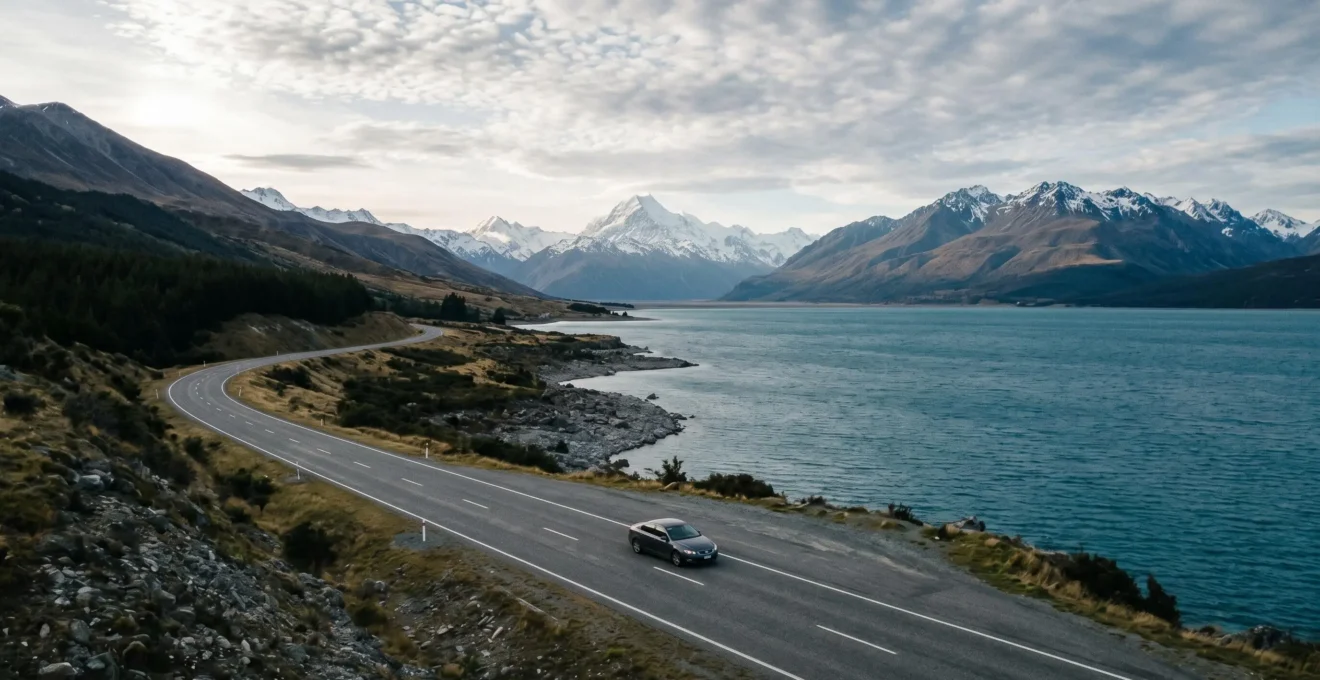
The vision is intoxicating: three weeks to conquer New Zealand. You picture winding roads through epic mountain passes, coastal drives with the Tasman Sea on your left, and the freedom of the open road. It’s a trip built on the promise of discovery, fueled by countless Instagram posts of campervans parked against breathtaking backdrops. Most travel guides reinforce this, presenting linear, A-to-B-to-C itineraries that seem to logically connect all the dots from Cape Reinga to Bluff.
But here lies the fundamental misconception, the logistical trap that ensnares countless first-time visitors. New Zealand is not a country built for relentless forward motion. Its deceptive geography—two long, mountainous islands separated by a costly ferry crossing—punishes the « see it all » mindset. The seemingly short distances on a map quickly expand into exhausting full-day journeys due to winding, single-lane highways, relentless photo stops, and the ubiquitous slow-moving campervan ahead of you. This constant-motion approach doesn’t lead to freedom; it leads to travel fatigue, decision exhaustion, and a trip that feels more like a delivery route than a vacation.
What if the secret to truly experiencing New Zealand wasn’t to cover more ground, but to cover it more intelligently? This guide dismantles the myth of the coast-to-coast road trip. We will demonstrate how a strategic shift in mindset—from a linear marathon to a hub-and-spoke exploration—can save you time, money, and your sanity. By adopting what we call the « Base Camp Method, » you can see New Zealand’s must-visit regions without the soul-crushing 6-hour daily drives.
To help you redesign your journey from the ground up, this article breaks down the critical planning mistakes and provides a clear framework for a more efficient, enjoyable, and ultimately more immersive New Zealand adventure. Explore the key considerations below to build a trip that feels freeing, not frantic.
Summary: A Guide to Smarter New Zealand Itinerary Planning
- Why Is New Zealand One of the World’s Most Expensive Travel Destinations?
- North or South Island New Zealand: Which Should You Prioritize in 2 Weeks?
- Do You Need a 4WD to Explore New Zealand’s Remote Regions Safely?
- The Off-Season Mistake That Leaves 30% of New Zealand Inaccessible
- When Can You Visit New Zealand With 50% Fewer Tourists at Major Sites?
- Why Do Road Trips Fail When You Drive More Than 4 Hours Per Day?
- Self-Drive Ring Road or Guided Small-Group Tour: Which Works Best in Iceland?
- How to Design Road Trips That Feel Freeing Instead of Exhausting?
Why Is New Zealand One of the World’s Most Expensive Travel Destinations?
Beyond the obvious costs of long-haul flights, New Zealand’s reputation as a pricey destination is cemented by on-the-ground expenses. Accommodation, activities, and food prices are comparable to those in Western Europe or North America. However, the most significant and often underestimated costs are logistical, directly tied to inefficient travel planning. A classic linear road trip, for instance, forces you into a one-way vehicle rental. This single decision can trigger hefty relocation fees; according to New Zealand rental market data, these can range from a modest sum to over $1,000 NZD depending on the route and season.
Moreover, the structure of an aggressive road trip creates a « fatigue tax. » When you’re exhausted after a 6-hour drive, you’re more likely to make expensive convenience-based decisions: opting for the pricey motorway service station cafe over a self-catered meal, booking a last-minute, overpriced motel because you’re too tired to drive further, or skipping a free scenic hike for a paid, passive attraction. These small, daily surcharges accumulate rapidly, significantly inflating the overall budget.
A detailed trip analysis from one couple’s three-week journey perfectly illustrates this phenomenon. Their documented spending showed a clear pattern: higher incidental costs on long driving days, a direct reflection of the psychological cost of fatigue. Inefficient planning doesn’t just waste time; it actively drains your wallet, turning a dream trip into a string of expensive compromises.
Understanding these logistical cost drivers is the first step toward designing a smarter, more affordable itinerary that prioritizes experience over a grueling race against the clock.
North or South Island New Zealand: Which Should You Prioritize in 2 Weeks?
For any trip under three weeks, the most critical—and financially impactful—decision you’ll make is whether to tackle both islands or focus on just one. The common impulse is to see it all, but this is a classic rookie mistake. Trying to « do » both the North and South Islands in two weeks transforms a vacation into a high-speed transit operation. You’ll spend more time in cars, airports, and on the Interislander ferry than you will actually experiencing the places you came to see. The logistics are punishing and the rewards are thin.
The expert consensus is clear. As the team at Earth Trekkers Travel Blog advises, « It’s better to put all of your time in the South Island rather than quickly skipping through both the North and South Islands in just two weeks. » This isn’t about one island being « better, » but about the reality of travel time. The South Island is generally considered to have the more dramatic and diverse landscapes—from the fjords of Fiordland to the glaciers of the West Coast and the alps of Aoraki/Mount Cook. Devoting your entire two weeks here allows for a deeper, more relaxed exploration of its vast offerings.
Attempting a two-island sprint also comes with significant financial penalties. One-way car rentals that cross the Cook Strait are notorious for high surcharges, as rental comparison platforms report substantial drop-off fees often in the NZ$200-500 range. By choosing one island and planning a circular or return trip, you eliminate these fees entirely and gain back precious days otherwise lost to transit.
For a three-week trip, a two-island itinerary becomes more feasible, but only if planned with extreme logistical precision, often involving a strategic internal flight to « jump » the gap rather than driving the entire length of the country.
Do You Need a 4WD to Explore New Zealand’s Remote Regions Safely?
A persistent myth among aspiring adventurers is that a 4WD vehicle is essential to unlock the « real » New Zealand. The fantasy involves turning off a main highway and bumping along a gravel road to a secret, crowd-free vista. The reality is that 99% of New Zealand’s must-see attractions and trailheads are accessible via sealed, well-maintained roads. A standard 2WD sedan or campervan is perfectly adequate for the vast majority of travelers. In fact, most rental car agreements, even for 4WDs, strictly prohibit off-road driving, neutralizing the main perceived advantage.
The few iconic roads that do require high-clearance or 4WD vehicles, such as Skippers Canyon near Queenstown, are typically off-limits for all rental vehicles anyway due to insurance restrictions. For these specific locations, the smart and safe approach isn’t to rent a specialized vehicle for your entire trip, but to utilize local expertise. Booking a dedicated tour with a licensed operator is not only safer but provides invaluable local context and history you’d miss on your own.
Thinking you need a 4WD is a symptom of inefficient planning. Instead of over-investing in a vehicle you don’t need, a far more effective strategy is to combine a standard 2WD rental with targeted, localized transport solutions. This « multi-modal » approach is the secret to accessing remote beauty without the cost and restrictions of a specialized vehicle. It’s about using the right tool for the right job, rather than using a sledgehammer for the whole trip.
Your Itinerary Sanity Check: A 5-Point Audit
- Driving Legs: List every planned drive between overnight stays. Is any single leg longer than 4 hours on Google Maps? If so, flag it for revision.
- Accommodation Hopping: Count the number of different places you’ll sleep. If it’s more than 5 in a 3-week trip, you’re likely in a logistical trap. Inventory your booked (or planned) accommodations.
- Buffer Time: Review your longest driving days. Have you added a 25-50% time buffer to Google’s estimate to account for winding roads, photo stops, and campervan traffic?
- Zero-Mile Days: Scan your calendar. Is there at least one full day with no inter-city travel scheduled for every 3-4 days of your trip? Identify where to insert these vital rest days.
- Efficiency Plan: Identify the top 3 « remote » experiences on your list (e.g., Milford Sound, Abel Tasman trail). Research and price out local shuttles, water taxis, or tours as alternatives to driving yourself.
This strategic mindset—pairing a cost-effective base vehicle with specific transport solutions—is a core tenet of efficient New Zealand travel.
The Off-Season Mistake That Leaves 30% of New Zealand Inaccessible
Travel forums are full of well-meaning advice to visit New Zealand in the « off-season » to avoid crowds and save money. While the principle is sound, this advice lacks crucial nuance and can lead travelers into a trap. There’s a significant difference between the pleasant, quieter « shoulder seasons » (spring and autumn) and the deep off-season of winter (June to August). While winter offers stunning alpine scenery and world-class skiing, it renders large parts of the country effectively inaccessible for the typical road-tripper.
In winter, many hiking trails at higher elevations, including some of the Great Walks, are closed or require mountaineering experience. Mountain passes like the road to Milford Sound can be subject to temporary closures due to snow and avalanche risk. Furthermore, many tourist-focused towns, especially in the South Island, go into a state of semi-hibernation. Cafes, tour operators, and even some accommodations reduce their hours or close entirely, creating what can feel like a « service desert. »
The drop in visitor numbers is stark. While summer months see huge international arrivals, official tourism statistics show that these numbers plummet in the heart of winter, with May and June being among the quietest months. This isn’t just because of the weather; it’s a reflection of the reduced accessibility and activity options. Choosing to visit in mid-winter without a specific focus on snow sports is the mistake that leaves many travelers facing closed doors and canceled plans.
The true sweet spot for fewer crowds and full accessibility isn’t the dead of winter, but the magical windows of the shoulder seasons, which offer the best of both worlds.
When Can You Visit New Zealand With 50% Fewer Tourists at Major Sites?
The dream of seeing Milford Sound without a flotilla of tour boats or hiking the Tongariro Alpine Crossing without a conga line of people is achievable. It simply requires strategic timing. The common advice is to visit during the « shoulder seasons » of spring (September-November) and autumn (March-May). This is correct, but we can be even more precise to find the absolute sweet spots where tourist numbers are dramatically lower, yet the weather is still generally stable and all attractions are open.
The peak season in New Zealand is undeniably summer, particularly from Christmas through the end of February. Research from the Ministry of Business, Innovation and Employment reveals that summer arrivals can be double the number of those in the winter season, with the shoulder seasons falling in between. This means that by simply avoiding the core summer months, you are already significantly reducing the crowds you’ll encounter.
To truly optimize your trip, you need to target the « magic windows » that fall just outside of peak times and local holidays. These are the periods where you can experience the country with what feels like 50% fewer people at major sites. For example, March is an excellent choice, as the summer crowds have dissipated, but the weather remains warm and settled. The first three weeks of November are another prime window, offering pleasant spring weather after Labour Day weekend but before the school holiday rush begins in December. By planning your trip within these specific, strategic periods, you get the million-dollar views without the million-person crowds.
Checklist for Finding Your « Magic Window »
- Target late autumn: Aim for the first three weeks of May. This is after the ANZAC Day holiday (April 25) but typically before the first significant winter snowfalls close high-country passes.
- Target late spring: Book your travel for the first three weeks of November. This period is after the Labour Day holiday but well before the Christmas and school holiday rush begins.
- Dodge the tour buses: For any major attraction (e.g., Hobbiton, Waitomo Caves), plan your visit for before 10 AM or after 3 PM to avoid the peak arrival times of large tour groups.
- Leverage public holidays: Plan your trip to begin the day *after* a major New Zealand holiday weekend concludes (like Easter Monday or Queen’s Birthday). You’ll benefit from the holiday atmosphere with thinning crowds.
- Embrace early autumn: Consider the entire month of March. It offers some of the most stable weather of the year, coupled with the rapidly diminishing crowds of the departing summer peak season.
Combining a visit during one of these magic windows with the Base Camp Method is the ultimate strategy for a relaxed and immersive New Zealand experience.
Why Do Road Trips Fail When You Drive More Than 4 Hours Per Day?
On paper, a four-hour drive seems perfectly reasonable. In New Zealand, however, a four-hour drive is a trap. This is the single biggest miscalculation that leads to road trip failure, turning a journey of discovery into a stressful marathon against the clock. The core issue is that map-based time estimates fail to account for the unique character of New Zealand’s roads and driving culture. This discrepancy creates a constant, nagging feeling of being behind schedule.
As road trip planning experts at Going Awesome Places note, the reality of driving here is far different from a multi-lane highway commute. They explain that « due to winding, single-lane roads, frequent photo stops, and slower traffic (campervans, trucks), a 4-hour estimate realistically becomes a 5.5- to 6-hour journey. » When this happens day after day, the cumulative effect is profound travel fatigue. This isn’t just about feeling sleepy; it’s a state of mental exhaustion where your decision-making ability plummets. You start skipping the scenic detours you planned, you eat unhealthy, expensive food for convenience, and your patience with your travel partners wears thin.
The four-hour mark is a critical threshold. Beyond this point, you spend more time focused on the destination than the journey. The joy of spontaneity is replaced by the anxiety of arrival. You stop pulling over for that incredible, unplanned viewpoint because you’re worried about checking into your accommodation before dark. The road trip, which was meant to be the definition of freedom, becomes a prison of its own making. Limiting planned daily driving to a maximum of four hours (which will realistically become five) is not a conservative suggestion; it is the fundamental rule for a sustainable and enjoyable New Zealand road trip.
This principle is the bedrock upon which a successful, stress-free itinerary is built, allowing for the flexibility and spontaneity that make road-tripping worthwhile.
Self-Drive Ring Road or Guided Small-Group Tour: Which Works Best in Iceland?
To understand why the classic linear road trip so often fails in New Zealand, it’s incredibly useful to look at a place where it succeeds: Iceland. Many travelers have experienced or read about the triumph of Iceland’s Ring Road, a 1,332km loop that perfectly circumnavigates the island, connecting most of its major attractions in a logical, circular path. This model is so effective that it has become the default mental model for « epic road trip » for an entire generation of travelers. The problem is, they then try to apply this same model to New Zealand, with disastrous results.
New Zealand’s geography is the antithesis of Iceland’s. It’s not a single, contained loop. It consists of two long, linear, and mountainous islands, bisected by the formidable Cook Strait. A « drive the whole loop » mindset simply doesn’t work. Trying to replicate an Icelandic-style road trip forces you into a punishingly long, 2,000km+ one-way journey with significant backtracking, a costly ferry crossing, and expensive one-way rental fees.
Case Study: The Geographic Fallacy of the ‘Ring Road’ Model in NZ
A travel planning analysis directly contrasts Iceland’s singular, circular 1,332km Ring Road with New Zealand’s dual-island structure. This geographic difference is precisely why the ‘drive the whole loop’ mentality that is so successful in Iceland becomes the primary cause of exhausting, budget-breaking itineraries in New Zealand. The analysis shows the most efficient travelers mimic the logistics of a guided tour without sacrificing autonomy. The solution is a multi-modal approach: combining targeted, shorter driving segments with strategic internal flights (e.g., Wellington to Queenstown) and scenic train journeys (like the TranzAlpine). This hybrid model breaks the « must drive everywhere » fallacy, saving days of travel time and hundreds of dollars in one-way fees and fuel.
This fundamental geographic difference is the key. Recognizing that New Zealand requires a different strategic approach is the « a-ha » moment in smart itinerary planning. You must shed the Icelandic Ring Road model and embrace a more flexible, hub-and-spoke system that is designed for New Zealand’s unique layout.
By understanding why the model fails, you can consciously choose a superior one, saving yourself from the most common and costly New Zealand travel mistake.
Key Takeaways
- The traditional A-to-B New Zealand road trip is a « logistical trap » that causes fatigue and inflates costs.
- For trips under 3 weeks, focusing on one island (typically the South) is far more efficient and enjoyable.
- The « Base Camp Method » — staying in 2-3 hub locations for multiple nights — is the superior strategy for a relaxed, immersive experience.
How to Design Road Trips That Feel Freeing Instead of Exhausting?
The solution to New Zealand’s logistical trap is to fundamentally change the way you structure your trip. Instead of a relentless linear push, you need to adopt a more intelligent and sustainable model. This is the Base Camp Method. The principle is simple: instead of packing and unpacking every single day, you choose 2-3 strategically located towns as your « base camps » for 4-5 nights each. From these hubs, you embark on shorter, radial day trips, always returning to the comfort of the same bed each night.
This approach immediately eliminates the two biggest stressors of a traditional road trip: the daily grind of packing/unpacking and the pressure of a long transit drive. It replaces decision fatigue with a sense of stability and freedom. You can wake up and decide whether to take a 2-hour drive to a remote trailhead, explore the local town, or simply have a « Zero-Mile Day » to rest and recharge. A town like Queenstown, for example, can serve as a perfect base camp for exploring Glenorchy, Arrowtown, and even day trips towards Fiordland, all without changing your accommodation.
This method is not only less stressful but also more cost-effective. It allows you to book accommodations with weekly discounts, self-cater more effectively, and completely avoid one-way rental car fees. The following table breaks down the stark contrast between the two approaches.
The table below clearly illustrates the overwhelming advantages of adopting the Base Camp Method over a traditional linear itinerary, showing dramatic improvements in stress levels, costs, and flexibility.
| Aspect | Traditional Linear Itinerary | Base Camp Method |
|---|---|---|
| Daily Packing/Unpacking | Every single day for 21 days | Only 2-3 times during entire trip |
| Average Daily Driving | 5-6 hours (including photo stops) | 2-4 hours on driving days, 0 hours on rest days |
| Accommodation Booking Stress | High – 21 different locations | Low – Only 2-3 advance bookings needed |
| Spontaneity Opportunities | Minimal – locked into route | High – flexible day trips from hubs |
| Decision Fatigue Level | Extreme – constant planning | Moderate – decisions clustered around moves |
| One-way Rental Fees | $300-500 NZD typically required | $0 – return to same location possible |
Stop following the flawed itineraries of the past. Start designing your own efficient, enjoyable, and unforgettable New Zealand adventure today by embracing the Base Camp framework. Your future relaxed self will thank you.