Contrary to popular belief, authentic food isn’t found by simply avoiding tourist hotspots; it’s identified by auditing the process behind the plate.
- Most tourist-centric restaurants intentionally dilute flavors to appeal to a broader, less adventurous palate, a phenomenon known as « flavor dilution. »
- True authenticity is verifiable through markers like official certifications (PDO/PGI), ingredient seasonality, and the cultural narrative accompanying the dish.
Recommendation: Shift your mindset from a traveler searching for a meal to a discerning auditor investigating a culinary ‘provenance chain’ to uncover genuine gastronomic treasures.
The frustration is a familiar one for any discerning traveler. You’ve journeyed to a new region, eager to immerse yourself in its culture through its most celebrated dishes, only to be served a bland, generic, and overpriced imitation. You followed the common advice: you ventured away from the main square, you looked for restaurants that seemed busy, yet the experience fell flat. The fiery curry was meek, the rich stew was thin, and the « local » specialty tasted suspiciously like something from a global food distributor’s catalog. This experience leaves you questioning if genuine culinary traditions are even accessible to outsiders.
The standard tips for finding authentic food often fail because they focus on superficial indicators. They don’t address the underlying economic and cultural dynamics at play. The reality is that in high-traffic tourist areas, a different business model prevails—one that prioritizes volume and broad appeal over culinary integrity. This results in a systemic ‘flavor dilution’, where complex, spicy, or rich profiles are toned down to suit a hypothetical international palate. It’s a calculated decision designed to minimize risk and maximize profit from a transient clientele that will never return.
But what if the key to unlocking a region’s true gastronomic soul wasn’t about location, but about method? This guide moves beyond the platitudes and provides you with an auditor’s framework. We will deconstruct the concept of authenticity into a series of verifiable markers and red flags. You will learn not just *what* to look for, but *why* it matters, transforming you from a hopeful tourist into a confident culinary investigator. We will explore the economic reasons for flavor dilution, how to use official labels to your advantage, and how to assess value beyond a simple price tag.
By adopting this discerning mindset, you can navigate any culinary landscape, from a bustling street market to an elegant dining room, and confidently identify the dishes that are a true expression of place and culture. The following sections provide a detailed roadmap for your culinary audits, equipping you with the tools to distinguish genuine craft from commercial compromise.
Summary: An Auditor’s Guide to Authentic Gastronomic Specialities
- Why Are Gastronomic Specialities in Tourist Areas 30% Less Spicy or Rich?
- How to Identify Authentic Gastronomic Specialities by Researching Traditional Recipes?
- Fine Dining Elevation or Street-Side Tradition: Which Presents Gastronomic Specialities Best?
- The Acclaimed Gastronomic Speciality That 40% of Visitors Actually Dislike
- When Can You Experience Gastronomic Specialities at Peak Freshness in Local Markets?
- The Culinary Discovery Restaurant That Charges £40 for £5 Street Food
- What Defines an Authentic Stay Beyond Just Traditional Architecture?
- How Can Non-Foodies Use Culinary Discoveries to Connect With Local Culture?
Why Are Gastronomic Specialities in Tourist Areas 30% Less Spicy or Rich?
The phenomenon of « flavor dilution » in tourist-heavy areas is not an accident; it’s a deliberate business strategy rooted in economics and risk aversion. Restaurants located near major landmarks operate on a model of high foot traffic and low repeat business. Their clientele is transient, meaning there is little incentive to build a loyal local following that would demand and appreciate a dish’s true, often challenging, gastronomic signature. Instead, the goal is to appeal to the broadest, most generic palate possible to maximize turnover. This means toning down spice, reducing rich fats, and simplifying complex flavor profiles that might be perceived as « too foreign » or « too intense » for the average tourist.
This culinary compromise is driven by a simple calculation: a challenging, authentic dish might alienate some customers, while a blander version is unlikely to offend anyone. As The Lazy Italian points out in its analysis, these establishments serve « overpriced, mediocre food because they rely on foot traffic rather than repeat customers. » They sacrifice authenticity for mass appeal and convenience. The result is a culinary feedback loop where tourists are served what restaurants *assume* they want, reinforcing a demand for simplified, less authentic food.
This is further compounded by supply chain logistics. Sourcing unique, high-quality local ingredients is more expensive and complex than relying on large, international food distributors. A restaurant catering to thousands of tourists a week will often prioritize cost and consistency over the provenance and character of its ingredients. Therefore, the watered-down flavor is a direct consequence of a business model that values volume over authenticity and transient customers over a loyal community.
How to Identify Authentic Gastronomic Specialities by Researching Traditional Recipes?
A discerning auditor doesn’t rely on luck; they use verifiable data. One of the most powerful tools in your culinary audit is researching a dish’s traditional form and cross-referencing it with what is being served. This starts with understanding legally protected markers of authenticity. In Europe, for instance, the Protected Designation of Origin (PDO) and Protected Geographical Indication (PGI) schemes are legally binding guarantees. According to EU quality scheme regulations for wines, for example, 100% of grapes must come exclusively from the geographical area for a PDO label. Seeing these labels on products like cheese, cured meats, or olive oil used by a restaurant is a strong positive indicator.
Beyond official labels, your research should focus on the core components of a traditional recipe. Are the ingredients seasonal? A restaurant offering asparagus risotto in autumn is a major red flag. Does the menu reflect the true local cuisine, or is it a generic « greatest hits » of the entire country’s food? An authentic restaurant often has a shorter, more focused menu, demonstrating specialization and a commitment to doing a few things exceptionally well rather than many things poorly. This deep dive into a region’s culinary DNA before you even arrive provides a baseline against which you can measure any restaurant’s claims.
This pre-trip intelligence gathering allows you to build a powerful checklist for on-the-ground auditing. By knowing what a dish *should* be, you can instantly spot deviations designed for the tourist market. The following checklist provides a framework for analyzing a restaurant’s menu and environment before you commit to a table.
Your Audit Checklist: Vetting a Restaurant’s Authenticity
- Menu Focus: Does the restaurant offer a limited, specialized menu focused on regional dishes, or a vast, multi-page menu covering everything from pizza to paella? Specialization is a mark of confidence.
- Ingredient Seasonality: Cross-reference the menu’s key ingredients with the current season. A menu that never changes and offers « fresh » summer vegetables in winter relies on industrial supply chains, not local markets.
- Language & Pricing: Is the menu only in tourist languages with glossy food photos? Compare its prices to those of establishments a few blocks away. Inflated prices often subsidize a prime location, not quality ingredients.
- Local Endorsements: Beyond online reviews, are there any signs of local approval? This could be a recommendation from a non-tourist-focused local guide, or by simply observing if the clientele includes locals.
- Provenance Claims: Does the menu mention the source of its ingredients (e.g., « cheese from the XYZ farm, » « lamb from the Pindus mountains »)? Verifiable claims indicate a commitment to a quality provenance chain.
Fine Dining Elevation or Street-Side Tradition: Which Presents Gastronomic Specialities Best?
A common misconception among culinary purists is that authenticity only resides in rustic, « hole-in-the-wall » establishments or street food stalls. While these can be incredible sources of genuine flavor, it’s a mistake to automatically dismiss fine dining interpretations. The question is not about the price point, but about intent. Is the « elevation » a respectful reinterpretation that honors the dish’s soul, or is it a cynical exercise in dressing up a mediocre product for a higher margin? An authentic fine dining experience doesn’t dilute a dish; it deconstructs and refines it, often using superior ingredients and advanced techniques to highlight its core character.
This approach often provides a deeper form of authenticity by adding a layer of cultural context and education that a busy street vendor cannot. It’s about creating an immersive experience. This aligns with a growing desire among travelers; a recent survey found that 72% of customers want more immersive dining choices, such as chef’s tables and themed events. A high-end restaurant might invest in reviving heirloom vegetable varieties or sourcing from a specific artisan cheesemaker, offering a taste of the region’s agricultural heritage that is, in its own way, more authentic than a standard commercial product.
The true audit, therefore, lies in evaluating the ‘why’ behind the elevation. Does the chef articulate a clear philosophy? Is the focus on the provenance of the ingredients? Does the experience offer a narrative that connects you to the region’s history and culture? In this context, both a £5 street-side bowl of noodles made with a generations-old family recipe and a £50 deconstructed version at a Michelin-starred restaurant can be equally, yet differently, authentic. One offers the raw, unvarnished tradition, while the other presents a curated, educational deep-dive. The inauthentic version is the one that uses the « fine dining » label merely to justify a high price for a standard dish without adding any value in technique, ingredients, or storytelling.
The Acclaimed Gastronomic Speciality That 40% of Visitors Actually Dislike
The pursuit of authenticity comes with an important caveat: authentic does not always mean agreeable. Many of the world’s most revered regional specialities possess strong, challenging, or unfamiliar flavors that can be off-putting to an uninitiated palate. Think of the pungent intensity of a truly fermented fish sauce, the bitter notes in certain Italian amari, or the gamey depth of some traditional meat preparations. The title of this section references the common experience where a significant portion of visitors, despite seeking an authentic dish, find they do not enjoy it. This disconnect is a crucial part of the gastronomic journey.
As Yang et al. noted in a study on food tourism, tourists value « originality, novelty and locality, » but their attitudes can be challenged by unfamiliar flavors. The key takeaway for the culinary auditor is that personal preference is not the ultimate measure of authenticity. A dish is not inauthentic simply because you dislike it. In fact, a slight sense of challenge can be an indicator that you are experiencing the uncompromised gastronomic signature of a region, rather than a version that has been tamed for tourist consumption. This is where context becomes paramount to appreciation.
Tourists value originality, novelty and locality, authenticity, and uniqueness of local food, which can significantly impact their overall travel satisfaction. However, tourists’ attitudes towards food can be challenging when encountering unfamiliar flavors.
– Yang et al., The effect of food tourism experiences on tourists’ subjective well-being
Research reinforces this idea, revealing that the link between authenticity and satisfaction is not direct. A study on food tourism experiences found that authenticity alone doesn’t guarantee tourist satisfaction; the relationship is mediated by the perceived quality of the restaurant and the emotional attachment a traveler feels to a place. This means that to truly appreciate a challenging authentic dish, a traveler often needs a story, an explanation of its cultural significance, or a host who can guide them through the experience. A great restaurant doesn’t just serve an authentic dish; it provides the context needed to understand and, ultimately, enjoy it.
When Can You Experience Gastronomic Specialities at Peak Freshness in Local Markets?
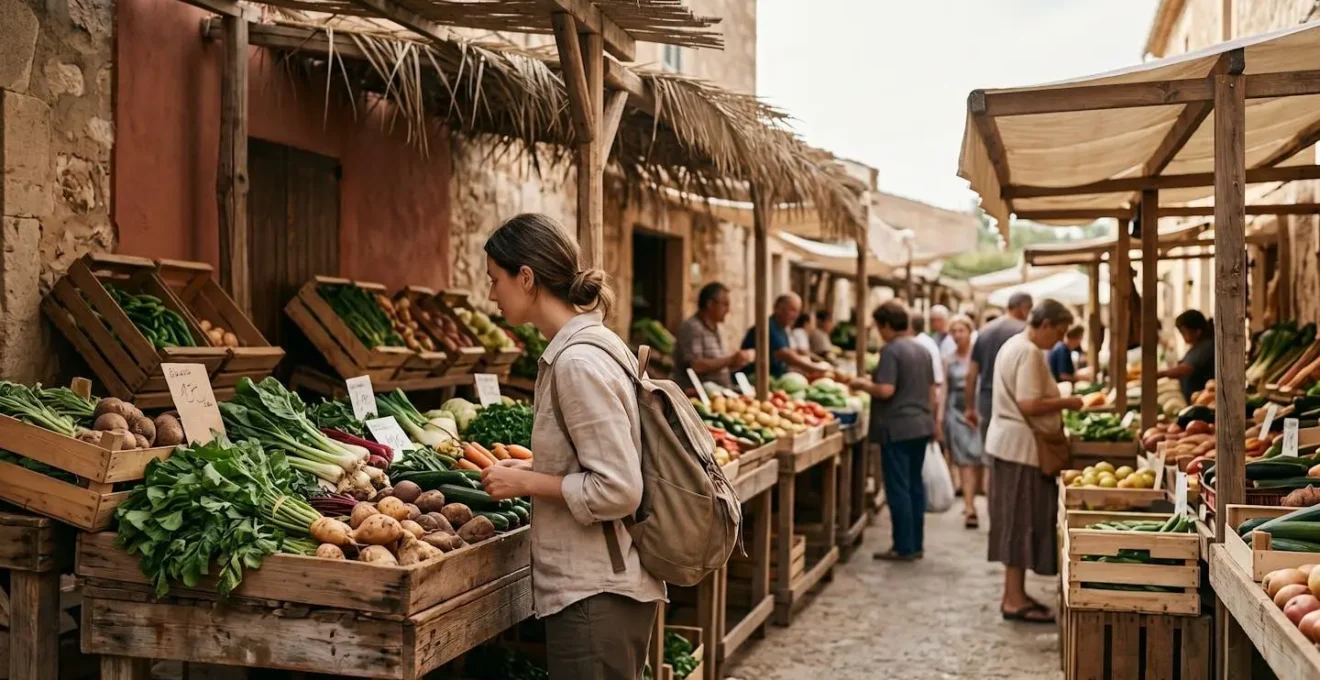
The ultimate expression of a region’s cuisine is inextricably linked to the seasonality of its ingredients. To experience a specialty at its absolute peak, the culinary auditor must align their visit with the local harvest calendar. This means shifting focus from a static restaurant menu to the dynamic environment of a local market. Markets are the living heart of a region’s food culture, showcasing what is truly fresh, abundant, and being cooked in local homes *right now*. The best time to visit a market is typically early in the morning, when the produce is at its freshest, often still holding the morning dew, and before the best items sell out.
Beyond the daily rhythm, timing your travel to coincide with seasonal food festivals offers an unparalleled opportunity for immersion. These events are curated celebrations of a specific ingredient or dish at its zenith, from truffle fairs in autumn to wild strawberry festivals in spring. They are a focal point for the entire community, attracting the best producers and chefs. Market analysis reveals that the food festival segment dominated the culinary tourism market, highlighting their crucial role in providing concentrated, high-quality culinary experiences. Visiting during a festival guarantees you are tasting a product at its peak, surrounded by people who are deeply passionate about it.
If your travel dates are fixed, use the local market as your guide. Observe what produce is piled high on every stall; that is the ingredient you should be looking for on menus. If the market is overflowing with artichokes, seek out restaurants serving dishes that celebrate them. This market-driven approach ensures you are eating in sync with the region’s natural rhythm, which is a fundamental tenet of authentic cuisine. It’s a simple, direct way to bypass the static, seasonless menus of tourist traps and connect with the true, living pulse of the local food scene.
The Culinary Discovery Restaurant That Charges £40 for £5 Street Food
One of the most common points of confusion for travelers is the vast price difference for what appears to be the same dish. Why does a bowl of Phở cost £5 on a street corner in Hanoi and £40 in a high-end London restaurant? Dismissing the latter as a « rip-off » is an oversimplification that ignores the concept of contextual value. A proper culinary audit involves deconstructing the price to understand what you are actually paying for. While the street food vendor offers the dish in its raw, traditional form, the high-end restaurant is selling a completely different product: a curated experience built around that dish.
This experience is composed of numerous invisible costs and value-adds. These can include significant investment in research and development, the use of rare or ethically sourced ingredients, the pedigree and labor of a highly skilled chef, and a designed environment with professional service. The higher price tag subsidizes not just the food, but the story, the comfort, and the educational component. This is a legitimate proposition, especially as a recent analysis of luxury culinary tourism illustrates the different factors that contribute to the final cost.
| Factor | Street Food (£5) | Fine Dining Elevation (£40) |
|---|---|---|
| Ingredient Provenance | Standard commercial suppliers | Rare heirloom varieties, artisan producers |
| Labor & Expertise | Basic preparation skills | Professional chef with recognized pedigree |
| Research & Technique | Traditional recipe replication | Modern technique application, R&D investment |
| Cultural Context | Minimal storytelling | Curated narrative, cultural education |
| Service & Ambiance | Casual, self-service | Professional service, designed environment |
The willingness to pay for this bundled experience is a growing trend. Research has found that a significant number of travelers intentionally plan entire trips just to visit a particular restaurant, demonstrating that the experience itself is the destination. The key for the auditor is to determine if the £40 price is justified by these factors or if it’s simply an inflated price for a standard dish in a fancy room. A restaurant that can articulate its ingredient provenance and explain the technique behind its interpretation is offering real value. One that cannot is merely a tourist trap with better lighting.
What Defines an Authentic Stay Beyond Just Traditional Architecture?
The search for authenticity extends beyond the restaurant table and into the very place you choose to stay. A hotel or rental with « traditional architecture » is not inherently authentic if its services are generic and disconnected from the local culture. A truly authentic accommodation acts as a gateway to the region’s culinary life, actively integrating local foodways into its guest experience. This is a key deciding factor for many travelers; industry research shows that for a large majority, having a good restaurant in their hotel is a priority, highlighting the demand for a seamless blend of accommodation and authentic culinary access.
So, how does a culinary auditor evaluate the authenticity of their lodging? It begins with the « Breakfast Test. » Does the morning buffet feature generic UHT milk, bland coffee, and mass-produced pastries, or does it showcase local jams, regional cheeses, bread from a nearby bakery, and coffee from a local roaster? The breakfast offering is a powerful and immediate indicator of an establishment’s commitment to its local provenance chain. This principle extends to self-catering accommodations. An authentically-minded host will equip the kitchen not with cheap, flimsy pans but with good knives, quality cookware, and a bottle of local olive oil, enabling guests to properly engage with ingredients from the local market.
The human element is just as critical. The quality of a host’s recommendations is another key performance indicator. Do they hand you a photocopied list of the top 10 tourist restaurants, or do they passionately share their personal favorite spots, secret local producers, and off-the-beaten-path markets? An authentic host is a cultural curator, not just a property manager. This deep integration of food culture, from the equipment in the kitchen to the quality of the recommendations, is what separates a truly authentic stay from a mere architectural shell.
Key Takeaways
- Authenticity is a verifiable process, not a feeling. Audit a restaurant’s menu, ingredient seasonality, and sourcing claims.
- « Flavor dilution » is a common strategy in tourist areas. A challenging or intense flavor can be a sign of an uncompromised, authentic dish.
- Price is not the ultimate indicator. Both cheap street food and expensive fine dining can be authentic if they deliver value, either through raw tradition or curated experience.
How Can Non-Foodies Use Culinary Discoveries to Connect With Local Culture?
You don’t need a refined palate to use food as a powerful tool for cultural immersion. For many travelers, food is simply a means to an end, but for the savvy non-foodie, it can be the most efficient and engaging lens through which to understand a new place. In fact, industry data shows that for over a third of tourists, cuisine is a primary motivator for their destination choice, because culinary culture provides a direct window into different ways of life. The key is to shift the focus from « tasting » to « observing. »
As travel experts often recommend, visiting a central market is less about shopping and more about conducting a rapid anthropological study. By observing what produce is most abundant, how vendors and customers interact, the sounds and smells of daily commerce, and the rhythm of the place, you can gain a deeper understanding of daily life in an hour than you might from visiting multiple museums. It’s a sensory, immersive experience that requires no prior culinary knowledge. It reveals what people truly eat, what is valued, and how the community functions.
Case Study: Markets as Cultural Immersion Tools
Travel experts recommend visiting central markets not to shop but to observe as an anthropological experience. By witnessing what produce is central, how vendors and customers interact, and experiencing the sounds and smells, travelers gain understanding of daily life faster than visiting multiple museums—making food culture accessible even to those without refined palates. This approach transforms the market from a place of commerce into a living museum of local culture.
Another powerful tool is the cooking class. For a non-foodie, the goal isn’t to become a master chef, but to gain a hands-on understanding of the region’s core ingredients and techniques. It provides a structured environment where you can ask questions and connect with a local in a meaningful way. As author Tim Leffel states, « In a new place, authentic food is the best window into the culture. » This window is accessible to everyone, regardless of their level of culinary interest. By using markets, cooking classes, and guided food tours as tools for observation and interaction, even the most casual eater can unlock a profound connection to local culture.
Start applying this auditor’s mindset on your next journey. Instead of asking « Where can I find authentic food?, » begin asking « What makes the food here authentic? » This shift in perspective will transform your travels and lead you to the true, vibrant, and delicious heart of every destination.