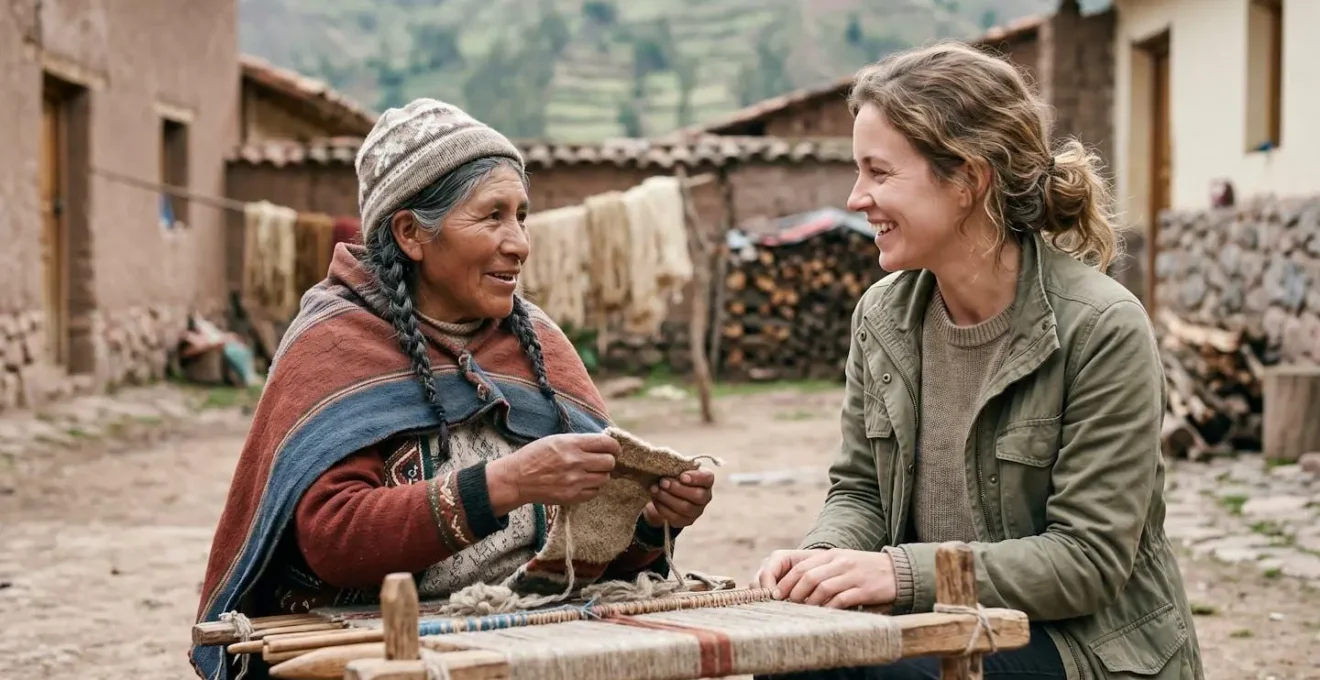
The key to respectful travel is not a checklist of actions, but a mindset shift from extractive tourism to consent-based immersion.
- Authenticity is defined by community agency, not a tour’s marketing label; look for experiences where locals control their own narrative.
- True respect goes beyond asking for a photo; it requires observing non-verbal cues and understanding the power dynamics of the interaction.
Recommendation: Focus on reciprocal exchange. Prioritize listening over speaking and the community’s comfort over your own experiential goals to build genuine connections.
The desire for an authentic travel experience is a powerful motivator. We dream of moving beyond sterile resorts to connect with the living, breathing heart of a place and its people. Yet, this desire is often shadowed by a deep-seated anxiety: Am I being respectful, or am I just another intrusive tourist? We worry about crossing the line from cultural appreciation to appropriation, of turning a person’s life into our vacation photo op. The common advice—learn a few local phrases, dress modestly, ask before taking pictures—is well-intentioned but can feel like a superficial performance.
These actions, while helpful, often fail to address the core of the issue. They can become a form of performative respect, a checklist we complete for our own peace of mind rather than a genuine effort to understand the community’s perspective. What if the real path to respectful engagement isn’t about what you do, but about how you think? The secret lies in moving from an extractive mindset, where you seek to take experiences and images, to one rooted in consent and reciprocity.
This guide reframes the challenge. It’s not about finding a perfect, « untouched » culture, but about learning to practice consent-based immersion. This approach prioritizes the community’s agency and comfort above all else. We will explore why some communities welcome tourism while others resist it, how to decipher genuine welcome from mere tolerance, and how to choose experiences that empower locals. By shifting your perspective, you can learn to be a guest who is not just tolerated, but truly welcomed.
Summary: A Framework for Consent-Based Cultural Engagement
- Why Do Some Local Culture Groups Embrace Tourism While Others Resist It?
- Which Local Culture Gestures and Phrases Show Genuine Respect Versus Performative Tourism?
- Community-Led or Commercial Tour: Which Local Culture Experience Is More Ethical?
- The Photography Behavior That Local Culture Communities Find Most Offensive
- How Can You Tell if Local Culture Communities Want You There or Just Tolerate Tourism?
- Why Do Diverse Cultures Present a « Tourist Version » of Their Traditions?
- The Attitude Problem That Makes Local Communities Resent Foreign Travellers
- How to Experience Diverse Cultures Authentically Without Committing Cultural Faux Pas?
Why Do Some Local Culture Groups Embrace Tourism While Others Resist It?
The varied reactions to tourism are not random; they are deeply rooted in economics, history, and a community’s control over its own destiny. The core differentiator is cultural agency: the power of a community to define its own identity, control its narrative, and benefit directly from the engagement. When tourism is imposed from the outside, with benefits flowing to external operators, it often fosters resentment. This is especially true when communities lack legal control over their own lands and resources.
For many Indigenous groups, tourism can feel like a continuation of colonial dynamics. Research reveals that only about 10 percent of Indigenous-held lands worldwide are legally recognized as their own. Without this foundational security, tourism can become an extractive industry that commodifies their culture without providing sustainable economic returns or respecting their sovereignty. Resistance, in this context, is not anti-tourist sentiment; it is an assertion of rights and a demand for a more equitable partnership.
Conversely, communities that have successfully harnessed tourism on their own terms often view it as a powerful tool for cultural preservation and economic self-determination. When a community designs, manages, and profits from the visitor experience, tourism can fund language revitalization programs, support traditional artisans, and provide a platform to share their story with the world authentically. As researchers from Frontiers in Sustainable Tourism note, this is not a new phenomenon:
Indigenous Peoples have always refused and resisted some colonial conservation policies and continue to assert their rights and responsibilities to their territories in innovative ways.
– Researchers at Frontiers in Sustainable Tourism, Sustainable tourism development and Indigenous protected and conserved areas in sub-arctic Canada
Embracing tourism becomes an act of agency, a strategic choice to engage with the outside world from a position of strength and control. Therefore, the question for a respectful traveler is not « Is tourism good or bad? » but « Who holds the power in this interaction? »
Which Local Culture Gestures and Phrases Show Genuine Respect Versus Performative Tourism?
In the quest for respectful engagement, it’s easy to focus on a checklist of actions: learning « hello » and « thank you, » bowing, or bringing small gifts. While these can be positive, they risk becoming performative gestures if they are not backed by a genuine mindset of humility and curiosity. The difference between authentic respect and performance lies in your intention. Are you doing it to get a warmer reception and a better photo, or are you doing it to cede social space and honor the other person’s context?
The most powerful gesture of respect is often the most passive: active and humble listening. It is the conscious decision to learn rather than to teach, to receive rather than to direct. This means putting away your camera, silencing your preconceived notions, and giving your undivided attention to the person in front of you. It is a non-transactional act that communicates, « Your story is more important than my agenda. » This is the foundation of a reciprocal exchange.
As the Sustainability Directory advises on the principles of ethical cultural tourism, the focus should be on creating a dialogue, not a monologue.
Listen more than you speak, ask questions with genuine curiosity, and be respectful of differing viewpoints. Remember that you are a guest in their home.
– Sustainability Directory, Ethical Cultural Tourism principles
This simple guidance shifts the dynamic entirely. Instead of performing a role, you are participating in a relationship. A traveler who masters the art of listening shows a far deeper respect than one who has memorized a dozen phrases but fails to hear the answer.
Ultimately, genuine respect is not demonstrated through isolated gestures but through a consistent attitude of deference. It is the quiet understanding that you are the visitor, the outsider, and the burden of adaptation is on you. This mindset is visible in your body language, your patience, and your willingness to observe without judgment.
Community-Led or Commercial Tour: Which Local Culture Experience Is More Ethical?
The conventional wisdom for ethical travelers is to always choose « community-led » tours over commercial ones. The logic is sound: money should flow directly to the community, and they should control their own story. However, the reality is more nuanced. The label « community-led » is not a guaranteed stamp of ethical purity, nor is « commercial » always synonymous with exploitation. The more critical factor is the underlying structure of agency and benefit-sharing.
A poorly managed community-based project can suffer from internal issues. A 2024 global review of community-based tourism found that problems like limited managerial capacity and « elite domination » can undermine the very goals of equity and authenticity. In such cases, benefits may be captured by a few powerful individuals, leaving the rest of the community disenfranchised. The experience, while labeled « community-led, » may not be truly representative or equitable.
Conversely, a commercial tour operator can, in some cases, establish a highly ethical and sustainable partnership with a community. This often happens when the company invests in capacity building, ensures fair wages, respects cultural protocols, and operates with long-term partnership goals rather than short-term profit motives. The key is whether the community has genuine power in the relationship.
Case Study: South Korea’s TourDure Program
A prime example of focusing on structure over labels is the TourDure program in South Korea. This initiative specifically targets capacity building and women’s entrepreneurship within community tourism. By training women to manage and operate their own tourism enterprises, it fosters financial independence and community resilience. This case highlights how empowering individuals with skills and resources is crucial for creating sustainable and ethical tourism, regardless of whether the initial framework is commercial or community-driven.
As a traveler, your task is to look beyond the marketing. Instead of asking « Is this tour community-led? », ask better questions: Who receives the majority of the money I pay? Who is making the decisions about what I see and do? Are the local guides employees with fair wages or empowered partners? The most ethical choice is the one that best enhances a community’s economic and cultural agency.
The Photography Behavior That Local Culture Communities Find Most Offensive
Of all the potential cultural faux pas, one behavior consistently emerges as the most deeply offensive: photography without consent. The issue, however, goes far beyond a simple failure to ask permission. At its heart, it is about objectification. When a traveler raises a camera to capture a « candid » shot of a local person, they are often, however unintentionally, reducing a human being to a component of the scenery—an exotic object for their collection.
This act of extractive photography strips the subject of their agency and turns a moment of their life into a transaction they did not agree to. As researcher Caroline Scarles discovered in her study on tourist photography in Peru, the feeling of being turned into an object is a profound source of resentment. One of the key findings was that:
Local communities argued that they hate to be considered as an object of tourist photography and criticized those tourists who attempted to take photos of them without previous permission or consent.
– Caroline Scarles, The Ethics of Tourist Photography: Tourists’ Experiences of Photographing Locals in Peru
Consent-based photography is the antidote. It is a process, not a single question. It begins with building a rapport, however brief. It involves showing genuine interest in the person, not just their aesthetic. The question « May I take your picture? » should be the end of an interaction, not the beginning. A better approach is to ask about their work, compliment an item they made, or simply share a smile. If a connection is formed, photography might become a natural, collaborative part of it.
The most ethical photographers go a step further by practicing reciprocity. Show them the photo on your camera screen. Offer to send them a copy. This simple act transforms the dynamic from extraction to a shared experience. It re-humanizes the moment, turning « subject » and « photographer » back into two people sharing a connection. The goal should never be to « take » a picture, but to be « given » one.
How Can You Tell if Local Culture Communities Want You There or Just Tolerate Tourism?
Discerning a genuine welcome from polite tolerance is one of the most subtle but critical skills for a sensitive traveler. It requires moving beyond surface-level interactions and learning to read the atmosphere of a place. Communities, especially those economically dependent on tourism, become adept at wearing a professional « host » mask. Your job is to look for the authentic signals that lie beneath it.
One of the most reliable indicators is the nature of the eye contact and smiles. Are they fleeting and directed only at those in the service industry, or do you receive spontaneous, warm greetings from people you pass on the street who have nothing to sell you? A genuine welcome is often characterized by unsolicited curiosity. Do children wave? Do elders nod in acknowledgment? Do people seem open to a casual, non-transactional conversation?
Economic indicators also provide clues. Pay attention to who owns the businesses. Are the hotels, restaurants, and tour agencies locally owned, or are they part of large, foreign chains? When a community has a direct stake in the tourism economy, they are more likely to see visitors as partners. This aligns with research on indigenous community perspectives, which reveals a direct correlation between perceived benefits and positive attitudes. If the economic costs of tourism (such as inflated prices and strained infrastructure) outweigh the benefits for the average resident, tolerance is the best you can hope for.
Another powerful sign is access. Are you strictly confined to a « tourist zone, » or are there opportunities for genuine, unstructured interaction? A community that welcomes visitors often does so by inviting them into their real, everyday spaces—not just the curated ones. This could be a shared meal, an invitation to observe a local sports game, or simply a conversation at a neighborhood market. The absence of these opportunities, or a subtle « gatekeeping » that keeps you at arm’s length, is often a sign of a community managing, rather than embracing, the tourist presence.
Why Do Diverse Cultures Present a ‘Tourist Version’ of Their Traditions?
Travelers seeking « authenticity » often express disappointment when they encounter a « tourist version » of a cultural tradition—a dance that feels rehearsed, a ceremony shortened for visitor attention spans, or crafts made for souvenir shops. It’s easy to dismiss these as inauthentic or commercialized. However, this perspective misses a crucial point: the tourist version is often a sophisticated and necessary form of cultural boundary management.
Presenting a simplified, standardized version of a tradition serves a vital protective function. It allows a community to participate in the tourism economy without exposing the most sacred, complex, or intimate aspects of their culture to misunderstanding or commodification. It is a buffer zone. Certain stories, rituals, and meanings are reserved for the community itself, while a more accessible, public-facing version is shared with outsiders. This is not an act of deception; it is an act of preservation and agency.
Furthermore, this curated presentation is a coping mechanism for individuals. As tourism ethics researchers point out, it relieves the immense emotional labor of constantly being a « cultural ambassador. »
Presenting a standardized ‘tourist version’ relieves individuals of the immense pressure to constantly act as cultural ambassadors. It’s a script that manages the interaction, preventing the emotional and intellectual exhaustion.
– Tourism ethics researchers, Tourism Ethics principles on cultural preservation
The « tourist show » is a predictable interface that manages expectations on both sides. It provides visitors with the accessible cultural experience they seek while protecting locals from the exhausting and often impossible task of explaining the deep complexities of their worldview to a transient audience. A respectful traveler understands and respects this boundary, appreciating the performance for what it is—a welcome, not an invitation to every part of their home.
The Attitude Problem That Makes Local Communities Resent Foreign Travellers
While specific actions like intrusive photography can cause offense, the most pervasive source of resentment from local communities often stems from a single, underlying attitude: traveler entitlement. This is the implicit assumption that because you have paid for a trip, you are entitled to a certain experience. You are entitled to access, to service, to photos, to a culture performing for your benefit. This attitude turns a potential relationship of mutual respect into a purely transactional one, where the local community is seen as a service provider and their home as a product to be consumed.
This sense of entitlement manifests in many ways: impatience when things don’t run on a familiar schedule, haggling aggressively over a few cents with an artisan, complaining that people don’t speak English, or ignoring local customs because they are inconvenient. It is the root cause of the « overtourism » backlash seen across the globe. As CNN Travel documented in the summer of 2024, tens of thousands of locals in popular destinations across Europe took to the streets to protest the negative impacts of tourism, fueled by a growing frustration with disrespectful and demanding visitor behavior.
The antidote to entitlement is a conscious cultivation of humility. It is the active recognition that you are a guest and that your presence has an impact. This means accepting that things may be different, slower, or less convenient than at home—and that this is part of the experience, not a flaw in the product. It means seeing every local person not as an NPC (non-player character) in your travel story, but as a person with their own life, work, and dignity, which exist independently of your vacation.
When you approach a new culture with humility, you are not there to be served, but to learn. You are not there to demand, but to ask. This fundamental shift in attitude is felt by local communities and is the single most important factor in transforming your presence from an intrusion into a welcome exchange.
Key Takeaways
- Shift from Extraction to Reciprocity: The goal is not to « get » an experience but to participate in a respectful exchange. Focus on what you can give—attention, respect, genuine interest—not just what you can take.
- Prioritize Community Agency: True authenticity lies in a community’s power to control its own narrative. Support businesses and tours where locals are empowered partners, not just employees.
- Consent Is an Ongoing Dialogue: Respect goes beyond asking a single question. It’s about continuously observing body language, social cues, and the overall atmosphere to ensure your presence is welcome.
How to Experience Diverse Cultures Authentically Without Committing Cultural Faux Pas?
Navigating a new culture without causing offense can feel like walking a tightrope. The fear of committing a faux pas can lead to a hesitant, distant travel style that prevents any real connection. The solution is not to memorize an exhaustive list of every possible rule, but to adopt a foundational mindset of adaptive respect. As cultural sensitivity experts from Satguru Travel explain, it is about shifting the burden of adaptation onto yourself.
Cultural sensitivity in tourism is the understanding that every culture has its values and traditions, and as visitors, we must adapt rather than impose our customs.
– Satguru Travel cultural sensitivity experts, 7 Tips for Cultural Sensitivity in Tourism and Travel
This means starting with observation before participation. Watch how people greet each other, how they dress, how they interact in public spaces. Your primary role, especially at first, is that of a student. This humble posture is universally appreciated and provides a buffer against unintentional mistakes. When you do err—which is inevitable—a sincere, humble apology is far more effective than a defensive explanation. Acknowledging your mistake shows you are trying, and the effort is what counts.
The distinction between cultural appreciation and appropriation also becomes clearer with this mindset. Appreciation is rooted in a desire to learn and honor, and it always involves consent, credit, and often, compensation. It’s buying a craft directly from the artisan who made it. Appropriation is taking a cultural element out of its context for your own benefit without understanding or permission, like wearing a sacred headdress as a festival costume. By focusing on consent-based immersion, you naturally stay on the side of appreciation.
Your Consent-Based Travel Checklist: An Attitude Audit
- Pre-Trip Research: Go beyond tourist sites. Research the social and political context. Who are the local Indigenous groups? What are the current community concerns regarding tourism?
- Economic choices: Inventory your spending plan. How much of your budget will go to locally-owned businesses (guesthouses, restaurants, guides) versus international corporations?
- Observation goals: Instead of a shot list for photos, create a listening list. What are three things you want to learn about the local perspective on family, work, or the environment?
- Reciprocity plan: What can you offer in return? This isn’t about material gifts. It could be sharing a skill (if appropriate and requested), helping with a task, or simply offering your undivided, respectful attention.
- Exit strategy: Plan to leave a place better than you found it. This means packing out all trash, leaving positive and fair reviews for local businesses, and carrying the stories you were given with respect, not as social media trophies.
Ultimately, traveling respectfully is a practice, not a destination. It requires constant self-awareness, humility, and the willingness to prioritize another’s comfort over your own agenda. By embracing a mindset of consent-based immersion, you transform from a consumer of places into a participant in a global community, creating experiences that are not only authentic for you, but also affirming for the people you meet.