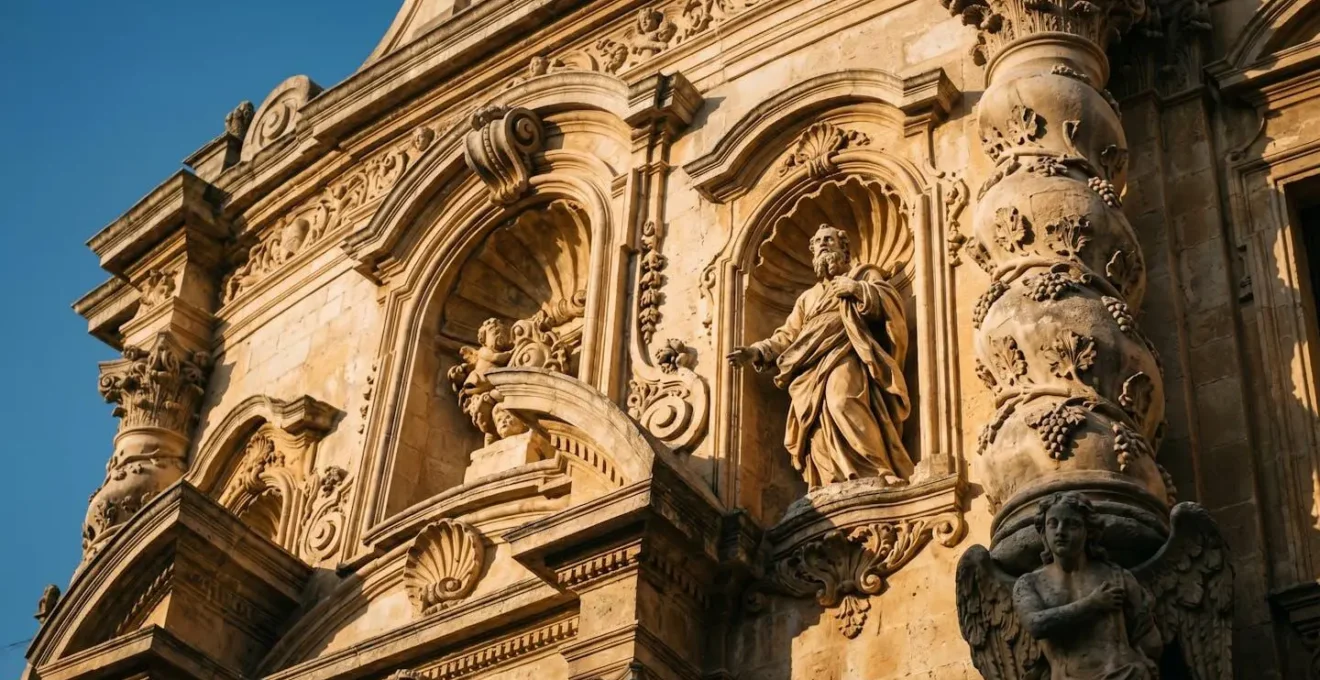
Recognizing authentic Baroque architecture requires more than a checklist of features; it demands an understanding of its psychological purpose as a tool of power and persuasion.
- Identify its origins in the Counter-Reformation’s need for emotional drama and overwhelming grandeur.
- Distinguish its three evolutionary stages: the serious Early and High Baroque from the lighter, more intimate Rococo.
Recommendation: Instead of just looking, use a three-step viewing method to actively decode the narrative and craftsmanship, turning sensory overload into profound appreciation.
Standing inside a Roman Baroque church, the sheer density of ornament can be overwhelming. Gilded surfaces, twisting columns, and soaring angels all compete for attention, often leaving the cultured traveller with a sense of visual fatigue rather than wonder. Many guides will advise you to look for the obvious: curved lines, dramatic contrasts, and a general sense of grandeur. While correct, this approach merely scratches the surface, failing to explain the profound difference between a genuine 17th-century masterpiece and a later, less coherent imitation.
The common mistake is to treat Baroque as a style defined only by its decorative elements. This leads to confusion with its later evolution, Rococo, and an inability to appreciate the building’s original intent. But what if the key was not a visual checklist, but a decoding method? What if we could learn to read these buildings as their creators intended: as powerful works of psychological theatre, designed to inspire awe, convey power, and overwhelm the senses for a very specific purpose? This is the true skill of the architectural connoisseur.
This guide moves beyond simple identification. We will first delve into the historical « why » behind Baroque’s emotional intensity. Then, we will establish a clear diagnostic framework for distinguishing its key evolutionary stages, particularly from the Rococo period that followed. Finally, we will provide you with practical, expert-level methods to experience these architectural marvels as living history, transforming you from a passive tourist into an active architectural detective.
To navigate this exploration of architectural meaning, the following sections will guide you through the core concepts, key locations, and practical techniques for becoming an expert observer of the Baroque style.
Summary: Decoding the Theatrical Language of Baroque Buildings
- Why Is Baroque Architecture So Emotionally Dramatic Compared to Renaissance Restraint?
- Which 7 European Cities Contain the World’s Finest Baroque Architecture Collections?
- Early Baroque or Rococo: How to Identify the 3 Evolution Stages of Baroque Architecture?
- The Sensory Overload That Ruins Baroque Architecture Appreciation After 5 Churches
- Where Can You Photograph Baroque Architecture Interiors Without Breaking Rules?
- How to Decode the 5 Historical Eras Visible in Ancient Cities’ Architecture?
- How to Identify Which Century a Historic Harbour Was Most Active by Its Buildings?
- How to Experience Ancient Cities as Living History Instead of Open-Air Museums?
Why Is Baroque Architecture So Emotionally Dramatic Compared to Renaissance Restraint?
The emotional intensity of Baroque architecture is not an aesthetic accident; it is a calculated strategy rooted in one of the most significant upheavals in European history: the Protestant Reformation. While Renaissance architecture prized harmony, clarity, and rational order, reflecting a humanistic worldview, Baroque was weaponized by the Catholic Church as a tool of the Counter-Reformation. Its primary goal was to create an overwhelming, emotionally charged experience that would reassert the Church’s power and draw the faithful back into the fold.
As an official instrument of propaganda, every element was designed for psychological impact. As Wikipedia contributors note on the subject, it was a style meant to inspire « astonishment, reverence and awe. » This was achieved through a sensory assault: monumental scale, dramatic lighting (chiaroscuro), opulent materials, and dynamic movement in statues and structures. The architecture was intended to bypass rational thought and speak directly to the soul, making the divine feel tangible and powerful. It was theatre on an architectural scale.
The sheer scale of this ambition is visible in projects like Gian Lorenzo Bernini’s design for St. Peter’s Square in Rome. It wasn’t just a gathering place; it was a stage set for the Catholic faith, deliberately engineered to accommodate up to 300,000 people. This immense capacity was a physical manifestation of the Church’s universal reach and power, designed to dwarf the individual and inspire a collective sense of awe. Unlike the intellectual serenity of a Renaissance palazzo, a Baroque church was meant to make you feel small, emotionally stirred, and humbled before God and the institution representing Him.
Which 7 European Cities Contain the World’s Finest Baroque Architecture Collections?
While individual Baroque masterpieces exist across Europe, certain cities became epicenters of the style, developing unique local interpretations. These urban centers offer more than just a few landmark buildings; they present entire streetscapes and squares that create an immersive Baroque environment. For the discerning traveller seeking to understand the style in its context, these cities are essential destinations. Here are seven of the world’s most significant repositories of Baroque architecture.
This image captures the concept of Baroque density, where buildings create an enveloping and theatrical urban fabric. To experience this immersion, consider visiting:
- Rome, Italy: The birthplace of the Baroque. It is a living museum of the works of Bernini and Borromini, from the Piazza Navona to countless churches showcasing the style’s dramatic origins.
- Turin, Italy: Home to the highly intellectual and complex Baroque of Guarino Guarini, with its mathematically daring domes and undulating facades.
- Lecce, Italy: The capital of « Barocco leccese, » a unique, exuberant variant carved from soft local limestone, giving facades an incredibly detailed, almost lace-like quality.
- Vienna, Austria: The heart of the Habsburg empire’s Imperial Baroque, characterized by monumental palaces like Schönbrunn and the Belvedere, designed to project dynastic power.
- Prague, Czech Republic: After the Thirty Years’ War, Prague was transformed into a Baroque capital, with countless churches and palaces built by families loyal to the Habsburgs.
- Dresden, Germany: Although heavily damaged in WWII and rebuilt, the Zwinger Palace and Frauenkirche stand as testaments to the city’s magnificent late Baroque and Rococo identity.
- Valletta, Malta: A fortified city that is a holistic masterpiece of Baroque planning and military architecture, exemplified by St. John’s Co-Cathedral.
Early Baroque or Rococo: How to Identify the 3 Evolution Stages of Baroque Architecture?
A common pitfall for even experienced observers is confusing High Baroque with its later, more flamboyant descendant, Rococo. Viewing them as a simple binary—heavy versus light—misses the crucial story of their evolution. The Baroque period can be broadly divided into three phases: Early Baroque (c. 1600-1625), High Baroque (c. 1625-1675), and Late Baroque (c. 1675-1750), which overlaps with and transforms into Rococo (c. 1715-1770). Recognizing these stages is key to dating buildings and understanding their context.
The primary shift is from public propaganda to private pleasure. Early and High Baroque were styles of the Church and absolute monarchies, designed for public squares and monumental churches. Rococo, by contrast, was the style of the French aristocracy, flourishing in the intimate interiors of private salons and hôtels particuliers. This shift in patronage and purpose is the core diagnostic tool for telling them apart. The following table, based on a comparative analysis of their features, provides a clear framework for identification.
| Characteristic | Baroque (1600-1700) | Late Baroque/Rococo (1715-1770) |
|---|---|---|
| Primary Mood | Serious, masculine, emotionally intense | Playful, feminine, lighthearted |
| Color Palette | Dark marbles, gold gilt, dramatic contrasts | Soft pastels, light pinks, blues, creams |
| Symmetry | Powerful symmetry projecting order and strength | Asymmetry for surprise and intimacy |
| Primary Patronage | Catholic Church and absolute monarchies | Aristocratic classes, private salons |
| Materials | Stone, dark woods, heavy marble | Stucco, mirrors, pastel-colored marble, plaster |
| Spatial Intent | Monumental public awe and propaganda | Intimate private pleasure and comfort |
Essentially, if a building or room feels designed to impress, command, and project power with its powerful symmetry and heavy materials, it is likely High Baroque. If it feels designed to charm, delight, and create a light, airy, and intimate atmosphere with its pastel palette and asymmetrical details, you are in the presence of Rococo.
The Sensory Overload That Ruins Baroque Architecture Appreciation After 5 Churches
Even for the most dedicated art history student, a day of exploring Baroque churches can lead to a specific form of aesthetic burnout. The relentless ornament, emotional intensity, and monumental scale can blur together, leaving you unable to distinguish one masterpiece from the next. This « sensory overload » is a genuine obstacle to appreciation. It happens because our brains are not equipped to process such a high density of visual information without a structured approach. The architects themselves knew this; they designed these spaces for overwhelming impact, not for casual, prolonged analysis.
To combat this fatigue and transform a potentially exhausting experience into a profound one, you must shift from passive looking to active decoding. Instead of trying to see everything at once, adopt a focused, three-part viewing method. This technique allows you to engage with the building on its own terms—first its overall impact, then its narrative, and finally its craftsmanship. It provides a mental anchor, preventing your mind from being swamped by the visual noise and allowing for a deeper, more memorable connection with the space.
Your Action Plan: The 3-Step Baroque Viewing Method
- The Threshold Gasp: Upon entering, pause immediately inside the doorway. Resist the urge to focus on details. Simply absorb the overall scale, the quality of light, and the initial emotional impact. This first impression is what the architect worked hardest to create.
- The Narrative Hunt: Identify the main focal point—usually the high altar or a central dome fresco. Trace the visual path the architecture creates to guide your eye towards it. Look for the story being told in the main sculptures or paintings; Baroque art is narrative-driven.
- The Single Detail Meditation: Choose one small, manageable element—the expression on a cherub’s face, the fold of a marble drapery, a section of gilded stucco—and study it for a full minute. This grounds you in the human scale of the craftsmanship and allows you to appreciate the skill involved.
By cycling through these three steps, you create a rhythm of observation that respects both the grand vision and the intricate details, making each visit distinct and rewarding.
Where Can You Photograph Baroque Architecture Interiors Without Breaking Rules?
Capturing the soul of a Baroque interior is one of photography’s great challenges. The extreme contrast between shadowy recesses and brilliant, gilded altars or sunlit windows pushes camera sensors to their limits. More importantly, these are often active places of worship where photography is restricted or forbidden. Succeeding requires a combination of technical skill, situational awareness, and profound respect for the space.
The first rule is to always check the rules. Look for signage at the entrance. If photography is allowed, it is almost universally forbidden to use a flash, as the intense UV light damages ancient pigments and materials. Tripods are also frequently prohibited as they can be a tripping hazard and are disruptive. Therefore, the successful photographer must master handheld, low-light techniques to capture the dramatic chiaroscuro that is the hallmark of the style.
To achieve shots that capture this « sculpted light » effect without breaking the rules, a specific technical strategy is required:
- Use Manual (M) or Aperture Priority (A/Av) mode. Set your aperture to f/8-f/11 to ensure a deep enough depth of field to keep the ornate details sharp from front to back.
- Manage your ISO. Start at a low ISO (100-400) and only increase it if necessary to achieve a fast-enough shutter speed to avoid blur. Shooting in RAW format is non-negotiable, as it provides the latitude needed to recover shadow and highlight detail in post-processing.
- Time your visit. The best light is often in the early morning or late afternoon, when directional sunbeams stream through windows, creating the dramatic, high-contrast scenes the architects intended.
- Bracket your exposures. If a tripod is permitted, take multiple shots of the same scene at different exposures (one normal, one darker, one brighter) and merge them later (HDR). This is the best way to capture the full dynamic range.
- Be discreet. Turn off all camera sounds. Move slowly and quietly. Never take photos during a service or when people are actively praying in your frame.
How to Decode the 5 Historical Eras Visible in Ancient Cities’ Architecture?
Ancient European cities are rarely the product of a single era. They are an architectural palimpsest—a manuscript on which later writing has been superimposed on effaced earlier writing. Layers of history are written in stone, with Gothic foundations, Renaissance additions, Baroque facelifts, and Neoclassical renovations often coexisting in a single view. Learning to read these layers is the ultimate skill of the architectural detective. The Baroque layer is often one of the most assertive and legible, as it was frequently used to modernize or re-brand older structures.
This process of layering is not random; it tells a story of power, wealth, and changing tastes. When a new political or religious force came to power, it often announced its arrival by literally re-facing the city’s key buildings in the dominant style of the day. The Baroque, with its dramatic and imposing nature, was perfectly suited for this task. It was a clear and unambiguous statement of a new order.
Case Study: Prague’s Old Town Square as an Architectural Palimpsest
Prague’s Old Town Square serves as a perfect classroom for reading architectural layers. A single panoramic view reveals multiple eras simultaneously. You can see the spires of the High-Gothic Týn Church, the simple facades of Romanesque and early-Gothic houses, and the more ornate fronts of Rococo buildings. The Baroque layer is particularly prominent. As Mark Baker notes in his analysis of Prague’s architecture, this layer was aggressively imposed following the Catholic Habsburg victory at the Battle of White Mountain in 1620. The victorious Catholic nobility and the Church systematically re-faced older, « heretical » buildings with new, triumphal Baroque facades, straightened medieval lanes, and constructed monumental palaces to cement their authority.
To decode a city, don’t look at buildings in isolation. Look for the junctions, the awkward transitions, and the stylistic clashes. Ask yourself: which style seems to be covering another? Which one is making the grandest statement? Often, the answer will be Baroque.
How to Identify Which Century a Historic Harbour Was Most Active by Its Buildings?
While the title specifies harbours, the principle applies to any center of power and commerce: the dominant architectural style of a city’s most prominent buildings reveals its golden age. If a historic city center is defined by grand, theatrical palaces and monumental administrative buildings, it is a strong indicator that its peak of power and influence coincided with the 17th or early 18th century—the Age of Absolutism and the height of the Baroque. The style and the political system were intrinsically linked.
Baroque was the official language of the absolute monarchy. Just as the Catholic Church used it to project spiritual power, centralized states used it to display secular power. Kings and emperors built on an unprecedented scale to demonstrate their wealth, control, and divine right to rule. These were not merely residences; they were instruments of statecraft, designed to awe visiting dignitaries and intimidate domestic rivals. The symmetry, scale, and endless procession of grand rooms were a physical manifestation of a highly ordered, hierarchical, and all-powerful state.
As the editors of the Britannica Encyclopedia point out, this was a Europe-wide phenomenon, but it found its ultimate expression in the court of Louis XIV.
The second tendency was the consolidation of absolute monarchies—Baroque palaces were built on a monumental scale to display the power of the centralized state, a phenomenon best displayed at Versailles.
– Britannica Editors, Britannica Encyclopedia
Therefore, when you see a historic city core dominated by palaces rather than, for example, Gothic cathedrals or Renaissance merchant houses, you can confidently deduce that its most formative and prosperous period was the Baroque era. The buildings are a direct broadcast of the political system that built them.
Key Takeaways
- Baroque is a language of psychological persuasion born from the Counter-Reformation, not just a decorative style.
- Learn to distinguish the serious, symmetrical, and powerful High Baroque from the playful, asymmetrical, and intimate Rococo.
- Use a structured, three-step viewing method (Gasp, Hunt, Meditate) to avoid sensory fatigue and deepen your appreciation.
How to Experience Ancient Cities as Living History Instead of Open-Air Museums?
The final step in mastering Baroque architecture is to transcend academic analysis and experience it as a living entity. Many tourists treat historic cities like open-air museums, ticking off a checklist of sites and passively consuming information. This approach creates a sterile distance, separating « then » from « now. » To truly connect with the past, you must dissolve that barrier and engage with the city as a continuous, four-dimensional story in which you are an active participant. This means shifting your mindset from that of a spectator to that of an interpreter.
The key is to use your historical knowledge not as a collection of facts, but as a lens through which to view the present. It involves an act of imagination and empathy. Instead of just noting that a palace is Baroque, try to channel the perspective of a historical visitor. Imagine arriving in 1680 as a minor noble, experiencing the overwhelming scale and theatrical grandeur designed specifically to intimidate and impress you. This transforms a simple viewing into a psychological re-enactment.
Another powerful technique is to follow thematic narratives rather than just geographic maps. Create your own « Power & Propaganda Walk » connecting sites commissioned by a specific pope, or a « Bernini vs. Borromini Rivalry Tour » in Rome to see competing architectural visions unfold across the city. This turns the city into a story with characters and plot. Finally, pay attention to the imperfections—the worn stone steps, the repaired cracks, the subtle asymmetries. These are not flaws; they are the fingerprints of time, the tangible evidence of centuries of human touch that bridge the gap between the past and your own present experience.
By adopting this immersive and analytical approach, you will no longer see just stone and gold. You will see the ambitions of popes, the power of kings, and the genius of architects who sculpted space to manipulate emotion. Your next visit to a great European city can be the moment you stop being a tourist and become a true architectural connoisseur.