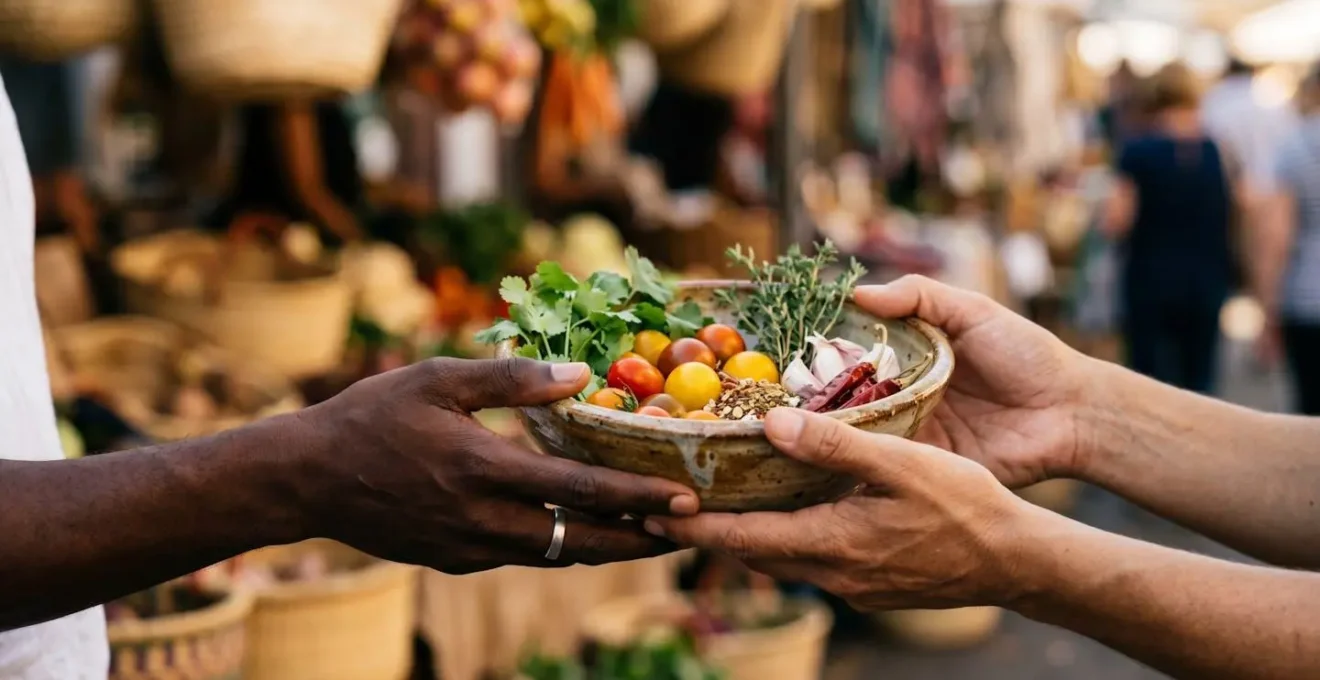
Connecting with local culture through food doesn’t require an adventurous palate—it requires a curious mind.
- Food is a cultural text you can learn to read, even without tasting every dish.
- Observing food systems, from markets to menus, reveals a culture’s values, economy, and daily rhythms.
Recommendation: Shift your focus from consumption to observation to unlock authentic cultural insights on your next journey.
The desire for authentic travel often leads us to a crossroads: the local food scene. For many, it’s a vibrant gateway to a new culture. But for others—the « non-foodies, » the picky eaters, those with allergies, or anyone who simply sees food as fuel rather than a hobby—this can feel like a barrier. The pressure to be an adventurous eater, to dive into mysterious dishes, can create more anxiety than connection. Mainstream travel advice often misses the point, offering platitudes like « just try everything! » or « eat where the locals eat, » without providing a practical framework for those who can’t or won’t.
This approach presumes that the only way to experience a culture through its food is by consumption. It positions culinary travel as a luxury reserved for those with fearless palates and iron stomachs. But what if this entire premise is flawed? What if the real secret to unlocking cultural understanding isn’t in the tasting, but in the observation? This is the essence of culinary anthropology: treating food not as a performance, but as a language. It’s about learning to read the story a culture tells through its ingredients, its markets, and its mealtime rituals.
This guide reframes culinary discovery. It’s not about what you put in your mouth, but what you see with your eyes and understand with your mind. We will explore how to decode food systems as a non-eater, navigate dietary restrictions without missing out, and determine what’s authentic versus what’s for show. You’ll learn that you don’t need to eat it to get it. You just need to know where to look.
This article will guide you through the essential strategies and mindsets to transform food from a travel hurdle into your most powerful tool for cultural connection. Explore the sections below to start your journey.
Summary: A Non-Foodie’s Path to Cultural Insight Through Food
- Why Do Culinary Discoveries Teach You More About a Place Than Guidebook Sights?
- How to Pursue Culinary Discoveries With Food Allergies or Limited Palates?
- Guided Food Tour or Self-Directed Culinary Discoveries: Which Teaches More?
- The Culinary Discovery Restaurant That Charges £40 for £5 Street Food
- When Should You Visit for Peak Culinary Discoveries Based on Seasonal Ingredients?
- Why Do Diverse Cultures Present a « Tourist Version » of Their Traditions?
- Community-Led or Commercial Tour: Which Local Culture Experience Is More Ethical?
- How to Verify if Gastronomic Specialities Are Genuine or Adapted for Tourists?
Why Do Culinary Discoveries Teach You More About a Place Than Guidebook Sights?
Monuments tell you what a culture values from its past, but its food tells you how it lives right now. A cathedral might stand for centuries, a testament to historical power and belief, but the local market is a living, breathing organism that reveals the daily pulse of a community. It’s here you see the economy in action, witness social interactions, and understand the agricultural realities shaped by geography and climate. This is why a growing number of travelers are realizing that food offers a more dynamic and immersive form of sightseeing. In fact, travel trend reports show that over 81% of travelers prioritize exploring local foods and cuisines as a central part of their itinerary.
Food is a cultural Rosetta Stone. A single dish can tell a story of migration (through imported spices), economic status (through the cut of meat), and religious tradition (through dietary restrictions). Observing what people eat, when they eat, and with whom they eat provides a window into social structures and family values that no museum plaque can fully convey. For example, the prevalence of communal dining tables in one culture versus private booths in another speaks volumes about social norms.
While a guidebook provides a curated list of « important » places, a culinary investigation allows for unscripted discovery. It turns a simple walk through a neighborhood into an anthropological field study. You’re not just a tourist ticking off a landmark; you are an observer decoding a living system. This approach moves you from a passive consumer of sights to an active participant in understanding a place. The knowledge gained is not just factual, but sensory and deeply contextual, making the connection to the place far more personal and memorable.
How to Pursue Culinary Discoveries With Food Allergies or Limited Palates?
For many, the idea of culinary discovery is fraught with anxiety. With nearly 33 million Americans affected by food allergies and countless others navigating dietary restrictions or simply a limited palate, the « try everything » approach is not just unhelpful—it’s impossible. However, this is where the shift from consumption to observation becomes a superpower. Your restrictions don’t have to be a barrier; they can be the very lens that sharpens your focus and deepens your investigation.
Instead of focusing on what you can’t eat, concentrate on what you can learn. This is the core of non-consumptive culinary discovery. Your mission changes from tasting to decoding. A food market becomes a living museum. A restaurant menu becomes a cultural document. You can learn just as much about a culture’s agricultural cycles, economic status, and social habits by observing the food system as you could by eating from it. This approach is not a consolation prize; it’s a legitimate and insightful method of travel.
Embracing this mindset opens up a world of activities that go beyond the plate. You can engage with producers, learn about history, and understand the context of food without ever taking a bite. This transforms a potential source of stress into an opportunity for a unique and profound connection with the place you’re visiting. Here are some practical strategies:
- Visit food-related museums and cultural institutions to learn about culinary history without tasting.
- Tour local farms, olive oil presses, or coffee plantations to understand production processes.
- Spend time observing at local supermarkets to see what ingredients locals purchase and how products are packaged.
- Attend cooking demonstrations or watch chefs prepare dishes to learn techniques and cultural context.
- Research ingredients and preparation methods specific to your dietary needs, turning restrictions into a deeper cultural investigation.
These actions allow for a rich, immersive experience, proving that a deep connection with a culture’s food is accessible to everyone, regardless of their dietary limitations. It’s about engaging your curiosity, not just your taste buds.
Guided Food Tour or Self-Directed Culinary Discoveries: Which Teaches More?
The choice between a structured guided tour and an independent exploration often feels like a trade-off between convenience and authenticity. A guided food tour offers a curated, narrative-driven experience. An expert guide can translate menus, explain historical context, and provide access to vendors you might otherwise overlook. For the non-foodie, this can be an invaluable introduction, removing the pressure of decision-making and language barriers. It provides a foundational vocabulary for understanding the local food scene.
However, the real learning often happens when you’re navigating the unknown on your own. Self-directed discovery forces you to become a more active observer. You learn to read non-verbal cues in a bustling market, decipher the logic of a menu layout, and make your own connections between the food you see and the life unfolding around you. This is where true culinary anthropology happens. It might be less efficient, but the insights gained through personal trial and error are often more profound and lasting.
Ultimately, the most effective approach may not be an « either/or » choice but a hybrid model. Combining both methods can offer the best of both worlds, providing a structured foundation followed by an opportunity for personal application.
Case Study: The Hybrid Immersion Approach
Educational travel programs for students abroad demonstrate the power of a combined approach. These programs often incorporate structured guided food experiences at the beginning of the trip. This allows students to gain cultural context and a basic culinary vocabulary from an expert. Armed with this knowledge, they are then encouraged to undertake independent explorations, applying what they’ve learned to navigate markets and eateries on their own. This hybrid model not only accommodates diverse dietary needs but also fosters genuine cultural engagement by empowering travelers to move from passive learning to autonomous discovery.
For the non-foodie traveler, starting with a guided tour can build confidence. But the ultimate goal should be to graduate to self-directed exploration, using your newfound knowledge to conduct your own sensory investigations.
The Culinary Discovery Restaurant That Charges £40 for £5 Street Food
One of the most confusing aspects of culinary travel is price. Why does one restaurant charge £40 for a dish that seems identical to the £5 version sold on the street corner? The non-foodie, focused on value and function, might see this as a scam. However, from a culinary anthropology perspective, the price difference itself is a rich source of cultural information. The two experiences are not offering the same product; they are offering entirely different « value stacks. »
The £5 street food stall offers authenticity and immersion. You are eating what locals eat, in the environment they eat in. The value is in the direct, unfiltered cultural experience. The preparation is transparent, but the hygiene standards are variable, and communication can be a challenge. You are paying for the food itself, and little else.
The £40 restaurant, on the other hand, is selling a different package. It’s selling comfort (climate control, seating, clean restrooms), service (English-speaking staff, table service), and, most importantly, a reduction of information asymmetry. The higher price is an insurance policy against uncertainty. It guarantees hygiene, explains the ingredients, and removes the risk of a transactional misunderstanding. It’s a curated, de-risked version of the local culture, tailored for an outsider. A look at the different components of value shows that you’re paying for much more than just the food.
| Value Component | Street Food ($5) | Tourist Restaurant ($40) |
|---|---|---|
| Food Quality | Authentic, local specialties | Modified for broader palates |
| Hygiene Guarantee | Variable, visible preparation | Strict health regulations, hidden kitchen |
| Cultural Context | Immersive, local environment | Curated storytelling, English explanations |
| Comfort & Amenities | Standing/basic seating, outdoor | Climate control, clean restrooms, table service |
| Language Barrier | Potential communication challenge | English menus, staff assistance |
| Information Asymmetry | High (unknown ingredients/safety) | Low (transparent, explained dishes) |
| Payment Method | Cash, local currency | Credit cards, multiple currencies |
Neither option is inherently « better. » They simply serve different needs. Understanding this allows you to make a conscious choice: are you seeking raw immersion or curated comfort? Recognizing what you are paying for—food, or a package of services around the food—is a key insight for any traveler.
When Should You Visit for Peak Culinary Discoveries Based on Seasonal Ingredients?
For the culinary anthropologist, timing is everything. Visiting a destination during its peak harvest season offers a direct connection to its agricultural rhythm and the most authentic version of its cuisine. When ingredients are at their freshest and most abundant, they are also at their cheapest and most widely used by the local population. This is when the true character of a region’s food culture shines brightest. A dish made with a sun-ripened tomato in August is a completely different cultural artifact than one made with a hothouse tomato in January.
But how do you identify this peak season? It requires a bit of pre-trip research into the local climate and key agricultural products. A simple search for « [region] harvest calendar » can be incredibly revealing. This knowledge allows you to plan your visit to coincide with festivals and markets celebrating the local bounty, from olive harvests in the Mediterranean to mango season in Southeast Asia. Some destinations even formalize this for travelers.
Case Study: The West Virginia Culinary Trail
In late 2023, the West Virginia Department of Tourism launched a statewide culinary trail. This initiative showcases top-tier restaurants and local food producers, connecting them in a way that highlights the state’s regional and seasonal offerings. This model demonstrates how travelers can be guided towards authentic seasonal experiences, connecting them with local farms, artisanal producers, and traditional cooking methods that are intrinsically tied to the time of year. It provides a roadmap for discovering the genuine taste of a place.
Even without a formal trail, you can use restaurant menus as your guide. A menu that changes frequently and highlights « daily specials » is a strong indicator that the chef is cooking with the seasons. Learning to read a menu for these clues is a crucial skill for any culinary detective.
- Look for « daily specials » or « chef’s selection » boards, which indicate dishes made with freshly available ingredients.
- Identify items marked as « seasonal » or « limited availability » as genuine indicators of the current harvest.
- Notice when dishes change between lunch and dinner service, suggesting reliance on daily market purchases.
- Ask servers which items are made with ingredients sourced that day or week from local suppliers.
- Compare the specials menu to the permanent menu—seasonal items reflect the local agricultural rhythm, while static dishes may use imported or preserved ingredients.
Why Do Diverse Cultures Present a ‘Tourist Version’ of Their Traditions?
Travelers often hunt for « authenticity, » only to feel disappointed when they suspect they’re being served a « tourist version » of a local dish. This is often perceived as a form of mild deception, a dumbing-down of the « real » culture. However, this interpretation misses a crucial anthropological point. The tourist version of a food isn’t necessarily a lie; it’s a cross-cultural conversation. It is a culture’s attempt to translate its flavors for an audience with a different palate, different expectations, and a different tolerance for risk.
This adaptation is often a direct response to tourist behavior. When travelers consistently ask for less spice, more familiar ingredients, or visible proof of Western-style hygiene, the market adapts. The « tourist food » phenomenon is not a one-sided act of commercialization; it’s a mirror reflecting the collective preferences and aversions of the tourists themselves. As one academic study notes, the adaptation is a practical response, not an inauthentic one.
Cultures adapt their food for tourists not out of deception, but in response to perceived tourist demands: less spice, more familiar ingredients, higher hygiene standards. The ‘tourist version’ is often a mirror reflecting the tourists’ own limited palate and risk aversion.
– Academic research study, Culinary Culture Shock: How Tourists Cope with Unexpected Flavours
Understanding this changes the dynamic. Instead of judging a dish as « inauthentic, » the culinary anthropologist asks, « What does this adaptation tell me? » It reveals a culture’s perception of outsiders, its economic reliance on tourism, and its willingness to code-switch to communicate. The existence of a « tourist version » alongside a « local version » is, in itself, a fascinating cultural data point. The challenge for the curious traveler is not to avoid the tourist version, but to learn to recognize it and understand why it exists.
Community-Led or Commercial Tour: Which Local Culture Experience Is More Ethical?
As travelers become more conscious of their impact, the ethics of tourism are coming into sharper focus. When it comes to culinary experiences, a key question arises: is it better to support a large, professional commercial tour company or a smaller, community-led initiative? There is no simple answer, as « ethical » can be defined in different ways—economic distribution, cultural preservation, and worker empowerment are all part of the equation.
Commercial tours often provide stable employment and adhere to standardized safety and service protocols. They can bring significant tourist dollars into an economy. However, the profits may be concentrated in the hands of a few owners, potentially international, and the cultural narrative may be scripted and sanitized to appeal to the widest possible audience. The experience, while smooth and professional, can sometimes feel performative.
Community-led tours, on the other hand, often promise a more direct economic benefit to the local population. Money is more likely to be distributed among local guides, family kitchens, and community projects. These experiences can offer a more unvarnished, personal perspective on the culture, as guides may have more freedom to share their own stories. However, they can also be less organized, with more variable standards of service and safety. The key is to look beyond the ownership model and ask deeper questions about agency and impact.
The ethical traveler’s job is to act as a discerning investor, using their travel budget to support models that foster local capacity and respect cultural agency. This means asking critical questions before booking any tour, whether it’s run by a slick global operator or a local family. The goal is to ensure that your curiosity isn’t contributing to exploitation but is instead supporting a sustainable and respectful exchange.
Key Takeaways
- Shift your travel mindset from « tasting » every dish to « observing » the entire food system as a form of cultural anthropology.
- Use non-consumptive methods like market visits, menu analysis, and observing producers to decode a culture’s values and daily life.
- Authenticity is often found where locals eat, identifiable by clues like single-language menus, a focus on seasonality, and a lack of « tourist-friendly » polish.
How to Verify if Gastronomic Specialities Are Genuine or Adapted for Tourists?
For the traveler seeking a genuine connection, the ultimate challenge is distinguishing between an authentic local dish and one that has been adapted for the tourist palate. This doesn’t require a sophisticated palate, but rather a sharp eye and a simple, repeatable method of investigation. The most powerful tools in your toolkit are the local supermarket and the lunchtime rush.
The « Supermarket Test » is your first step. Before you even think about dining out, visit a neighborhood supermarket—not one in a tourist hotspot, but one in a residential area. Observe what locals are actually buying. What vegetables are in season and piled high? What are the staple grains and proteins? This provides you with an objective, data-driven baseline of the local diet. Then, when you look at a restaurant menu, you can cross-reference. If the menu is full of ingredients you saw in local shopping carts, its authenticity is much more likely.
Case Study: Decoding Menus as Cultural Indicators
Research on restaurant accessibility shows that menu design is a reliable indicator of the target audience. Authentic local establishments often feature menus exclusively in the local language with minimal descriptions or photos. They serve a regular clientele who already knows the food. In contrast, tourist-oriented venues provide multilingual menus with glossy photos of every dish, detailed descriptions, and guidance on spice levels. While helpful, this very accessibility is a signal that the food has likely been adapted for tourist expectations rather than maintaining traditional preparation methods.
The second technique is the « Lunchtime Litmus Test. » Find simple eateries packed with local workers or students during their lunch break. These places thrive on regular, local customers and have no incentive to cater to tourist tastes. Observe what people are ordering from the often-handwritten, daily-changing menu. This is the real, everyday food of the culture. These two methods, combining observation and strategic timing, provide a reliable framework for any traveler to become an effective authenticity detective.
Your 5-Step Authenticity Audit: A Practical Checklist
- Points of Contact: Identify key observation points for your fieldwork. Prioritize neighborhood supermarkets, worker canteens during lunch hour, and morning food markets away from the main tourist squares.
- Collecte: Inventory the local staples. Take mental or physical notes of the top 5 most purchased vegetables, grains, and proteins you see locals buying for their homes.
- Coherence: Cross-reference your findings with restaurant menus. Ask yourself: does the ‘special of the day’ or ‘plat du jour’ reflect the seasonal ingredients you saw locals buying?
- Mémorabilité/Emotion: Spot the « tourist tells. » Look for red flags like multilingual photo menus and staff soliciting customers on the street, versus green flags like handwritten, local-language boards and a clientele of regulars.
- Plan d’Intégration: Prioritize your culinary plan. Build your « must-observe » or « must-try » list around eateries and dishes that passed your coherence and authenticity checks, focusing on places that serve the community.
By applying this anthropological lens, you transform every meal, market, and menu into an opportunity for genuine insight. Your next trip doesn’t have to be a stressful culinary challenge. Instead, it can become your most rewarding cultural investigation yet.
Frequently Asked Questions on How Can Non-Foodies Use Culinary Discoveries to Connect With Local Culture?
Where does the money from the tour actually go?
Research whether revenue supports individual tour operators, international companies, or is distributed among local suppliers, guides, and community initiatives. Community-led tours often reinvest profits in local infrastructure and cultural preservation, while commercial operations may provide more stable employment but concentrate ownership.
Do local guides have narrative control over the stories they tell?
The key ethical differentiator isn’t the ownership structure but whether guides have the freedom to share nuanced, authentic stories, including cultural complexities and challenges, rather than performing sanitized, romanticized versions required by commercial scripts.
Does the tour model foster local capacity or create dependency?
Evaluate whether the tour operation trains local residents in hospitality skills, preserves traditional food knowledge through partnerships with heritage organizations, or creates situations where communities become dependent on tourist income without developing sustainable alternative economic opportunities.