The belief that a checklist of « dos and don’ts » guarantees respectful travel is the biggest myth preventing authentic connection.
- Genuine engagement stems from an internal mindset of mindful observation, not a memorized list of rules.
- Authenticity is found in understanding the « why » behind cultural norms, not just performing the « what. »
Recommendation: Shift your focus from fearing mistakes to cultivating curiosity and learning to read the subtle social cues that signal whether your presence is truly welcomed or merely tolerated.
The desire to connect with diverse cultures is a powerful driver for modern travel. You book a trip not just to see new landscapes, but to experience a different way of life, to share a moment of genuine human connection that transcends language and background. Yet, this desire is often shadowed by a persistent anxiety: « What if I do something wrong? » You’ve heard the horror stories—the unintentional insults, the cultural blunders, the feeling of being an intruder. The common advice is to learn a few phrases, cover your shoulders, and avoid certain topics, but this superficial approach often feels like walking on eggshells, replacing genuine interaction with a performance of respect.
This approach misses the fundamental point. The difference between cultural appreciation and appropriation, between being a welcome guest and an tolerated customer, isn’t about perfectly executing a set of rules. It’s about your internal disposition. The real work of respectful travel happens before you even speak a word; it’s in cultivating a mindset of deep listening, mindful observation, and genuine curiosity. It’s about understanding that culture is not a product to be consumed, but a living, breathing system to be respectfully witnessed.
But what if the key wasn’t about avoiding faux pas, but about developing the sensitivity to navigate them gracefully when they inevitably occur? This guide moves beyond the simplistic checklists. It provides a framework for developing the internal skills necessary to engage with diverse cultures authentically. We will explore the reasons behind the « tourist-facing » traditions, learn how to research norms with the depth of an anthropologist, and, most importantly, learn how to read the unspoken language of a community to understand the true nature of your welcome.
To help you navigate this complex but rewarding journey, this article breaks down the essential skills and mindset shifts required for truly authentic travel. The following sections provide a clear path from preparation to deep, respectful engagement.
Summary: A Framework for Authentic Cultural Engagement
- Why Do Diverse Cultures Present a « Tourist Version » of Their Traditions?
- How to Research Cultural Norms for Diverse Cultures Beyond « Don’t Wear Shoes Indoors »?
- Guided Cultural Tour or Self-Directed Learning: Which Deepens Understanding of Diverse Cultures?
- The Insensitive Behavior That Locals in Diverse Cultures Find Most Disrespectful
- How Can You Tell if Your Visit to Diverse Cultures Is Welcomed or Tolerated?
- Which Local Culture Gestures and Phrases Show Genuine Respect Versus Performative Tourism?
- The Attitude Problem That Makes Local Communities Resent Foreign Travellers
- How Deep Should You Engage With Local Culture to Be Respectful, Not Intrusive?
Why Do Diverse Cultures Present a « Tourist Version » of Their Traditions?
When you witness a cultural performance that feels a bit too polished or a craft that seems conveniently packaged for sale, you’re likely encountering what’s known as « staged authenticity. » This isn’t necessarily a deceitful practice but a complex response to the pressures of tourism. For many communities, tourism provides a vital economic lifeline. Presenting a simplified, digestible, and scheduled version of a tradition—what can be called the « tourist version »—is often a pragmatic way to meet visitor expectations while generating income. A ritual that might traditionally span days is condensed into a 30-minute show, and intricate spiritual meanings are simplified into a brief narration.
This staging also serves a protective function. The most sacred, intimate, or complex aspects of a culture are often not for public consumption. Presenting a simplified version for tourists allows a community to keep its core traditions, beliefs, and private ceremonies intact, safe from misunderstanding or commodification. This « front stage » performance, as sociologist Erving Goffman would call it, creates a buffer, preserving the sanctity of the « back stage » where true cultural life unfolds away from the tourist gaze.
Understanding this dynamic is the first step toward authentic engagement. Instead of judging a performance as « inauthentic, » a mindful traveler recognizes it as a complex negotiation between economic need and cultural preservation. The goal is not to force your way into the « back stage » but to appreciate the « front stage » for what it is and to seek out interactions that exist outside of this purely transactional framework. These moments are often found not in the paid performance, but in the unscripted conversations that happen before or after.
How to Research Cultural Norms for Diverse Cultures Beyond « Don’t Wear Shoes Indoors »?
Moving beyond superficial guidebooks requires adopting the mindset of a cultural anthropologist, focusing on understanding the ‘why’ behind the ‘what’. Generic advice like « dress modestly » is a starting point, but it lacks the depth to foster genuine respect. Why is modesty valued in this context? Does it relate to religious beliefs, social hierarchy, or concepts of public versus private space? Answering these deeper questions transforms a rule you follow into a cultural value you understand and respect. This deeper research prevents you from simply mimicking behavior and allows you to act with genuine consideration.
To achieve this, focus on primary sources and insider perspectives. Instead of relying solely on travel blogs, seek out literature, films, and documentaries produced by people from the culture you plan to visit. Read local news outlets (translated online) to understand current events and public sentiment. This approach provides an emic perspective—the insider’s view—which is far more valuable than the etic (outsider) interpretations found in most travel guides. It helps you understand a culture on its own terms, appreciating its nuances and complexities rather than viewing it through a foreign lens.
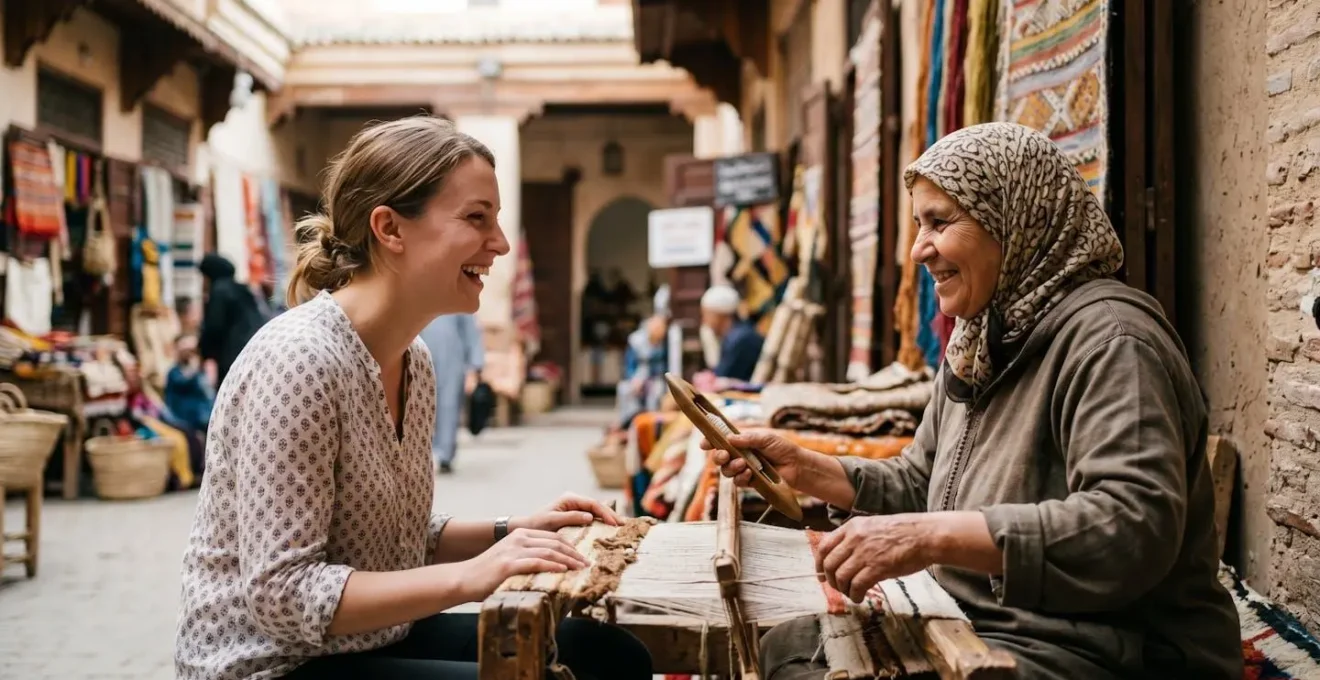
This deeper research is not about becoming an expert overnight, but about cultivating a baseline of informed curiosity. It’s about knowing enough to ask better, more respectful questions and to observe with greater understanding. The image below represents the heart of this process: paying attention to the practice and skill embedded in a culture, rather than just its final product.
When you appreciate the years of practice behind the hands weaving a textile or shaping pottery, you move from a consumer to a respectful witness. Your research should aim to build this same appreciation for the unseen social and historical fabric of the community you are about to enter.
Action Plan: Your Pre-Travel Cultural Research
- Go Beyond Guides: Supplement travel guides with novels, poetry, and films from local creators to grasp emotional and cultural subtext.
- Understand the ‘Why’: For every social norm you learn (e.g., gift-giving etiquette), research its underlying value (e.g., reciprocity, social status).
- Follow Local Voices: Use social media to follow artists, journalists, and community leaders from your destination to get a feel for contemporary issues and daily life.
- Learn Historical Context: Research major historical events from the last century. Understanding a nation’s recent struggles and triumphs provides crucial context for its present.
- Map Out Sacredness: Identify not just the famous temples, but the concepts, figures, or times of day that are considered sacred or private to avoid unintentional disrespect.
Guided Cultural Tour or Self-Directed Learning: Which Deepens Understanding of Diverse Cultures?
The choice between a guided tour and independent exploration presents a classic traveler’s dilemma. A guided tour offers structure, efficiency, and access to sites you might otherwise miss. A knowledgeable guide can provide historical context and translate nuances you wouldn’t catch on your own. However, traditional tours can also insulate you, keeping you within a « tourist bubble » that moves from one designated sight to the next, often interacting only with other tourists and professional guides. The experience, while informative, can lack the spontaneity that leads to genuine connection.
On the other hand, self-directed learning offers unparalleled freedom and the potential for serendipitous encounters. By navigating public transport, eating at local, non-tourist restaurants, and simply getting lost, you open yourself up to unscripted interactions. This path demands more effort, preparation, and a higher tolerance for uncertainty. The risk is that without context, you may misinterpret what you see or inadvertently cause offense. True understanding requires a foundation of knowledge, which is why the principle of cultural relativism is so vital.
Cultural relativism — understanding a culture on its own terms without applying external judgments.
– Cultural Anthropology Research, Vaia.com
A third, and often more effective, option is emerging: community-based tourism. These experiences, often developed and led by locals themselves, combine the best of both worlds. They provide the structure and access of a guided tour but are rooted in authentic, daily life rather than staged performances. This model ensures that your visit directly benefits the community financially and fosters interactions built on mutual respect rather than a simple commercial transaction.
Case Study: The Rise of Community-Based Immersion
A significant shift in the travel industry highlights a move toward more authentic experiences. According to market analysis, in 2024, 39% of Asia-Pacific tour operators launched community-based cultural packages that focus on direct engagement. These programs integrate travelers into local life through activities like craft workshops and shared culinary heritage, with 36% of rural destinations adopting this model. This approach not only provides a deeper, more genuine cultural exchange but also ensures economic benefits are retained within the host community, moving beyond the traditional tour model.
The Insensitive Behavior That Locals in Diverse Cultures Find Most Disrespectful
While specific gestures or dress code violations can cause offense, the most profound disrespect often stems from a single, overarching attitude: treating a culture as a commodity. This happens when a traveler views a place and its people as a backdrop for their personal experience—a checklist of sights to be seen, photos to be taken, and stories to be collected. This consumerist mindset reduces sacred rituals to entertainment, complex histories to simplified narratives, and people to props in a vacation album. It is the root cause of the behavior that generates the most resentment in local communities.
This attitude manifests in several ways: haggling aggressively over a handmade craft that took weeks to create, ignoring posted rules at a sacred site to get the « perfect » photo, or treating a religious ceremony as a spectacle to be loudly narrated or filmed. It’s the assumption that your payment grants you unlimited access and the right to consume every aspect of the culture. This behavior contributes directly to what sustainable travel experts call the degradation of local quality of life. The constant feeling of being on display, of having one’s home and traditions treated as an amusement park, erodes goodwill and fosters deep-seated frustration.
As Sustainable Travel International notes, this can escalate quickly: » This disparity fosters resentment among residents, escalating social tensions as they feel tourism degrades their quality of life. » The most respectful act a traveler can perform is to recognize that they are a guest in someone else’s home, not a customer in a theme park. This means accepting that some places are off-limits, some moments are private, and some traditions are not for sale or for your camera. It’s about exercising restraint and appreciating that the most meaningful experiences are often the ones you witness, not the ones you capture.
Observing with respectful distance, as shown above, is often more powerful than intrusive participation. It signals that you understand the value of the space and are not there to conquer it, but to honor it.
How Can You Tell if Your Visit to Diverse Cultures Is Welcomed or Tolerated?
In a world where, according to recent data showing that 56% of all travel is focused on cultural heritage, the line between a genuine welcome and polite tolerance can be incredibly fine. Many communities depend on tourism and have mastered the art of professional hospitality. A smile might be part of a job, and a « thank you » can be a transactional courtesy. Discerning the difference requires moving beyond words and learning to read the subtle, non-verbal « reciprocity signals » that indicate a genuine connection.
A tolerated presence is often characterized by purely transactional interactions. Conversations are brief, functional, and rarely stray from the business at hand. Eye contact may be fleeting, and smiles, while polite, don’t quite reach the eyes. You might feel a sense of being processed—efficiently served, but kept at arm’s length. The interaction ends cleanly once the transaction is complete. In these situations, your presence is accepted because of the economic benefit it brings, but it hasn’t broken through the professional barrier into a personal one.
A genuine welcome, however, feels different. It is marked by curiosity. Locals might ask you questions about your home, your family, or your journey—not as a script, but out of real interest. Body language is more open and relaxed. A transactional smile might be replaced by a shared laugh. You may receive a small, unprompted gesture of kindness: an extra piece of fruit at the market, a helpful tip not found in any guidebook, or an invitation to continue the conversation. These are « reciprocity signals »—small signs that your respectful curiosity has been noticed and is being returned in kind. This is the shift from being a spectator to a participant, even in a small way.
Which Local Culture Gestures and Phrases Show Genuine Respect Versus Performative Tourism?
Memorizing a few local phrases like « hello » and « thank you » is a common piece of travel advice, but the line between using them respectfully and performatively is thin. Performative usage is often about the traveler, not the local. It’s saying « hello » loudly in a restaurant to show other tourists you’ve done your homework, or using a gesture incorrectly but with great confidence. These actions can come across as a caricature, a superficial display that highlights your otherness rather than bridging a cultural gap. As anthropologists often note, good intentions do not always translate to respectful actions.
Genuine respect, in contrast, is demonstrated through mindful observation and humble application. Instead of performing the one phrase you know, listen first. How do people greet each other? Is it verbal or a simple nod? Is it loud or quiet? Watch the rhythm and flow of interactions before attempting to join in. A quiet, correctly timed nod of acknowledgement can show far more respect than a boisterous, mispronounced greeting. The goal is not to prove you know a word, but to show you’ve paid enough attention to understand its context.
The same principle applies to gestures. Many cultures have complex systems of non-verbal communication, where a simple hand movement can have vastly different meanings. Rather than trying to master a dozen gestures from a YouTube video, focus on observing what is universally understood: a gentle smile, an open posture, and patience. When in doubt, a slight bow or nod of the head is a gesture of humility and respect in many cultures. The most genuine sign of respect is not a flawless performance of local customs, but the visible effort to observe, learn, and adapt with humility.
The Attitude Problem That Makes Local Communities Resent Foreign Travellers
Beyond isolated incidents of rude behavior, the most corrosive attitude that fosters resentment in local communities is a sense of entitlement. This is the unspoken belief that because you are a paying tourist, the destination and its people should adapt to your needs, expectations, and comfort levels. It’s an attitude that places the traveler’s desires above the daily lives and well-being of the residents. This entitlement can be subtle, but its effects are profound and are a major driver of the negative impacts of overtourism.
This attitude manifests when travelers complain that shops close at normal local hours, that a festival is too loud, or that not everyone speaks their language. It’s the expectation of seamless, frictionless service, even in a place with completely different infrastructure and cultural rhythms. As one analysis on overtourism points out, » The constant presence of tourists can lead to frustration or resentment among locals. » When a community feels its own customs and quality of life are being judged and devalued by visitors, a « we versus them » mentality inevitably develops.
This resentment is often compounded by tangible economic and social pressures. While tourism brings money, it can also lead to overloaded infrastructure, rising housing costs that push out long-term residents, and the privatization of public spaces. When locals feel they are being priced out of their own homes and that their towns are becoming unlivable to cater to a constant influx of visitors, their initial welcome can easily curdle into resentment. The « attitude problem » is thus not just about individual arrogance; it’s about a collective failure of the tourism industry and travelers to recognize that a destination is first and foremost a home, not a service provider.
Key Takeaways
- Authentic travel begins with self-awareness and a willingness to be an observer before becoming a participant.
- True respect is demonstrated through quiet adaptation and mindful observation, not loud or flawless performances of local customs.
- The ultimate goal is to seek invited participation based on mutual curiosity, moving beyond the role of a passive consumer.
How Deep Should You Engage With Local Culture to Be Respectful, Not Intrusive?
The question of how deeply to engage is not about finding a specific « level » of interaction, but about adopting an ethical framework to guide your actions. There is no universal rule for how much engagement is « enough » or « too much. » The appropriate depth is situational and is best navigated by applying principles from cultural anthropology: transparency, impact awareness, and profound respect for cultural nuances. The goal is not to « go deep » for the sake of a story, but to engage in a way that is mutually respectful and leaves a positive or neutral impact.
As a guiding principle, let your engagement be led by invitation. Genuine engagement is rarely forced; it unfolds naturally when a host community extends an offer. This invitation might be as simple as a gesture to join a game or as significant as an offer to share a family meal. Your role is to be open and ready for these invitations but to never demand or assume them. This requires patience and the ability to read social cues. If you sense any hesitation or discomfort, it is your responsibility to gracefully retreat. This demonstrates that you respect their boundaries more than you desire an « experience. »
Ultimately, the right depth of engagement is one that is comfortable for both you and your hosts. A guide on ethics in anthropology states that it involves » considering the potential impact of one’s research on the community, being transparent…and being respectful. » For a traveler, this means being honest about your intentions (you are a visitor, not a new resident) and constantly assessing your impact. Are you contributing to the scene or disrupting it? Are you taking more than you are giving—not in money, but in energy and social space? The most respectful travelers understand that sometimes, the deepest form of engagement is to simply watch from a distance, appreciate the moment for what it is, and leave it undisturbed.
Start your next journey by applying this framework of mindful observation, ethical engagement, and genuine curiosity to transform your travel from a simple visit into a meaningful and respectful connection.