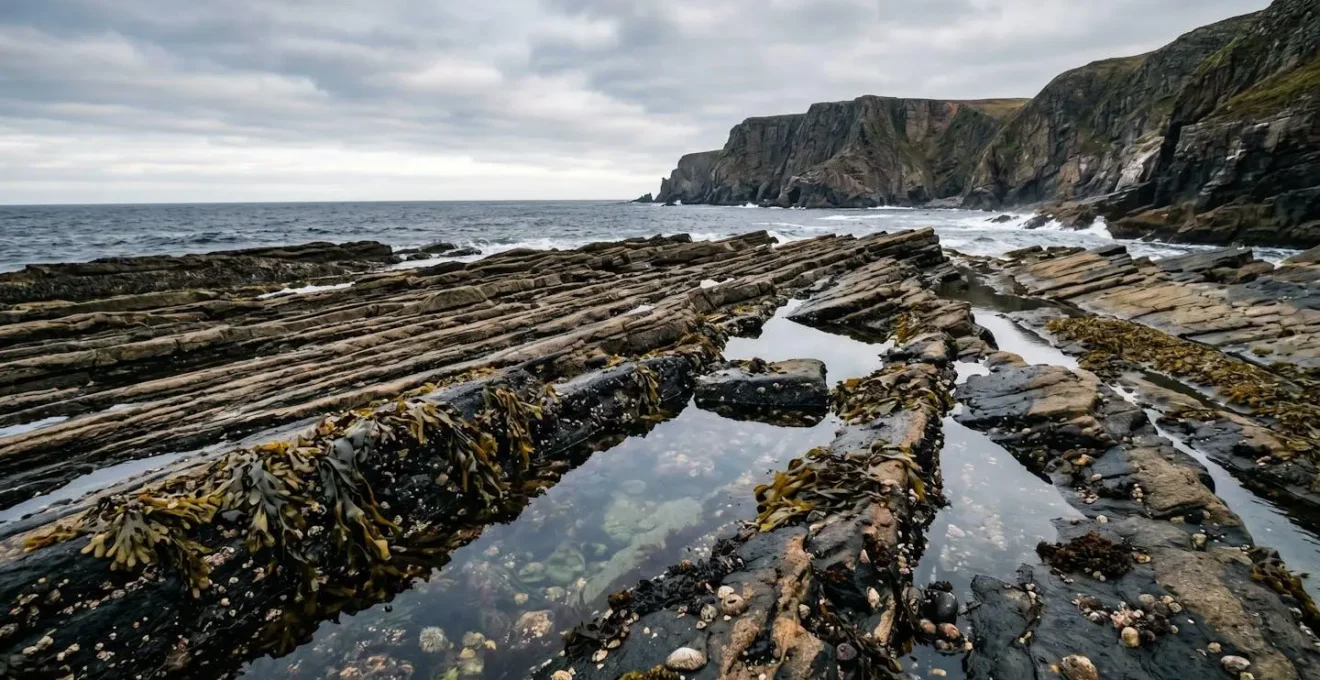
Most coastal visits remain superficial, focused on photos rather than understanding. The real magic, however, lies in developing ‘seascape literacy’—the ability to read the coast as a dynamic story of geology, biology, and physics. This guide provides the foundational skills to decode these stories, transforming you from a passive observer into an active interpreter of the rich, interconnected systems at play on any shoreline.
For many, a trip to the coast is an exercise in capturing beauty. We take photos of crashing waves, dramatic cliffs, and stunning sunsets. We might look for interesting shells or watch a distant seabird. But this approach often only scratches the surface, treating the seascape as a static, beautiful backdrop. It’s like admiring the cover of a book without ever learning to read the story inside.
The common advice— »be careful of tides, » « watch for wildlife »—is essential but incomplete. It maintains a separation between us and the environment. But what if the key wasn’t just to *look* at the coast, but to learn how to *read* it? The true wonder of a seascape lies in its nature as a dynamic manuscript, constantly being written and rewritten by the forces of geology, biology, and weather. Understanding this language transforms a simple walk on the beach into an intellectual adventure.
This guide is your primer in seascape literacy. We will move beyond simple observation to active interpretation. We’ll explore how to decipher the biodiversity in a single tide pool, recognise millions of years of history in a rock face, and understand how your presence can contribute to conservation, turning every coastal visit into a profound connection with the natural world.
Summary: Decoding the Stories Written on the Shoreline
- What Can Seascapes’ Tide Pools Teach You About Ocean Biodiversity?
- How to Recognize 5 Million Years of Geology in Seascapes’ Rock Formations?
- Which UK Seascapes Offer the Best Seal, Puffin, and Dolphin Sightings?
- The Tidal Misjudgment That Traps 100+ People Annually in UK Seascapes
- When Do Seascapes Reveal the Most Marine Life and Geological Features?
- How to Apply Leave No Trace in Wilderness Areas Beyond « Pack Out Your Rubbish »?
- The Forecast Ignorance That Traps Hikers in Extraordinary Landscapes
- How Can Your Visit to Wilderness Areas Help Conservation Instead of Harming It?
What Can Seascapes’ Tide Pools Teach You About Ocean Biodiversity?
At first glance, a tide pool is a simple puddle of seawater left behind by the receding ocean. But to the trained eye, it’s a bustling, miniature metropolis—a complete ecosystem packed with drama, competition, and extraordinary biodiversity. These small basins are one of the most accessible classrooms for learning the principles of marine ecology. The sheer density of life is staggering; research analyzing 116 intertidal rock pools worldwide found anywhere from 11 to 68 different types of organisms (taxa) in each pool. This is the ‘why’ behind the ‘wow’—not just a pretty pool, but a concentrated hub of life.
The key to reading a tide pool is understanding the concept of vertical zonation. The organisms you see are not scattered randomly; they are arranged in distinct bands based on their ability to tolerate exposure to air and sun. This natural organisation creates visible layers of life on the rocks.
As marine biology experts Castro & Huber explain, this elegant structure is a direct response to the physical stresses of the intertidal zone. The higher up the rock, the more an organism is exposed during low tide.
Zonation in the intertidal is due to varying degrees of exposure. The upper (or high) intertidal is the most exposed. The lower intertidal is least exposed.
– Castro & Huber, BIO 131 Lab Manual – Biodiversity in an Intertidal Marine Ecosystem
You’ll find tough, resilient barnacles and periwinkles in the upper « splash zone, » while more delicate sea anemones, starfish, and sponges thrive in the lower zones, which remain submerged for longer. Learning to spot these zones transforms a chaotic jumble of creatures into a logical, structured community.
How to Recognize 5 Million Years of Geology in Seascapes’ Rock Formations?
If tide pools are a lesson in biology, the cliffs and rocks are a masterclass in deep time. Every layer, crack, and colour in a coastal rock formation is a chronological clue—a page from Earth’s diary. Learning to read this geological manuscript begins with understanding a simple principle: not all rocks are created equal. Softer sedimentary rocks, like clays and shales, erode quickly, creating gentle slopes, bays, and beaches. Harder igneous or metamorphic rocks, like granite and basalt, resist the ocean’s assault, forming dramatic headlands, sea stacks, and arches.
This simple binary of hard versus soft rock explains the fundamental shape of a coastline. Are you standing in a wide, sandy bay or on a rocky, exposed point? The answer is a direct reflection of the underlying geology. The interplay between rock type and erosion is the primary author of the coastal landscape you see today. Recognizing this allows you to move from passive appreciation to active geological interpretation.
By observing these features, you can start to piece together a story that spans millions of years. A single headland can reveal a saga of volcanic activity, tectonic uplift, and relentless erosion.
Case Study: The Story of Oregon’s Basalt Headlands
Iconic features like Yaquina Head and Cape Lookout on the Oregon Coast are not random formations. They are the remnants of massive underwater basalt flows that occurred 15-17 million years ago. This molten rock pushed into ancient estuaries. Over millions of years, the surrounding, softer sedimentary rocks eroded away, but the incredibly hard basalt resisted. What remains today are the dramatic headlands that jut out into the sea, a direct, visible legacy of volcanic events from the Miocene epoch.
This is seascape literacy in action. The headland is no longer just a « big rock »; it’s a testament to ancient lava flows and the patient, powerful force of erosion. Every cliff face tells a similar story, waiting to be read.
Which UK Seascapes Offer the Best Seal, Puffin, and Dolphin Sightings?
Wildlife sightings are often a highlight of any coastal trip, but they are rarely a matter of pure luck. They are a function of the interconnected systems of geology, oceanography, and biology. The best places to see marine wildlife are where these systems create abundant food and safe shelter. For example, the dramatic cliffs you learned to read in the previous section are not just geological wonders; they are high-rise apartments for vast colonies of seabirds.
In the UK, certain locations have become famous for their reliability. The Farne Islands in Northumberland are a prime example. Between May and July, wildlife surveys show that they are home to over 40,000 nesting puffins, alongside colonies of guillemots, razorbills, and a significant population of grey seals. Further north, the Moray Firth in Scotland is one of the best places in Europe to spot bottlenose dolphins from shore. But these hotspots are fragile. Understanding them also means understanding their vulnerability. According to the 2023 Seabirds Count census, the UK has seen a devastating loss, with 23% of Puffins lost in just 20 years, making responsible viewing more critical than ever.
Your ability to read the seascape enhances the experience. Knowing that seals « haul out » on specific rock shelves at low tide to rest and digest, or that dolphins often feed on rising tides that bring fish closer to shore, turns your observation from a passive wait into a strategic search. You begin to understand that wildlife behaviour is tied to the landscape and the rhythm of the tides, a crucial piece of seascape literacy.
The Tidal Misjudgment That Traps 100+ People Annually in UK Seascapes
The tide is the metronome of the coast, a rhythmic pulse that dictates life in the intertidal zone and governs safety for human visitors. Yet, a fundamental misunderstanding of its power and speed leads to hundreds of rescue incidents each year. The title’s statistic, while shocking, illustrates a critical failure in seascape literacy: underestimating the physical force represented by the tide chart. It’s one thing to know the time of low tide; it’s another to understand that a « gentle » incoming tide can fill a flat, mile-wide bay faster than a person can walk, cutting off escape routes.
The most common trap is tidal cut-off. A visitor, engrossed in exploring a distant headland or a beautiful stretch of sand, fails to notice the water silently filling in a channel between them and the main beach. What was a clear path minutes before becomes an impassable, and often dangerous, waterway. This isn’t malice on the ocean’s part; it’s predictable physics that must be respected.
True tidal awareness goes beyond a quick glance at a tide app. It involves observing the landscape itself. Are there large, wet expanses of sand far from the current water line? That’s a sign of a large tidal range and a fast-moving tide. Are there V-shaped channels in the sand? Water will pour through those first. Reading these signs is as crucial as reading the tide chart. To prevent becoming a statistic, a proactive safety mindset is essential.
Your Action Plan: Safe Tidal Exploration
- Plan Your Timing: Target low tides of less than 0.5 feet that occur during daylight hours. The lower the tide, the more is revealed and the greater your safety margin. Start exploring as the tide is going out, and plan to be heading back well before it turns.
- Be Wave Wise: Never turn your back on the ocean. The coastal environment is unpredictable, and « sneaker waves » can appear suddenly, even on calm days. Always maintain a visual on the sea.
- Watch Your Step: Intertidal rocks are notoriously slippery, especially those covered in seaweed. Plan each footstep carefully on bare rock surfaces to avoid falls and to protect the delicate life underfoot.
- Know Your Exit: Before you venture out onto a beach or around a headland, identify your exit route. Look back frequently to ensure it remains clear as the tide comes in.
- Carry a Watch and a Tide Chart: Do not rely on your phone, which can lose battery or signal. A simple watch and a printed tide chart for the specific location are your most reliable tools.
When Do Seascapes Reveal the Most Marine Life and Geological Features?
The question of « when » to explore the coast has a simple answer and a complex one. The simple answer is: at low tide. This is the moment the sea draws back its curtain, revealing the secrets of the intertidal zone. The lower the tide, the more is revealed. Specifically, the lowest tides of the month, known as spring tides (which have nothing to do with the season), occur during the full moon and new moon. These are the premium times for any aspiring seascape reader, exposing areas of the shore that are usually deep underwater.
However, the more complex and fascinating answer is that the seascape is a « dynamic manuscript » that changes not just twice a day, but across seasons and even decades. The « when » of your visit determines which chapter you get to read. A winter visit might reveal the raw power of the ocean, with storm waves rearranging the beach and exposing geological features hidden under sand all summer. A spring visit showcases the breeding season for seabirds and the first blooms of coastal flowers. It is a constantly evolving narrative.
This long-term change is the subject of serious scientific study, turning tide pools into crucial barometers for planetary health. The work done at places like Stanford’s Hopkins Marine Station, which has maintained daily monitoring since the 1920s, provides an invaluable long-term record.
The 1995 Science paper reported these data indicated rising average summer surface temperatures and changing tidepool populations – consistent with climate change predictions and observations in other ecosystems.
– Stanford Doerr School of Sustainability, The world in a tidepool research summary
This adds a profound dimension to your observation. When you look into a tide pool, you are not just seeing a snapshot of today, but a living indicator of global change. The types and abundance of species you see are a data point in a story that spans generations, making your mindful observation a connection to a much larger scientific narrative.
How to Apply Leave No Trace in Wilderness Areas Beyond « Pack Out Your Rubbish »?
True seascape literacy extends beyond reading the environment to understanding how to write your own presence upon it responsibly. The « Leave No Trace » principle is often reduced to « pack out what you pack in, » but in the fragile and crowded intertidal zone, our impact is far more subtle and significant. Every step, every overturned rock, and every touch can have consequences for the delicate organisms that live in this high-stress environment.
The goal is to be a ghost: to observe and learn while leaving the ecosystem as undisturbed as if you were never there. This requires a deeper level of awareness and a specific set of ethical guidelines tailored to this unique environment. The core idea is to minimize stress on creatures that are already dealing with pounding waves, intense sun, and constant threats from predators. Your visit should not be another stressor they have to endure.
The National Oceanic and Atmospheric Administration (NOAA) provides an excellent framework for ethical tide pooling that goes far beyond just packing out your rubbish. These are not just suggestions; they are best practices for anyone who truly respects the marine life they are privileged to observe. Key guidelines include:
- Find footholds on bare rocks. Surfaces covered in seaweed, barnacles, or mussels are not just slippery; they are living communities. Stepping on them can crush hundreds of tiny organisms. Stick to the bare rock to minimize your impact.
- If you peek under a rock, put it back. Gently place it back exactly as you found it. The underside of a rock is a dark, damp refuge for countless creatures like crabs, worms, and juvenile fish. Exposing them to the sun and air can be a death sentence from dehydration or predation.
- Leave all animals, plants, and shells. Do not collect anything, not even « empty » shells, which are often used as homes by hermit crabs or are broken down to become part of the sand. In many areas, collecting intertidal species is also illegal.
Adopting these habits is the ultimate expression of respect for the environment. It’s the practical application of your growing knowledge, ensuring these incredible miniature worlds can be enjoyed by others and continue to thrive.
The Forecast Ignorance That Traps Hikers in Extraordinary Landscapes
The final element of seascape literacy is learning to read the sky and the atmospheric story it tells. Coastal weather is notoriously fickle; a calm, sunny morning can devolve into a gale with blinding rain in a matter of minutes. To ignore the weather forecast on the coast is to willingly read a book with a crucial chapter ripped out. It’s not just an inconvenience; it’s a serious safety risk that demonstrates a profound disconnect from the environment you are in.
The power of coastal weather is difficult to comprehend until you see its work etched into the landscape itself. The wind and waves are not just ephemeral forces; they are the primary sculptors of the coastline. Understanding the forecast is about understanding the power that is actively shaping the cliffs, beaches, and headlands in front of you. This is especially true during storm events, whose immense energy can alter landscapes overnight.
Case Study: The Unseen Power of Storm Waves
Scientific research using wave-tank experiments has demonstrated the incredible force of storm waves. Far from just moving sand, these waves can produce what are known as « imbricated coastal boulder deposits. » This means they can pick up, move, and stack boulders weighing tens or even hundreds of tonnes, moving them considerable distances inland. This phenomenon is a stark illustration of the extreme power unleashed by coastal storms and why heeding weather warnings for such events is not optional.
For the coastal explorer, the forecast is your guide to both safety and opportunity. It tells you when to seek shelter and when conditions are perfect for observation. A forecast for high winds might make a cliff-top walk dangerous, but it could also create a spectacular display of wave action against a resistant headland—best viewed from a safe distance. Learning to correlate the forecast with the landscape is a high-level skill. It’s about looking at the wind speed and direction and predicting where the sea spray will be thickest, where the waves will be most dramatic, and where you can find a sheltered cove to continue your exploration.
Key takeaways
- Read, Don’t Just Look: Shift your mindset from passive viewing to active interpretation. The coast is a story written in geology, biology, and physics.
- Systems Are Interconnected: Geology dictates where life can thrive, tides dictate when you can see it, and weather dictates the safety and mood of the entire experience. They are not separate subjects.
- Ethics Are Essential: True appreciation includes deep respect. Advanced Leave No Trace principles are not optional; they are a core part of responsible exploration that ensures these ecosystems survive our curiosity.
How Can Your Visit to Wilderness Areas Help Conservation Instead of Harming It?
We have journeyed from the micro-scale of a tide pool to the macro-scale of geology and weather. The final piece of the puzzle is you. How can your presence, armed with this new literacy, become a positive force for conservation? The answer lies in transforming your newfound interest into meaningful action. When you understand the complexity and fragility of these ecosystems, the desire to protect them becomes a natural consequence.
Your visit matters on a global scale. Many coastal areas are not just locally important but are critical habitats for worldwide populations, such as the UK hosting up to 50% of the world’s grey seals. Your responsible behaviour contributes directly to the health of these globally significant populations. This is the ultimate « why » behind seascape literacy: the deeper you understand, the more you care. This connection between interest and biodiversity is not just anecdotal; it’s a documented psychological phenomenon.
Multiple dimensions of biodiversity drive human interest in tide pool communities, providing the first direct experimental link between the functional emotion of interest and biodiversity.
– Nature Scientific Reports, Multiple dimensions of biodiversity drive human interest in tide pool communities
This scientific finding confirms the entire premise of this guide. Learning to see the different life forms, geological stories, and ecological patterns literally makes the experience more interesting, which in turn fuels a desire to learn more and to protect what you’ve come to appreciate. You can channel this interest by participating in citizen science projects (like beach cleans or wildlife surveys), sharing your knowledge with others, and advocating for the protection of these vital spaces. Your journey into seascape literacy doesn’t end when you leave the beach; it begins a lifelong cycle of learning, appreciation, and stewardship.
Start today by choosing one aspect of seascape literacy—perhaps identifying the zones in a single tide pool on your next coastal walk—and begin your journey of reading the rich, beautiful, and endlessly fascinating story of the shore.