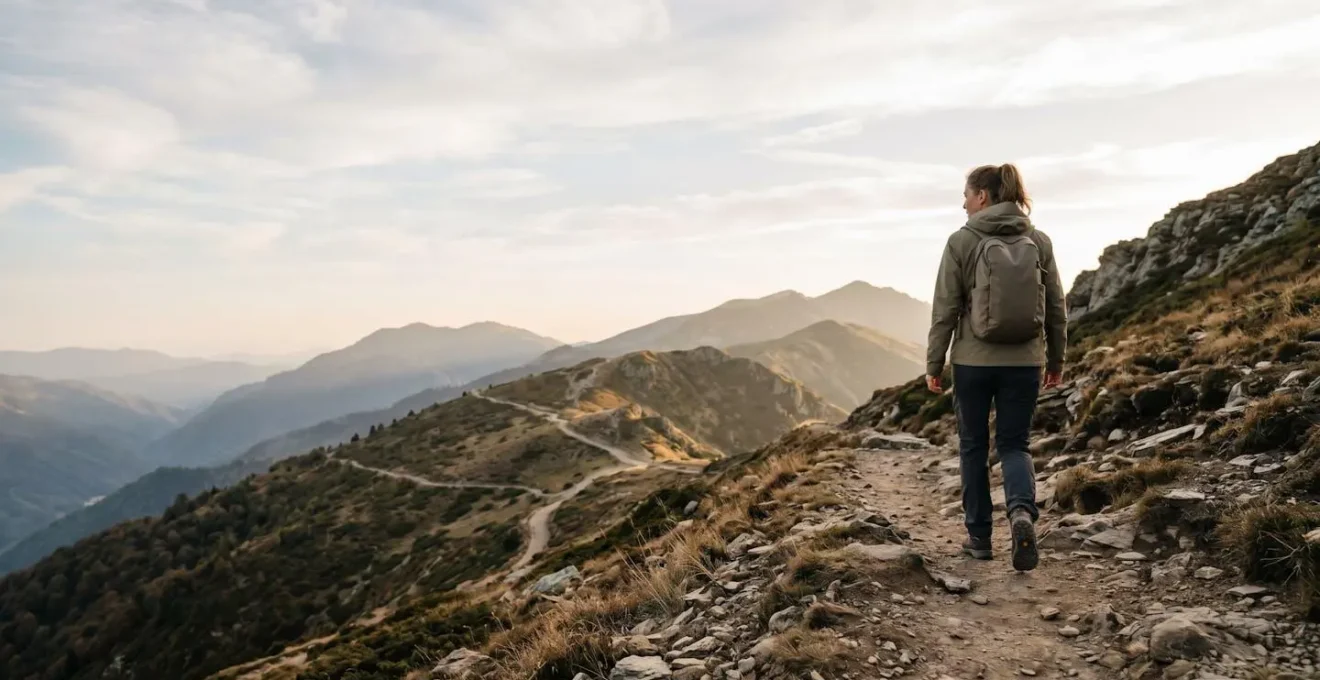
The common belief that vacations derail fitness progress is a myth; in reality, they are a unique opportunity to accelerate it.
- Travel naturally boosts your metabolism through increased Non-Exercise Activity Thermogenesis (NEAT) from exploration and movement.
- Unpredictable outdoor environments provide a more effective, full-body workout than sterile, repetitive gym settings.
Recommendation: Shift your mindset from « fitness maintenance » to « strategic acceleration » by planning holiday activities that challenge your body and mind in new ways.
The familiar feeling for many health-conscious travelers is a subtle dread that mixes with the excitement of an upcoming trip. You return from a week of well-deserved pleasure feeling rested, yet also sluggish, out of sync, and a step behind in your fitness goals. The conventional advice is often a compromise: try to find a hotel with a gym, squeeze in a morning run before sightseeing, or pack resistance bands. These are attempts to superimpose a rigid home routine onto a dynamic travel experience, and they often fail.
But what if this entire premise is flawed? What if the vacation itself, with its unique environment and rhythm, isn’t a threat to your fitness but is actually a more potent tool for progress than your structured workouts at home? The key isn’t to fight against the holiday environment, but to strategically embrace it. By understanding the powerful physiological and psychological principles at play, you can transform your travels from a potential setback into your most effective training camp of the year.
This guide will deconstruct this paradigm shift. We will explore the science behind why outdoor activities on holiday can be more effective than gym workouts, identify the best activities for maximum gain with moderate fitness, and establish a framework for balancing intense activity with crucial rest. Finally, we will outline a clear path for progressing from simple day trips to rewarding multi-day wilderness adventures, turning your wanderlust into a powerful engine for physical transformation.
To help you navigate this new approach, this article is structured to guide you from foundational principles to practical application. The following sections break down everything you need to know to make your next trip a milestone in your fitness journey.
Summary: A Strategic Guide to Leveraging Holiday Travel for Peak Fitness
- Why Do Outdoor Activities During Travel Accelerate Weight Loss Compared to Home Exercise?
- Which Outdoor Activities Can You Safely Attempt With Moderate Fitness Levels?
- Active Holiday or Rest Days: What Ratio of Outdoor Activities Prevents Exhaustion?
- The Ankle Sprain That Ruins 20% of Hiking Holidays for Unprepared Travelers
- Which Outdoor Activities Work the Most Muscle Groups for Maximum Fitness Gain?
- Why Do 50% of First-Time Wilderness Adventures End in Early Retreat?
- How to Calculate Food and Water Needs for 5 Days in Remote Locations?
- How Can Beginners Transition From Day Hikes to Multi-Day Wilderness Adventures?
Why Do Outdoor Activities During Travel Accelerate Weight Loss Compared to Home Exercise?
The reason travel can be a powerful fitness accelerator lies in two key concepts often overlooked in standard fitness advice: environmental stimulus and metabolic amplification. A typical gym offers a controlled, predictable environment. A treadmill’s surface is flat, the temperature is stable, and the resistance is constant. Your body adapts to this efficiency, learning to perform the same movement with the minimum possible energy. In contrast, outdoor activities during travel are the antithesis of predictable. Hiking on a trail, swimming in a lake, or even walking on a cobblestone street introduces constant, subtle variations in terrain, incline, and resistance.
This environmental stimulus forces your body’s smaller, stabilizing muscles to engage continuously. Every step on an uneven path requires micro-adjustments for balance, recruiting more muscle fibers and burning more calories than a step on a perfectly flat surface. Wind resistance adds another layer of challenge that a climate-controlled gym simply cannot replicate, forcing your body to work harder to produce the same forward motion. This constant, varied engagement is a form of functional training that builds real-world strength and endurance far more effectively than isolated machine exercises.
The second, and perhaps more significant, factor is the amplification of Non-Exercise Activity Thermogenesis (NEAT). NEAT is the energy expended for everything we do that is not sleeping, eating, or formal exercise. It includes walking to a café, exploring a museum, or carrying groceries. At home, for many, this is minimal. During travel, it skyrockets. You walk for hours, exploring new cities and landscapes. This dramatic increase in low-intensity movement creates a massive caloric deficit that scheduled exercise alone rarely achieves. The difference can be staggering; according to obesity medicine research, NEAT can vary by up to 2,000 kcal/day between individuals, making it a critical, yet hidden, engine for weight management.
Which Outdoor Activities Can You Safely Attempt With Moderate Fitness Levels?
With a new understanding of why outdoor activity is so effective, the next step is choosing the right ones. For someone with a moderate fitness level—perhaps you exercise 2-3 times a week but aren’t an elite athlete—the goal is to find activities that offer a high fitness benefit without an overwhelming technical skill requirement or risk of injury. The key is to challenge your body, not to overwhelm it. Activities like stand-up paddleboarding or kayaking are excellent examples.
These water-based activities provide a full-body workout with minimal impact on the joints. Stand-up paddleboarding, for instance, is a masterclass in core strength and balance. Simply staying upright on the board engages your legs, back, and abdominal muscles continuously. This creates a state of constant, low-level muscle activation that builds phenomenal stability and endurance. It’s a workout that is impossible to replicate on a machine.
This image captures the essence of such an activity: focused, balanced, and deeply engaging with the natural environment.
To help you make strategic choices, it’s useful to think in terms of a risk vs. reward framework. An activity’s « reward » is its fitness benefit, while its « risk » involves the technical skill required and the potential for injury. The following table provides a clear guide for activities suitable for moderate fitness levels, helping you select the perfect challenge for your holiday.
| Activity | Technical Skill Required | Fitness Benefit | Impact Level |
|---|---|---|---|
| Walking/Light Hiking | Low | Moderate Cardio | Very Low |
| Trail Running | Low | High Cardio | Moderate |
| Kayaking | Moderate | Upper Body + Core | Low |
| Stand-Up Paddleboarding | Moderate | Full Body Balance | Very Low |
| Cycling (Flat Paths) | Low | Cardiovascular | Low |
| Swimming (Natural Water) | Moderate | Full Body | Very Low |
| Rock Climbing | High | High Strength + Core | Moderate |
Active Holiday or Rest Days: What Ratio of Outdoor Activities Prevents Exhaustion?
The temptation on an active holiday is to go all-out every day. You have limited time and a long list of things to see and do. However, this approach is a fast track to exhaustion, overtraining, and even injury. The secret to a successful and energizing active holiday lies in adopting a concept from professional athletics: periodization and active recovery. Instead of viewing days as either « on » or « off, » think in terms of high-intensity and low-intensity days.
A smart ratio for a one-week trip is 2:1 or 3:1 of active days to active recovery days. For example, you might plan two days of challenging hikes followed by a day of light, restorative activity. This « active recovery » day isn’t about sitting in a hotel room; it’s about engaging in gentle movement that promotes blood flow, reduces muscle soreness, and still allows you to explore. Think a leisurely swim, a gentle cycling tour on flat ground, or a long walk through a city market. This approach allows your body to repair and adapt, coming back stronger for the next high-intensity day.
This isn’t just folk wisdom; it’s a scientifically-backed training principle. As experts in sports medicine note, planned recovery is not a sign of weakness but a cornerstone of sustainable performance. UCHealth Sports Medicine experts explain this principle clearly:
Athletes who follow a seasonal training program may need to adopt a process called periodization, which incorporates pre-scheduled recovery days and even recovery weeks throughout the year.
– UCHealth Sports Medicine, Rest and Recovery for Athletes: Physiological and Psychological Well-Being
To implement this on your trip, pre-plan your active recovery days and have a list of enjoyable, low-intensity options ready. This ensures you’re making a conscious choice to recover, rather than feeling guilty for « taking a day off. » Options could include leisurely nature walks, swimming in a hotel pool, or a gentle yoga session with a view. The goal is movement, not intensity.
The Ankle Sprain That Ruins 20% of Hiking Holidays for Unprepared Travelers
Nothing brings an active holiday to a halt faster than a preventable injury. Among hikers and trail runners, the ankle sprain is the most common culprit, a direct result of the body being unprepared for the increased proprioceptive demands of uneven terrain. Proprioception is your body’s « sixth sense »—its ability to perceive its position, movement, and balance in space. On a flat sidewalk or a gym floor, this sense is rarely challenged. On a rocky, root-filled trail, it’s working overtime.
When you step on an unstable rock, your ankle’s nerves, muscles, and ligaments must react in milliseconds to prevent a roll. If they aren’t trained for this rapid response, they fail, and a sprain is the result. This is why individuals who are « fit » in a gym setting can still be highly susceptible to injury in the wild. Their strength is often linear and specific to certain machines or movements, lacking the multi-directional stability required for outdoor environments. Preparing for this challenge doesn’t require complex equipment; it requires specific, targeted exercises that « bulletproof » your ankles by improving their proprioceptive feedback loop.
The preparation should begin weeks before your trip. Integrating a simple routine of balance and stabilization exercises can dramatically reduce your risk of injury. This isn’t about building massive muscle; it’s about re-educating the neuromuscular pathways that protect your joints. By dedicating just a few minutes each day, you build the resilience needed to tackle challenging terrain with confidence.
Your Action Plan: Pre-Trip Ankle Bulletproofing Protocol (4-Week Routine)
- Week 1-2: Start with single-leg balance exercises, holding for 30 seconds per leg in 3 sets daily on a stable, flat surface to build a foundation.
- Week 2-3: Progress to an unstable surface by performing balance work on a wobble board, foam pad, or even a folded towel to challenge stabilizers.
- Week 3-4: Introduce dynamic movements such as controlled single-leg toe touches and gentle lateral hops to train the ankle’s reaction time.
- Throughout: Perform calf raises (15 repetitions, 3 sets) to strengthen the key muscles in your lower legs that support the ankle joint.
- Throughout: Enhance mobility with ankle alphabet exercises, using your big toe to trace the letters A through Z in the air.
Which Outdoor Activities Work the Most Muscle Groups for Maximum Fitness Gain?
For the traveler focused on fitness efficiency, the goal is to choose activities that deliver a « compound » workout, engaging multiple muscle groups simultaneously. This is where outdoor activities have a distinct advantage over many gym-based routines that isolate individual muscles. The most effective activities are those that combine elements of cardiovascular work, strength, and balance into a single, fluid motion. They create a functional fitness that translates directly into real-world capability.
Activities like swimming in open water, trail running, and rock climbing are prime examples. However, two of the most accessible and effective full-body workouts are kayaking and stand-up paddleboarding (SUP). These activities are far more than just a leisurely paddle. They are dynamic, engaging workouts that target the entire body. For instance, studies show that kayaking burns approximately 385 calories per hour for an average person, but the benefit goes far beyond calorie burn. The act of paddling is a powerful upper-body and core exercise, engaging the lats, shoulders, biceps, and obliques with every stroke. Simultaneously, your legs and core are constantly working to stabilize the boat in the water.
Stand-up paddleboarding takes this concept even further. As research on the activity has demonstrated, it provides a workout that engages the back, obliques, and legs simultaneously just to maintain balance. The act of paddling adds the upper body component, creating a true full-body exercise. This type of integrated, multi-joint movement is superior to isolated gym exercises because it trains muscles to work together as a coordinated system, improving overall strength, stability, and endurance. It’s the ultimate expression of turning a fun holiday activity into a high-performance training session.
Why Do 50% of First-Time Wilderness Adventures End in Early Retreat?
The dream of a multi-day wilderness adventure—of self-sufficiency under a canopy of stars—is a powerful motivator. Yet, for many first-timers, this dream dissolves into a premature retreat within the first 24 to 48 hours. The reasons are rarely as dramatic as a bear encounter or getting lost. Instead, failure typically stems from two subtle but powerful saboteurs: a psychological mismatch of expectations and a physical mismatch of energy expenditure versus intake.
Psychologically, the reality of the wilderness can be a shock. The Instagram-perfect vista is often preceded by hours of grueling uphill climbs, pesky insects, and the mental fatigue of constant decision-making. The lack of modern comforts—a soft bed, a hot shower—wears down morale faster than many anticipate. When the perceived effort vastly outweighs the immediate reward, the motivation to continue plummets.
Physically, the error is even more fundamental. Beginners consistently and drastically underestimate the sheer number of calories their bodies burn while hiking with a heavy pack, especially in challenging terrain or weather. They pack food based on their at-home appetite, not their on-trail energy needs. This creates a rapidly growing energy deficit. Within a day, this deficit manifests as profound fatigue, poor decision-making, and a loss of physical and mental stamina. At its most extreme, this energy imbalance has severe consequences; extreme expeditionary research documents body weight loss of up to 25% in unsupported polar journeys due to massive, sustained energy deficits. While a weekend trip won’t be this severe, the underlying principle is the same: without enough fuel, the engine stops.
How to Calculate Food and Water Needs for 5 Days in Remote Locations?
Solving the energy deficit problem that plagues so many first-time adventurers requires a shift from casual estimation to methodical calculation. « Packing enough food » is not a strategy; it’s a guess. A strategic approach involves calculating your specific caloric needs based on your body, your activity level, and your environment. This ensures you are carrying the precise amount of fuel needed for peak performance, plus a safety margin.
The foundation of this calculation is your Basal Metabolic Rate (BMR), which is the number of calories your body burns at rest. This is your baseline. To this, you must add the calories burned during the activity itself—hiking with a pack can consume 400-600 calories per hour. Finally, you must apply an environmental multiplier. Your body burns significantly more calories to stay warm in the cold or to function at high altitudes. Forgetting this multiplier is a common and critical error.
Water calculation follows a similar logic of baseline plus activity. You need a baseline for personal hydration and cooking, then factor in availability. Will you be crossing reliable, filterable water sources, or do you need to carry your entire supply? The following step-by-step method provides a robust framework for calculating your needs for a multi-day trip, turning a dangerous guess into an informed plan.
- Step 1: Calculate your Base Metabolic Rate (BMR) using a standard formula like the Harris-Benedict equation, which accounts for your age, weight, and sex.
- Step 2: Estimate your activity calories by multiplying the number of hours you plan to hike by a conservative activity factor (e.g., 450 kcal/hour for moderate hiking).
- Step 3: Apply an environmental multiplier, adding 10-20% more calories for cold weather conditions and 15-25% for high altitudes above 8,000 feet.
- Step 4: Sum your total daily needs by adding BMR + Activity Calories + Environment Adjustment to get your total daily caloric requirement.
- Step 5: Multiply this daily total by the trip duration (e.g., 5 days) and then add a 10-20% safety buffer for unexpected delays or exertion.
For water, a common rule of thumb is to plan for 2-3 liters for personal hydration plus 1 liter for cooking per person, per day, adjusting downwards based on the number of reliable, filterable water sources you have confirmed on your route.
Key takeaways
- Leverage NEAT (Non-Exercise Activity Thermogenesis) by embracing walking and exploration; it’s a powerful calorie-burning engine.
- Prioritize activities on varied, uneven terrain (trails, sand) over flat surfaces to challenge more muscles and improve stability.
- Integrate « active recovery » days (light swimming, gentle walks) into your itinerary to prevent overtraining and promote adaptation.
How Can Beginners Transition From Day Hikes to Multi-Day Wilderness Adventures?
The leap from a comfortable day hike—ending with a hot meal and a warm bed—to a self-sufficient multi-day trek can feel intimidatingly large. The key to bridging this gap is not to take a single leap, but to walk across a series of well-placed stepping stones. This progressive framework builds skills, confidence, and gear familiarity in a controlled, low-risk sequence. Each step is a self-contained success that prepares you for the next, more challenging stage.
This journey begins with mastering the day hike. Before even thinking about overnight gear, become proficient in navigation, pacing, and understanding your body’s needs over a 4-8 hour period. The next logical step is to test your gear not in the remote wilderness, but in a completely controlled environment like your own backyard. This allows you to discover that your new sleeping pad is faulty or your stove is difficult to operate without the consequence of being miles from your car. As Outdoor Active Gears aptly puts it, backpacking adds the complex challenge of carrying all your gear, which demands both fitness and meticulous preparation.
Only after mastering these foundational stages should you progress to your first overnight trip. This methodical progression transforms a daunting goal into a manageable, exciting project. It replaces anxiety with competence, ensuring that when you finally embark on your first true multi-day adventure, you are not just hoping for success—you have systematically prepared for it.
Your Action Plan: The 5 Stepping Stones to Wilderness Progression
- Stepping Stone 1: Master day hikes by completing 5-10 treks of increasing difficulty and length (4-8 miles) to build baseline fitness, test footwear, and hone navigation skills.
- Stepping Stone 2: Conduct a backyard or local park campout to test your entire gear system—shelter, sleeping bag, and cooking setup—in a safe, controlled environment.
- Stepping Stone 3: Use car-camping as a basecamp, setting up a secure camp accessible by vehicle and undertaking progressively longer day hikes from this fixed location.
- Stepping Stone 4: Embark on a one-night « out-and-back » trip. Hike 3-5 miles to a destination, camp for the night, and return on the same trail the next day to simplify logistics.
- Stepping Stone 5: Plan your first two-night point-to-point trip, which requires different entry and exit points and forces full self-sufficiency for 48 hours.
Stop seeing your holidays as a liability to your fitness and start planning them as your ultimate asset. By applying these strategic principles, you can return from your travels not just refreshed, but measurably stronger, fitter, and more resilient. Your next adventure is your next breakthrough.