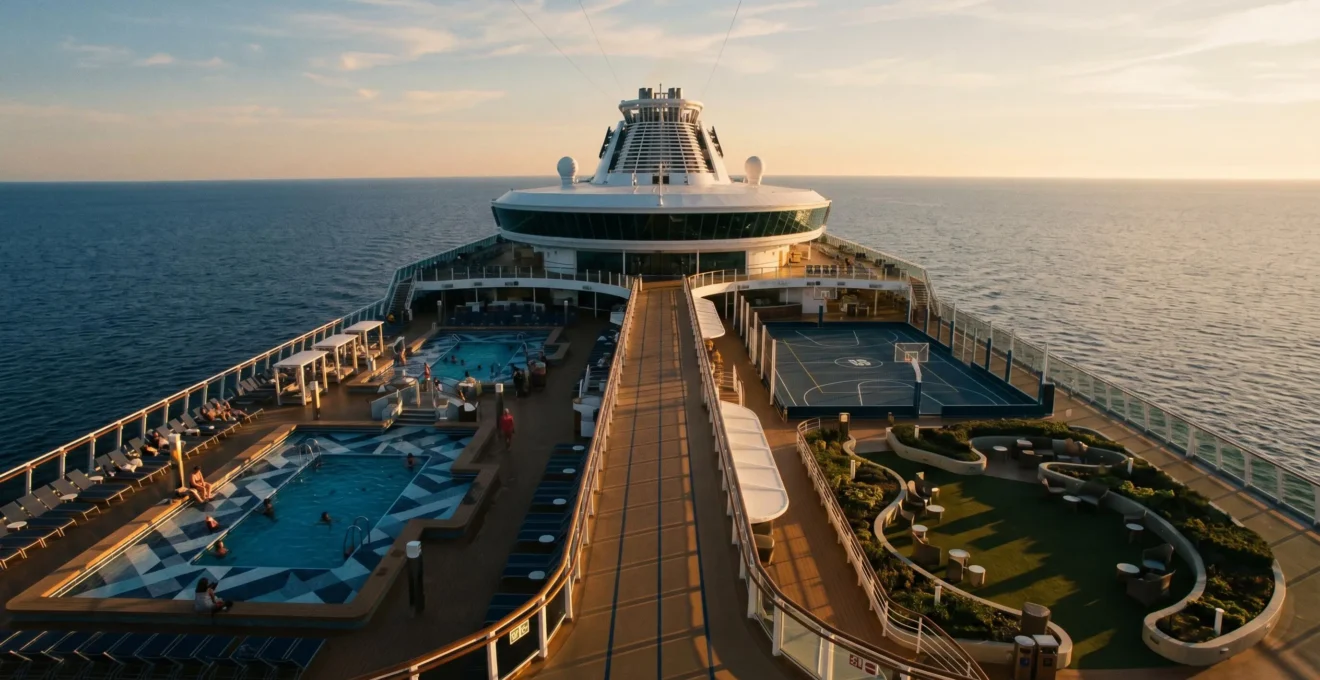
The true value of a cruise is not in its advertised price, but in your ability to strategically utilize its amenities to generate a high-value experience that rivals more expensive land-based holidays.
- Most cruisers follow the crowd, leading to over-priced extras and crowded facilities, which drastically lowers their vacation ROI.
- By adopting a contrarian schedule and understanding the ship’s operational rhythm, you can access popular amenities like pools and slides with virtually no one else around.
Recommendation: Stop thinking like a passenger and start thinking like an investor in your vacation. The key is not to do more, but to do the right things at the right time.
For the cost-conscious traveller, the central question of cruising is one of value. Does a £500 cruise that inflates to £1,200 with extras truly offer a better return on investment than a land-based holiday? The typical answer involves a vague reference to « all-inclusive » perks, drink packages, and sprawling buffets. This approach, however, completely misses the point and often leads to disappointment and budget overruns.
The conventional wisdom—to pre-purchase every package and try every single activity—is a trap. It leads to what we can call ‘package fatigue,’ an obligation to extract value that turns leisure into a checklist. The true, and far more rewarding, path lies in a radical mindset shift. It requires you to stop being a passive consumer and start acting as a strategist, viewing the billion-dollar ship not as a floating hotel, but as a complex asset whose resources can be optimized.
The secret to unlocking exceptional value is not in spending more, but in understanding the ship’s economy and crowd dynamics. It’s about leveraging timing and information to create a luxury, crowd-free experience. This guide is not a list of money-saving tips; it’s a strategic framework for maximizing your ‘amenity ROI’ and proving that a well-planned cruise can deliver value that far exceeds its final cost.
This article will deconstruct the onboard economy and provide you with a strategic playbook. You will learn to identify hidden value, bypass crowds, evaluate upgrades with an investor’s eye, and ultimately transform your cruise experience from a game of chance into a masterpiece of value optimization.
Summary: A Strategic Guide to Cruise Amenity Value
- Which Onboard Amenities Are Free and Which Cost Extra on Modern Cruises?
- How to Sample All Onboard Amenities on a 7-Day Cruise Without Exhaustion?
- Thermal Spa Pass or Standard Pool: Which Onboard Amenities Upgrades Are Worth £200?
- The Timing Mistake That Means 400 People at the Onboard Amenities Pool Simultaneously
- Should You Reserve Onboard Amenities Like Specialty Dining and Spa Before Boarding?
- Why Does Cruise Travel Costing £500 End Up Being £1,200 After Extras?
- Which Port of Call Stops Are Skippable for Onboard Relaxation Days?
- What Do First-Time Cruise Travel Passengers Need to Know to Avoid Rookie Mistakes?
Which Onboard Amenities Are Free and Which Cost Extra on Modern Cruises?
The first step in any value optimization strategy is to create a clear inventory of your assets. On a cruise ship, this means separating the genuinely free amenities from the up-charges masquerading as part of the experience. The advertised fare covers a surprising number of high-value activities, but the business model is built on tempting you with premium extras. A strategist knows the difference and uses the included offerings to their fullest before even considering an upgrade.
Most passengers are aware of the free main dining room and buffet. However, the real hidden value lies in the amenities that are included but under-utilized. On many Royal Caribbean ships, for instance, activities like the FlowRider surf simulator, rock climbing walls, and even ice skating sessions are part of your fare. These are experiences that would carry a significant cost on land. The key is to identify this « free » column and build your schedule around it, treating paid extras as deliberate, calculated splurges rather than default choices.
To provide a clear framework, this table breaks down the typical division between free and premium amenities on a modern mega-ship. Use it as a baseline to audit any cruise line’s offerings.
| Category | Free Amenities | Premium/Paid Amenities | Typical Cost |
|---|---|---|---|
| Dining | Main Dining Room, Windjammer buffet, Café Promenade, Sorrento’s pizza, Dog House | Specialty restaurants (steakhouse, Italian, sushi, hibachi) | $25-$110 per person |
| Beverages | Water, basic coffee, tea, juice, lemonade (at select venues) | Specialty coffee, alcoholic drinks, sodas, premium beverages | $4-$15 per drink |
| Entertainment | Broadway shows, ice shows, dive shows, live music, movies, dance parties, trivia | Specialty shows with reserved seating, some interactive experiences | Varies by ship |
| Activities | Pools, waterslides, FlowRider, rock wall, zip line, mini golf, sports court, gym access | Thermal spa suite, fitness classes (yoga, Pilates, spin), spa treatments | $10-$50 per class/$100-$200 per cruise spa pass |
| Youth Programs | Adventure Ocean for ages 3-17, teen lounges, supervised activities | Babysitting services (group or in-cabin) | $6-$12 per hour |
Beyond this table, seek out the truly « hidden » freebies. Many cruisers miss out on free sauna and steam rooms in the gym (separate from the paid thermal suite), cooking demonstrations that include samples, and the simple pleasure of borrowing a book from the ship’s library. Maximizing these zero-cost assets is the foundation of a high-ROI cruise.
How to Sample All Onboard Amenities on a 7-Day Cruise Without Exhaustion?
The short, strategic answer is: you don’t. The rookie cruiser, driven by a Fear of Missing Out (FOMO), creates a frantic itinerary to « get their money’s worth » by doing everything. The strategist, however, understands the concept of package fatigue and practices the Joy of Missing Out (JOMO). The goal isn’t to sample *all* amenities, but to curate a select few high-value experiences that deliver maximum enjoyment without burnout.
This principle is perfectly illustrated by the challenge of dining on a mega-ship like Icon of the Seas, which boasts over 20 dining venues. A reporter who purchased an Unlimited Dining Package found that the pressure to maximize its value turned dining into a nightly chore. Instead of spontaneous enjoyment, each meal became an obligation. The strategic lesson is profound: on ships with extensive options, the highest value comes from targeted selection, not exhaustive sampling. Booking two or three specialty meals that you’re genuinely excited about will always yield a higher ‘enjoyment ROI’ than a package that dictates your every evening.
The same logic applies to activities. Instead of rushing from the rock wall to the mini-golf course to the flowrider, a strategist groups activities by location and predicts crowd flow. You might dedicate a morning to the sports deck and an afternoon to the pool, with ample downtime in between. The objective is to replace frantic activity with purposeful leisure. This requires a small amount of pre-cruise planning to identify your ‘must-do’ experiences, leaving room for spontaneity and relaxation.
Thermal Spa Pass or Standard Pool: Which Onboard Amenities Upgrades Are Worth £200?
Evaluating an upgrade like a thermal spa pass requires you to think like an investor calculating ROI, not a vacationer making an impulse purchase. The question isn’t « is it nice? » but « does it deliver value proportional to its cost? » A £200 thermal suite pass may seem steep, but when you break it down, the value proposition can become surprisingly compelling. The key metric is cost-per-hour-of-enjoyment.
A single 60-minute massage can cost £150 or more, offering a high-cost, low-duration experience. In contrast, a thermal suite pass grants you unlimited access for the entire voyage. If you use it for two hours every day on a 7-day cruise, your cost is roughly £14 per hour for a serene, exclusive environment with heated loungers, saunas, and steam rooms. This often compares favourably to the « free » but crowded main pool, where the value is diminished by noise and competition for chairs.
One frequent cruiser’s experience perfectly encapsulates this strategic calculation:
A frequent cruiser who tested thermal suite access found it ‘one of the best splurges’ made during an itinerary. She enjoyed heated loungers with her book every afternoon, often resulting in a nap, and felt the purchase was worthwhile because she could enjoy the spa amenities every day of the cruise. In contrast, single spa massages lasting only 60 minutes provided far less cumulative value. Her strategy: thermal suite passes offer better cost-per-hour-of-enjoyment compared to one-time treatments.
– Frequent Cruiser Experience
The decision framework is simple: if you are someone who will genuinely use the facility daily as a sanctuary from the bustle of the ship, the thermal suite pass offers tremendous value density. It’s an investment in tranquility. If, however, you’re likely to only visit once or twice, the money is better allocated elsewhere. Always assess upgrades based on your personal ‘utilization forecast’.
The Timing Mistake That Means 400 People at the Onboard Amenities Pool Simultaneously
The single most common mistake cruisers make is moving with the herd. They wake up at the same time, eat at the same time, and flock to the pool deck at the same time—typically between 10 am and 3 pm on a sea day. This creates a low-value, high-stress environment. The strategist knows that the ship operates on predictable rhythms and leverages this knowledge through a technique we call Crowd Flow Arbitrage: being where the crowds are not.
On a mega-ship, the difference is staggering. The pool deck that feels like a chaotic public pool at 11 am is a serene, private oasis at 8 am. Based on experienced cruiser observations, it’s confirmed that before 9am, the pool area is virtually empty. This gives you hours of peaceful enjoyment of a multi-million dollar facility, completely free. The « cost » is simply waking up a little earlier. This is the essence of high-ROI cruising: trading a small, easy action for an exponentially more valuable experience.
This contrarian approach applies to all popular amenities. The waterslides have no queues when they first open. The gym is quiet during peak dinner times. The buffet is calm during the first and last 30 minutes of service. By simply shifting your schedule by an hour or two from the norm, you can fundamentally change your experience. Here is a tactical schedule for dodging the crowds:
- Pool Deck: Visit before 10am or after 4pm. The quietest time is often during the first dinner seating (around 5:30pm-7pm).
- Water Slides & Attractions: Go immediately after they open on a port day, or during popular show times or dinner hours. The worst time is mid-afternoon on a sea day.
- Embarkation Day: Pack your swimsuit in your carry-on and head straight to the pool or slides while everyone else is finding their cabin or eating lunch. The amenities are open but underused.
- Dining: If you have ‘Anytime’ dining, go at the very beginning or end of service to avoid a wait. On sea days, have an early breakfast and a late lunch.
Should You Reserve Onboard Amenities Like Specialty Dining and Spa Before Boarding?
The decision to pre-book amenities is a classic strategic trade-off between securing savings and maintaining flexibility. Cruise lines heavily incentivize pre-booking through their online portals, often offering significant discounts compared to onboard prices. For a strategist, the default position should be to book high-priority, limited-capacity items in advance, especially if a discount is offered.
Specialty dining is a prime example. Cruise lines can offer up to 40% savings on packages booked online versus onboard. Waiting until you board not only costs more but also runs the risk of your desired restaurant or time slot being fully booked. The same applies to popular spa treatments, fitness classes, and show reservations. These are finite resources, and on a ship with thousands of passengers, demand often outstrips supply.
Case Study: Norwegian’s Specialty Dining Package Pricing
Norwegian Cruise Line’s pricing model clearly shows the pre-booking advantage. Booking their Specialty Dining Package online typically saves $10 per person compared to buying it onboard. While this guarantees savings, it also locks you in. The package requires you to commit to a certain number of specialty meals, and while your first night can be arranged pre-cruise, the rest must be booked onboard, where availability for prime times at popular venues like Cagney’s Steakhouse or Teppanyaki can be scarce. The lesson, as outlined in this specialty dining package analysis, is that pre-booking packages delivers financial value only if you are willing to be proactive about making remaining reservations as soon as you board and are flexible about venues and times.
The strategic rule of thumb is this: If an activity is a high priority for you (e.g., a birthday dinner at the steakhouse) or has very limited capacity (e.g., a popular cooking class), book it before you sail. This locks in the experience and often saves you money. For lower-priority items or if you value spontaneity above all, you can take the chance and book onboard, but you must be prepared to pay more or be flexible if your first choice is unavailable. Never assume you can just walk in.
Why Does Cruise Travel Costing £500 End Up Being £1,200 After Extras?
The phenomenon of « cost creep » is the number one source of frustration for first-time cruisers and the primary reason they question the value proposition. A cruise fare is not all-inclusive; it’s a base price for a collection of services. The final bill skyrockets due to a combination of automatic charges and a steady stream of optional, fee-based services. Understanding these is key to controlling your budget.
The most significant and often surprising extra is automatic gratuities or ‘service charges’. These are not optional tips; they are mandatory daily fees added to your onboard account for every person in your cabin. Based on Royal Caribbean’s current gratuity structure, this is $18 per person per day for staterooms. For a family of four, that’s an instant $72 per day, or over $500 on a 7-night cruise, added to your bill before you’ve bought a single drink. Pre-paying these gratuities when you book your cruise doesn’t save you money, but it prevents the « bill shock » at the end and helps you treat it as part of the initial cost.
Beyond gratuities, the budget is attacked by five main culprits. A strategic cruiser knows them and has a zero-cost or low-cost alternative for each:
- Alcoholic Drinks: The profit margin here is huge. A drink package is only worth it if you consume 5-7 drinks per day, every day. The zero-cost alternative is to stick to the included water, juice, and basic coffee/tea.
- Specialty Coffee: That $6 latte adds up. The zero-cost alternative is the free basic coffee from the buffet or dining room.
- Wi-Fi: Onboard internet is notoriously expensive and slow. The smart-spender approach is to use free Wi-Fi in port to catch up on emails and post photos. Embrace the disconnect at sea.
- Specialty Dining: These are wonderful for a special occasion, but the included Main Dining Room offers excellent, multi-course meals for free. Limit specialty dining to one or two planned events.
- Shore Excursions: Ship-sponsored tours are convenient but pricey. Researching independent local tours or simply exploring a port on foot can save you 30-50% and often provide a more authentic experience.
By anticipating these costs and having a plan to counter them, you can keep your onboard spending to a minimum, ensuring your final price stays much closer to the enticing headline fare.
Which Port of Call Stops Are Skippable for Onboard Relaxation Days?
A master-level strategic move is to view a port of call not as an obligation, but as an opportunity. Specifically, it’s an opportunity to have a billion-dollar mega-ship almost entirely to yourself. The value unlocked by strategic skipping—consciously staying onboard while 90% of passengers are ashore—can vastly exceed the value of a repetitive or mediocre port excursion. On a port day, the ship transforms from a bustling city into a tranquil private resort.
The buffet has no lines. You have your choice of any lounger on the pool deck. The hot tubs are empty. There are often special discounts on spa treatments and specialty dining to entice the few passengers who remain. You are essentially getting a VIP experience for free. The key is identifying which ports are the best candidates for this strategy. Not all ports are created equal. Skipping a unique destination like Santorini would be a mistake, but skipping the third similar Caribbean beach in a row might be a brilliant move.
To make an informed decision, you need a framework. This simple test helps you analyze your itinerary and weigh the opportunity cost of getting off the ship versus staying on.
Your Action Plan: The Four-Step Port Redundancy Test
- Identify Repetitive Ports: Look at your itinerary. If you have three consecutive beach stops in the Caribbean or three similar historic towns in the Mediterranean, the second or third one is a prime candidate for skipping.
- Assess Your Ship’s Amenity Score: On a scale of 1-10, how interested are you in your ship’s unique features (e.g., surf simulator, go-kart track, thermal suite)? A high score means the ship itself is a destination worth exploring.
- Apply the Tender Port Signal: If a port requires a tender boat to get ashore, it is a strong signal to stay onboard. Tenders involve long queues and eat up valuable time, making a day on the quiet ship an even more attractive alternative.
- Calculate Opportunity Cost: Compare the value. Is a mediocre $80 per-person tour of a familiar-looking town worth more than the priceless experience of having the ship’s best amenities all to yourself?
If your ship’s amenity score is high and the port is either repetitive or a tender port, the decision is clear. Staying onboard delivers a far superior value and a more relaxing day. This isn’t about saving the $80 from an excursion; it’s about gaining hundreds of dollars worth of perceived value in a peaceful, exclusive experience.
Key Takeaways
- The highest cruise value is achieved by thinking like an investor optimizing an asset, not a tourist on a spending spree.
- Your most powerful tool is timing. A contrarian schedule allows you to enjoy free, high-value amenities like pools and waterslides in a crowd-free, luxury environment.
- Strategic skipping is an advanced tactic; consciously missing a repetitive port day can yield a priceless ‘private ship’ experience that far outweighs a mediocre excursion.
What Do First-Time Cruise Travel Passengers Need to Know to Avoid Rookie Mistakes?
For a first-time cruiser, the sheer scale of a modern ship can be overwhelming. On a peak sailing, there can be over 10,000 people onboard (including passengers and crew), all competing for the same resources. The difference between a fantastic vacation and a frustrating one comes down to a few critical mindset shifts that separate the rookie from the seasoned strategist.
Avoiding rookie mistakes isn’t about memorizing a list of tips. It’s about fundamentally changing your perspective on what it means to be on a cruise. It’s about moving from a passive state, where you are simply carried along by the currents of the crowd, to an active one, where you are the architect of your own high-value experience. This requires a conscious effort to think differently about your time and the resources available to you.
The most successful cruisers operate on a different wavelength. They see the ship not as a monolith, but as a dynamic system with predictable patterns. They understand that true value isn’t about price, but about the quality of the experience. Here are the four essential mindset shifts to elevate your cruise from average to exceptional:
- Shift 1 – From Passive to Strategic: Stop following the daily planner blindly. Think like a cruise director and predict where the crowds will be, then go somewhere else. The schedule tells you what everyone else will be doing, which is your signal to do the opposite.
- Shift 2 – Understand the Onboard Economy: The ship is a microcosm of supply and demand. Prime pool chairs at noon on a sea day are a scarce, high-demand commodity. The same chair at 8 am is an abundant, zero-demand asset. Exploit these fluctuations.
- Shift 3 – Embrace JOMO over FOMO: Reject the « Fear of Missing Out. » You cannot and should not do everything. Cultivate the « Joy of Missing Out » by consciously curating a few experiences you truly care about, and feel good about skipping the rest. Quality trumps quantity.
- Shift 4 – Recognize Value over Price: The rookie buys the most expensive package. The pro knows the highest value is often free but perfectly timed—like watching the sunset from a quiet, hidden deck that doesn’t cost a penny.
By internalizing these shifts, you stop being a tourist and become a travel strategist. You are no longer at the mercy of the crowds but are in control of your environment, actively creating moments of tranquility and delight. This is the ultimate key to unlocking the true value of a cruise.
Now that you have the strategic framework, the next step is to apply it. Begin evaluating your next cruise not just on its price, but on its potential for value optimization. Your vacation ROI depends on it.