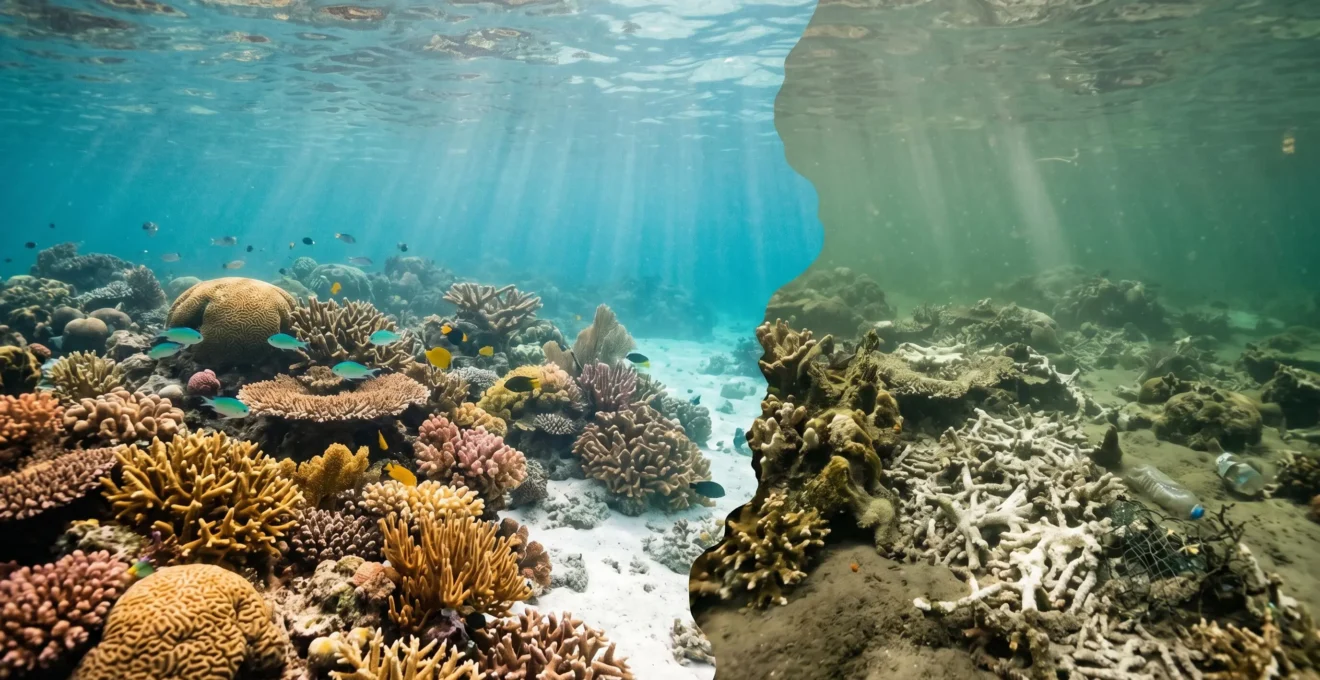
The destructive force of mass tourism stems not from travel itself, but from the flawed economic and logistical systems that extract value without reinvesting in local communities or environments.
- Systemic « economic leakage » means up to 80% of tourist money never reaches the local economy, creating a cycle of dependency and environmental neglect.
- The timing of visits, dictated by cruise schedules and package tours, creates unsustainable « visitor pressure » that degrades infrastructure and natural sites.
Recommendation: Shift from being a passive consumer to an active, informed traveller by understanding and subverting these systems through strategic timing, direct spending, and supporting community-owned initiatives.
The image of a pristine beach or a historic city square is a powerful lure for travellers. Yet, for the conscious explorer, that image is often tinged with guilt. The very act of visiting a dream destination seems to contribute to the ‘overtourism’ that strains local resources, displaces residents, and erodes the natural beauty we seek. The statistic that mass tourism can obliterate 40% of coastal ecosystems in just over a decade is not just a shocking figure; it is a symptom of a deeply flawed system. Many guides offer simple solutions: travel off-season, buy local. While well-intentioned, these tips often fail to address the core of the problem.
The issue isn’t simply the number of people, but the mechanics of how they arrive, where they spend their money, and who profits. The standard model of mass tourism is built on volume and extraction, leading to what researchers call « economic leakage, » where the majority of revenue is siphoned away from the destination itself. This leaves communities with the social and environmental costs of tourism, but few of the financial benefits needed to manage them sustainably. It creates a paradox where more visitors can actually lead to greater poverty and degradation for the host location.
But what if the solution wasn’t to stop travelling, but to travel with a systemic understanding? This analysis moves beyond the platitudes to deconstruct the ‘why’ behind the damage. We will investigate the economic and logistical frameworks that fuel overtourism’s destructive cycle. By understanding these underlying systems—from economic leakage and visitor pressure to the drivers of cultural resistance—you can transform your travel choices from a potential liability into a powerful tool for environmental preservation and genuine community support. This guide provides the data and insights to help you visit the world’s most sought-after places not just responsibly, but restoratively.
This article provides a data-driven framework to help you navigate the complexities of modern travel. The following sections break down the core systems at play, offering evidence-based strategies for making truly impactful and responsible choices.
Summary: The Systemic Reasons Mass Tourism Degrades Destinations and How to Counter Them
- Which mass tourism hotspots will be closed to visitors by 2030?
- How to visit mass tourism destinations responsibly without skipping your dream holiday?
- Mass tourism package or independent eco-travel: which actually costs less?
- The timing error that puts you in crowds of 50,000+ at mass tourism sites
- What are the 5 red flags that a hidden gem is becoming a mass tourism trap?
- How to apply Leave No Trace in wilderness areas beyond « pack out your rubbish »?
- Why do some local culture groups embrace tourism while others resist it?
- How have travellers’ priorities shifted from bucket lists to sustainability?
Which mass tourism hotspots will be closed to visitors by 2030?
The concept of a popular destination becoming inaccessible is no longer a hypothetical scenario; it is a management strategy being actively implemented worldwide. Faced with irreversible environmental damage and crumbling infrastructure, governments are moving from welcoming all visitors to imposing strict limits, escalating fees, or outright closures. This isn’t about discouraging tourism, but about saving these locations from the sheer visitor pressure generated by unchecked mass travel. The trend signals a fundamental shift: the era of unlimited access to global icons is ending, replaced by a model of highly managed, and often exclusive, visitation.
This paradigm is vividly illustrated by recent actions in Japan. The country is systematically transitioning towards a more restricted tourism model to protect its most fragile sites from « bullet climbing » and waste.
Case Study: Japan’s Progressive Restrictions
On Mount Fuji’s Yoshida Trail, Japanese officials introduced a mandatory ¥2,000 climbing fee in 2024 and capped daily access at 4,000 hikers to prevent unsafe practices and reduce environmental strain. These fees are set to escalate, reaching 4,000 yen by 2026. In parallel, Kyoto has banned tourists from the private alleys of its Geisha district following resident protests, and Iriomote Island now limits daily visitors to 1,200. These are not isolated incidents but part of a coordinated national strategy to manage tourism impacts, signaling a future where access to iconic sites is a regulated privilege, not a given.
The transformation of these destinations serves as a stark warning. The image below captures the haunting beauty of a landscape altered by environmental pressures, a visual premonition of what happens when carrying capacity is ignored for too long.
This scene, devoid of human activity, illustrates the ultimate consequence of overtourism: a place so degraded that it can no longer support the ecosystem—or the industry—that once thrived there. The list of at-risk destinations is growing, with parts of Antarctica, Venice, and fragile coral reef systems all facing similar regulatory futures.
How to visit mass tourism destinations responsibly without skipping your dream holiday?
The desire to see iconic destinations is understandable, and avoiding them entirely is not the only responsible option. The key is to subvert the systems of mass tourism that cause the most harm. The most significant of these is economic leakage, a phenomenon where the vast majority of money spent by tourists fails to benefit the local community. All-inclusive resorts, foreign-owned tour companies, and cruise lines are primary channels for this leakage, as they often import goods and repatriate profits, leaving the host destination with the environmental cleanup bill but little revenue to pay for it.
Research from the Travel Foundation reveals a staggering reality: in many developing nations, between 50% and 80% of total tourist spending leaks out of the local economy. This means that for every $100 you spend on a typical package holiday, as little as $20 might stay within the community you are visiting. The rest flows back to multinational corporations headquartered thousands of miles away. This dynamic creates a vicious cycle: communities don’t see the financial benefits, so infrastructure and environmental protections remain underfunded, leading to further degradation.
The antidote to economic leakage is conscious, direct spending. This requires a shift in mindset from seeking convenience to seeking authenticity and impact. Instead of booking through a large international portal, seek out locally owned guesthouses or boutique hotels. Eat at family-run restaurants that source their ingredients from nearby farms. Hire local guides who are certified and recommended by the community, not just the ones contracted by large tour operators. Each of these choices acts as a form of systemic subversion, ensuring that your travel funds directly support the people and businesses that are the custodians of the destination. This not only provides a more authentic cultural experience but also empowers the community to preserve its heritage and environment.
Mass tourism package or independent eco-travel: which actually costs less?
A common misconception is that responsible, eco-conscious travel is a luxury reserved for the wealthy. While a high-end eco-lodge may carry a premium price, the core principles of independent, sustainable travel often prove more economically efficient for the traveller and vastly more beneficial for the destination. The financial structure of mass-market package tours is designed for profit extraction, not local benefit. A Travel Foundation report found that in some cases, only around 5 dollars per 100 dollars spent by tourists from developed countries stays in a developing destination’s economy.
This extreme economic leakage means that the advertised « value » of a package deal is often subsidized by the host community, which bears the external costs of water usage, waste management, and infrastructure strain without receiving proportional revenue. Independent travel, by contrast, puts the consumer in direct control of their spending. By choosing to pay a local family for a room, a local guide for a tour, or a local farmer for a meal at their restaurant, you cut out the international middlemen and ensure a near 100% retention rate of your money within the community. This can lead to a more affordable trip overall, as you are not paying for corporate overheads and shareholder profits.
The data on economic leakage rates across different types of economies is revealing. It demonstrates that the structure of the local economy and the type of tourism model employed have a direct and predictable impact on how much money stays within a country.
| Destination Type | Economic Leakage Rate | Local Economy Retention |
|---|---|---|
| Small Island Developing States (SIDS) | 55% to 80% | 20% to 45% |
| Most Developing Countries | 40% to 50% | 50% to 60% |
| Advanced and Diversified Economies | 10% to 20% | 80% to 90% |
| Thailand (specific example) | 70% | 30% |
| Caribbean Islands (specific example) | 80% | 20% |
| India (specific example) | 40% | 60% |
As the table sourced from a UN-affiliated analysis of tourism economics shows, destinations heavily reliant on all-inclusive, foreign-owned tourism (like many Caribbean islands) see up to 80% of revenue leak away. In contrast, more diversified economies that support small, local businesses retain a much larger share. Therefore, choosing independent travel in a destination like the Caribbean is not just an ethical choice; it is a powerful economic intervention.
The timing error that puts you in crowds of 50,000+ at mass tourism sites
Beyond economics, the single most impactful factor in a traveller’s experience—and their environmental footprint—is timing. The common advice to « travel off-season » is a simplification of a more precise strategy: temporal contrarianism. This means understanding and avoiding the specific, often very short, windows of peak visitor pressure. At many iconic sites, the difference between a serene, reflective experience and an overwhelming, destructive crowd is not a matter of months, but of hours. This phenomenon is most acutely demonstrated by the impact of cruise ships.
A single large cruise ship can disgorge 5,000 people into a small historic town for a few hours, instantly overwhelming its infrastructure, from sewage systems to sidewalks. Travellers who unknowingly visit during these docking windows find themselves in a tourist trap of their own making, contributing to the very crowds they hoped to escape. This « Cruise Ship Blind Spot » is a critical timing error that turns a dream destination into a stressful ordeal for both visitor and resident.
Case Study: The Cruise Ship Effect in Kotor
The Adriatic UNESCO city of Kotor is a stark example. Each year, an estimated 500 large cruise ships dock, some carrying 5,000 people. This sudden influx into a city with only 22,000 residents creates intense traffic congestion, strains public services, and drives up housing costs, forcing locals from their ancestral homes. Within hours of a ship’s arrival, the city transforms from a manageable, historic gem into an overwhelmed tourism hub, perfectly demonstrating how a failure to consider micro-timing leads to peak visitor pressure.
The reward for practising temporal contrarianism is immense. It is the difference between shuffling through a crowded square and having it almost to yourself, as captured in the image below. This is not about avoiding popular places, but about experiencing them as they were meant to be seen: with space for contemplation and connection.
Achieving this requires research. Before you visit a coastal or riverside city, check the cruise ship docking schedule—it is often publicly available online from the port authority. For any major landmark, plan to visit at the very beginning or the very end of the day, avoiding the midday rush created by large tour bus schedules. This simple act of strategic timing is one of an informed traveller’s most powerful tools.
What are the 5 red flags that a hidden gem is becoming a mass tourism trap?
Every mass tourism trap was once a hidden gem. The transition from a quiet, authentic destination to an over-touristed hotspot follows a predictable pattern. For the conscious traveller seeking to visit places before they are spoiled, or for those who wish to support communities resisting the negative impacts of overdevelopment, recognizing the early warning signs is a critical skill. These red flags indicate that a location’s tourism model is shifting from sustainable and community-integrated to extractive and high-volume.
One of the most telling metrics is the tourist-to-resident ratio. When the number of annual visitors dramatically eclipses the local population, it signals that infrastructure, social services, and the very culture of a place are under immense strain. As recent data shows, Barcelona receives 32 million tourists annually, overwhelming its population of just 1.6 million—a ratio of 20 to 1. This imbalance is a direct driver of resident frustration, rising housing costs due to short-term rentals, and the commodification of public spaces. As an academic review notes, this kind of pressure is often amplified by social media trends.
Instagram tourism has been implicated as a cause of overtourism.
– Multiple scholars cited in overtourism research, Overtourism academic literature review
Based on patterns observed in places like Barcelona, Venice, and Maya Bay, here are five key red flags to watch for:
Your Checklist: 5 Red Flags of an Emerging Tourist Trap
- The « Instagram » Effect: A sudden proliferation of foreign-owned businesses (cafes, hostels, tour operators) all catering to a homogenous, international aesthetic rather than local culture. Look for menus exclusively in English and decor that could be anywhere in the world.
- Infrastructure Prioritizes Tourists over Residents: New developments like massive cruise ports, oversized airports, and highways are built to serve visitors, while local needs like schools, hospitals, and public parks are neglected or displaced.
- Commodification of Culture: Authentic cultural practices and rituals are turned into scheduled, ticketed « performances » for tourists. Souvenirs shift from locally crafted goods to mass-produced trinkets featuring the same iconic image.
- Rise of « Tourist-Only » Zones: Areas of a city or town become effectively off-limits to locals due to exorbitant prices or a hostile atmosphere. You’ll hear more foreign languages than the local tongue.
- Appearance of Overt « Anti-Tourism » Sentiment: The presence of graffiti, posters, or organized local protests explicitly asking tourists to « go home » or decrying the impacts of overtourism. This is a late-stage sign that the social carrying capacity has been breached.
When you see these signs, it does not necessarily mean you should not visit. It means you must be exceptionally diligent in your choices, making a concerted effort to seek out and support the remaining local, family-run businesses that are being pushed to the margins.
How to apply Leave No Trace in wilderness areas beyond « pack out your rubbish »?
The « Leave No Trace » (LNT) ethos is a cornerstone of responsible outdoor recreation, but its most common interpretation— »pack it in, pack it out »—only scratches the surface. In an era of high-definition GPS and social media geotagging, the most significant impacts we have on wilderness areas are often invisible and unintentional. Applying advanced LNT principles means recognizing that our presence alters ecosystems not just physically, but biologically, acoustically, and even digitally.
The principle of « Biological Leave No Trace » is a critical, yet often overlooked, responsibility. When you move from one natural area to another, your boots, tires, and gear can act as vectors for invasive species. A single seed from a non-native plant or a fungal spore carried in the mud on your hiking boot can devastate a fragile alpine meadow or an old-growth forest. Similarly, « Acoustic Leave No Trace » addresses noise pollution. The use of speakers or drones in natural settings can disrupt wildlife communication, interfere with predation patterns, and shatter the solitude that is a primary value of wilderness for many visitors. It is about respecting the natural soundscape as much as the landscape.
The most modern challenge is practicing « Digital Leave No Trace. » Geotagging a photo of a pristine waterfall or a remote wildflower field on social media can unleash a torrent of visitors to a location that lacks the infrastructure to handle the traffic. This has led to the trampling of sensitive vegetation, soil erosion, and the creation of « social trails » that scar the landscape. The responsible choice is to be vague about the specific location of sensitive areas, allowing others the joy of discovery while protecting the resource.
This macro view of a thriving microhabitat on a mossy log illustrates what is at stake. The intricate web of lichens, fungi, and insects represents the delicate biological integrity that advanced L.N.T. principles are designed to protect. The following actions extend the L.N.T. framework to address these subtle but profound impacts.
Why do some local culture groups embrace tourism while others resist it?
The reaction of a local community to tourism is rarely a simple binary of « embrace » or « resist. » It is a complex calculation of economic benefit versus cultural cost, and the determining factor is almost always community sovereignty. When a community has control over the development, pace, and nature of tourism in their area, they are far more likely to see it as a positive force. Conversely, when tourism is imposed by outside corporations or a distant central government, it is often perceived as a form of colonization, leading to resentment and resistance, even if it brings some jobs.
The economic argument for tourism is powerful. Before the pandemic, pre-pandemic data demonstrates that global tourism employed over 333 million people (one in 10 jobs globally) and was a massive contributor to global GDP. For many communities, it represents the most viable path to economic development. However, these benefits are only realized if the revenue stays within the community. When economic leakage is high and the only jobs created are low-wage service positions in foreign-owned hotels, the promised prosperity never materializes. Instead, locals face rising costs of living and competition for resources like water and land.
The key difference between a community that embraces tourism and one that resists it is who holds the power and reaps the rewards. The Galapagos Islands provide a compelling model for tourism managed on the community’s terms.
Case Study: Community Sovereignty in the Galapagos
A study by the National Geographic Society found that marine-based tourism in the Galapagos brought in over $178 million annually and supported more than a third of all jobs. This success is rooted in a model of community control. Strict visitor caps, mandatory licensed local guides, and regulations designed and enforced by local authorities ensure that the community retains decision-making power. This contrasts sharply with imposed tourism models, where external corporations control infrastructure and revenue streams, triggering local resistance as communities experience displacement and cultural erosion without commensurate economic benefit.
Therefore, a traveller’s most ethical choice is to support tourism models that empower local communities. This means choosing businesses that are not just locally owned but that also demonstrate a commitment to community well-being, whether through fair wages, environmental stewardship, or investment in local services. Your choice is a vote for a specific type of tourism, and by supporting community-led initiatives, you help foster a more sustainable and equitable industry for all.
Key takeaways
- Mass tourism’s damage is systemic, driven by economic models that extract value and create unsustainable visitor pressure.
- Conscious travellers can subvert these systems through direct spending in local economies and strategic timing to avoid peak loads.
- The future of travel is shifting from unlimited access to managed visitation, prioritizing ecological health and community well-being over sheer volume.
How have travellers’ priorities shifted from bucket lists to sustainability?
For decades, the dominant travel ethos was one of collection: the « bucket list. » This approach treated destinations as trophies to be acquired, experiences to be checked off, and photos to be captured. The focus was on the self—what the traveller could get from a place. However, a growing awareness of tourism’s dark side, particularly its environmental cost and social impact, is fostering a significant shift in priorities. The conscious traveller of today is moving from a consumptive mindset to a contributory one, asking not « What can this place do for me? » but « How can my visit be a positive force for this place? »
This shift is driven by stark data. The tourism sector is a major contributor to global carbon emissions, and its footprint is growing. An analysis of the sector shows that global tourism emissions grew at 3.5% per year between 2009 and 2019, accounting for a significant portion of total global greenhouse gas emissions. Travellers are increasingly aware that every flight, every hotel stay, and every purchase has an environmental cost. This has led to the rise of concepts like « flygskam » (flight shame) and a greater demand for carbon-neutral travel options, rail journeys, and destinations that prioritize renewable energy.
This evolving consciousness is pushing the industry beyond simple « greenwashing » and towards more fundamental changes. It’s no longer enough to offer a reusable water bottle; travellers are now demanding transparent supply chains, fair labour practices, and demonstrable contributions to conservation. This pressure from the consumer side is aligning with a new, more radical way of thinking from academics and policy experts, who argue that simply managing tourism is not enough.
Tourism degrowth has emerged as a framework for addressing overtourism that goes beyond conventional demand-management tools, referring to a deliberate and planned reduction in tourism activity, prioritizing ecological sustainability and community well-being over visitor volume.
– Büscher, Fletcher, Hall, Lundmark, and Zhang, Overtourism academic framework
This concept of « degrowth » represents the ultimate evolution of traveller priorities. It accepts that in some places, the only sustainable path forward is less tourism, not just « better » tourism. For the individual traveller, this translates into a preference for longer, more immersive stays in a single location rather than frantic, multi-country trips. It prioritizes depth of connection over breadth of conquest. The new bucket list is not a list of places, but a list of principles: to leave a place better than you found it, to forge genuine human connections, and to travel in a way that sustains the planet for future generations.
By understanding the systems of economic leakage, visitor pressure, and community sovereignty, you can move beyond the guilt of tourism and become an agent of positive change. The next step is to apply this framework to your future travel planning, turning every trip into an opportunity to support a more sustainable and equitable world.