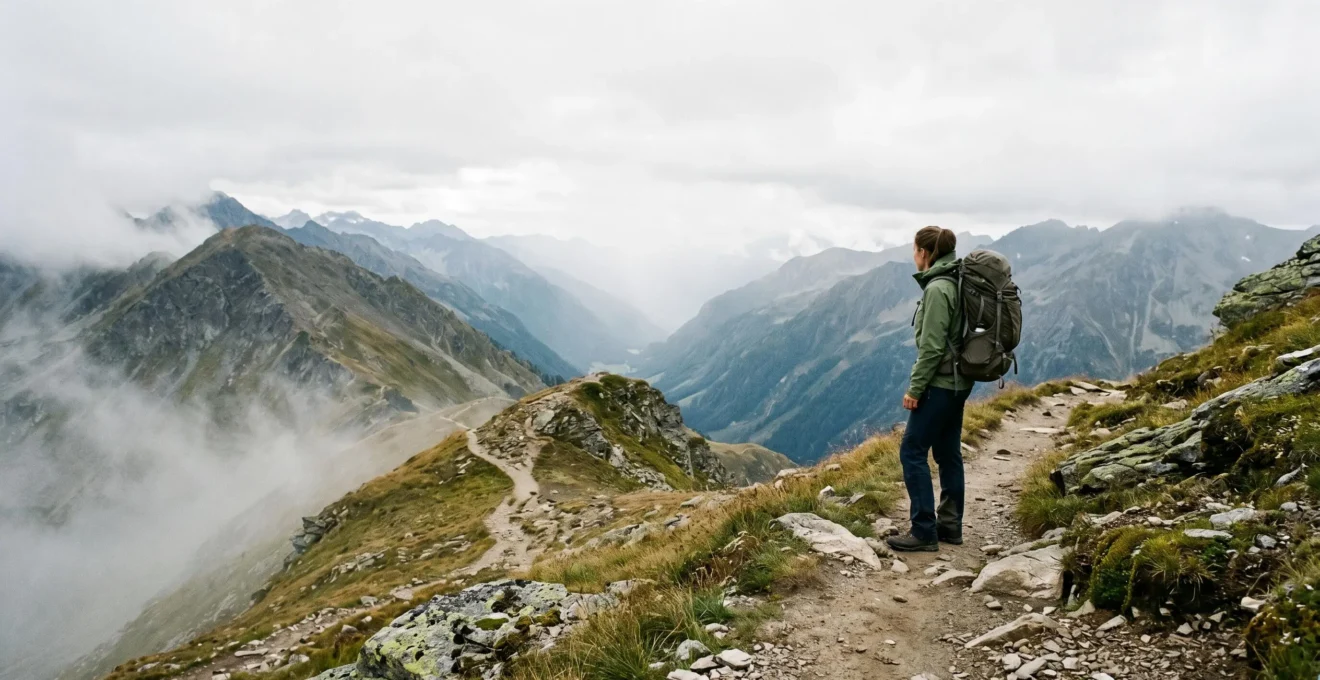
The greatest danger in off-the-beaten-track travel isn’t what you pack, but the cognitive biases you carry. True safety comes from a strategic mindset, not just a longer packing list.
- Authentic places become tourist traps due to a predictable « authenticity paradox, » which you can learn to spot and avoid.
- Finding hidden gems requires using « second-order location thinking » and leveraging local, non-tourist logistics rather than relying on guidebooks.
- Smart risk management involves consciously choosing your level of remoteness (from « moderately hidden » to « completely remote ») based on your skills and psychological readiness.
Recommendation: Shift your focus from avoiding all risk to intelligently calibrating it. Your primary tool isn’t a 4×4; it’s a rigorous process of due diligence and self-assessment.
You’ve seen the picture on Instagram: a pristine, hidden village, a solo traveler gazing into an untouched landscape. But when you arrive, you find a parking lot, a queue for the « authentic » photo spot, and rows of souvenir shops. The desire to escape overcrowded tourist circuits is a powerful one, especially for those who seek genuine connection and discovery. Yet, venturing into the unknown brings a legitimate concern: how do you find these authentic places without sacrificing your safety?
The standard advice often feels inadequate. Learning a few local phrases or telling a friend your itinerary are basic precautions, but they don’t address the core challenge. They don’t teach you how to distinguish a calculated adventure from a reckless gamble. The real work of safe, off-the-beaten-track travel is mental and strategic. It’s about understanding the systems that create tourist traps, developing a framework for finding places before they hit the mainstream, and honestly assessing what level of « remote » is right for you.
This guide moves beyond generic safety tips. We will deconstruct the lifecycle of a tourist destination, providing you with the tools to identify opportunities before they are commercialized. We’ll explore the critical psychological mistake that puts travelers in danger and provide a framework for making smarter decisions. Ultimately, you will learn to calibrate risk, leverage local logistics, and engage with communities ethically, turning the dream of authentic travel into a safe and achievable reality.
To navigate this complex topic, we’ve structured this guide to build your expertise progressively. The following sections will equip you with the strategic mindset needed for true and responsible adventure.
Summary: A Strategic Guide to Safe and Authentic Exploration
- Why Do Once-Authentic Villages Become Tourist Traps Within 5 Years?
- How to Find Off-the-Beaten-Track Destinations Before Travel Influencers Ruin Them?
- Moderately Hidden or Completely Remote: Which Off-the-Beaten-Track Level Suits You?
- The Critical Mistake That Puts Off-the-Beaten-Track Travellers in Dangerous Situations
- When to Visit Off-the-Beaten-Track Destinations: Timing That 75% Get Wrong
- Community-Led or Commercial Tour: Which Local Culture Experience Is More Ethical?
- How to Calculate Food and Water Needs for 5 Days in Remote Locations?
- How to Reach Remote Locations Without a 4×4 or Wilderness Survival Skills?
Why Do Once-Authentic Villages Become Tourist Traps Within 5 Years?
The transformation from a tranquil village to a bustling tourist hub follows a predictable, often rapid, cycle. This phenomenon, known as the authenticity paradox, occurs when the very qualities that make a place unique and desirable—its culture, landscape, and sense of remoteness—attract an influx of visitors that ultimately erodes those same qualities. Initially, pioneer travelers discover the location, followed by early adopters. As word spreads, often amplified by social media, infrastructure develops to cater to tourists, not locals. This process can lead to what academics call « tourism gentrification. »
Tourism gentrification refers to the process by which tourism-related activities result in the displacement of long-term residents in favour of capital investment focused on tourism.
– Agustín Cocola-Gant, Tourism gentrification research, Geografiska Annaler Series B
Case Study: Penglipuran Village, Bali
The traditional village of Penglipuran in Bali serves as a powerful example. Its unique cultural hospitality and well-preserved spatial design made it an authentic gem. However, after COVID-19 travel restrictions lifted, its popularity exploded. Tourist arrivals skyrocketed from around 147,000 in 2021 to over 956,000 by 2023. This surge accelerated the village’s commercialization, demonstrating how the very features that attract discerning travelers can become the engine of their own commodification, often within a five-year window.
This visual and economic shift is often subtle at first—a new guesthouse, a café with an English menu—but it signals the beginning of a fundamental change in the community’s fabric. Understanding this cycle is the first step in learning to identify destinations that are still in the early, authentic phase of this lifecycle.
This juxtaposition between authentic, weathered textures and encroaching, blurred commercialism is the visual hallmark of the authenticity paradox in action. For the responsible traveler, the goal is to find and support communities before the background blur comes into sharp focus, overwhelming the original character of the place.
How to Find Off-the-Beaten-Track Destinations Before Travel Influencers Ruin Them?
Finding genuinely untrodden paths in a hyper-connected world requires moving beyond traditional search methods. Standard guidebooks and popular travel blogs are, by nature, lagging indicators of authenticity; by the time a place is featured, it’s already on the tourist map. The key is to adopt a proactive, investigative mindset and use digital tools in unconventional ways to get ahead of the curve. This means looking for signals of authentic local life rather than tourist-focused marketing.
This search for genuine experiences is a growing movement. The demand for responsible and authentic travel is not just a niche interest; it’s a significant economic force, as global market analysis of ethical tourism trends shows the market size reached USD 258.54 billion in 2024. To tap into this, you need to think like a local researcher, not a tourist. This involves strategies like leveraging expat communities for insider knowledge, using map filters to deliberately look away from hotspots, and even searching in local languages to find community hubs instead of commercial fronts.
Instead of searching for a famous national park, apply « second-order location thinking » by looking for adjacent state forests or regional reserves. These areas often share a similar ecology but lack the tourist infrastructure and crowds. Another powerful technique is to cross-reference historical satellite imagery on Google Earth with local bus schedules. This allows you to identify villages and towns that have remained structurally stable over time, indicating a life not yet reshaped by tourism development. These methods require more effort but yield exponentially more rewarding discoveries.
- Use the ‘expat forum strategy’: Search for ‘[country name] + expats’ on platforms like Reddit or Facebook. Expat communities possess deep local knowledge of hidden gems that rarely appear in guidebooks.
- Apply the ‘map-based accommodation filter’: Use map views on Booking.com or Airbnb and intentionally look for properties far from city centers and known tourist attractions. This is a direct way to find communities where tourism is not the primary economy.
- Leverage ‘local language domain searches’: Searching for terms like « cultural festival » or « local market » in the local language on country-specific domains (e.g., site:.th for Thailand) uncovers events and places meant for residents, not tourists.
Moderately Hidden or Completely Remote: Which Off-the-Beaten-Track Level Suits You?
The term « off-the-beaten-track » is not a monolith. It represents a spectrum of remoteness, each with different requirements, risks, and rewards. The most crucial step in planning a safe and enjoyable trip is to honestly assess your skills, experience, and psychological readiness to determine which level is right for you. A mismatch between your capabilities and your destination’s demands is a primary source of stress and danger. We can break this spectrum into three distinct levels of travel.
Level 1 (Moderately Hidden) involves locations reachable by public transport, with basic guesthouses and local restaurants. This requires cultural sensitivity and a willingness to improvise but does not demand advanced survival skills. Level 2 (Significantly Remote) requires specialized local transport like shared taxis or regional flights, and accommodations are often limited to homestays. Self-sufficiency and intermediate navigation skills become important. Level 3 (Completely Remote) is the realm of expeditions, requiring multi-day treks or chartered transport. There is no tourist infrastructure, and travelers must possess advanced wilderness skills, medical self-sufficiency, and be prepared for extreme isolation.
This table helps clarify the distinctions and allows for a more honest self-assessment of what kind of « off-the-beaten-track » experience you are truly prepared for.
| Level | Accessibility | Infrastructure | Required Skills | Psychological Readiness | Risk Level |
|---|---|---|---|---|---|
| Level 1: Moderately Hidden | Reachable by public transport or local buses | Basic guesthouses, local restaurants available | Basic language skills, social adaptability, cultural sensitivity | Tolerance for ambiguity, comfort with improvisation | Low to Moderate |
| Level 2: Significantly Remote | Requires specialized local transport (shared taxis, boats, regional flights) | Minimal facilities, homestays or basic lodging only | Intermediate navigation skills, moderate language proficiency, self-sufficiency | Resilience to loneliness, comfort with limited communication | Moderate to High |
| Level 3: Completely Remote | Requires expedition planning (mules, chartered boats, multi-day trekking) | No infrastructure, camping or community hospitality only | Advanced wilderness skills, medical self-sufficiency, emergency protocols | Crisis decision-making under stress, extreme isolation tolerance | High to Very High |
Choosing a Level 3 destination with Level 1 skills is a recipe for disaster. As seasoned travelers advise, your personal safety must always be the first consideration, especially in unfamiliar environments. The romance of spontaneous adventure should never eclipse the need for smart preparation.
You can’t simply jump on a random bus in El Salvador or Cambodia and let it take you out to the middle of nowhere unless you have some idea of what lies ahead. Particularly in some of the sketchier places around the world you always need to consider your own personal safety first.
– Don’t Forget To Move Travel, How to Really Get Off The Beaten Track
The Critical Mistake That Puts Off-the-Beaten-Track Travellers in Dangerous Situations
The most dangerous element in off-the-beaten-track travel is not a venomous snake or a faulty piece of gear; it is a flaw in human psychology. The critical mistake that precedes most dangerous situations is a failure to account for our own cognitive biases. These are mental shortcuts and patterns of thinking that, while useful in everyday life, can lead to catastrophic misjudgments in unfamiliar, high-stakes environments. Overlooking these internal risk factors is the most common path to trouble.
As the CDC’s guidelines for adventure travelers point out, this human factor can be decisive. A traveler might suffer from « optimism bias, » underestimating the likelihood of negative events like a flash flood or a vehicle breakdown. Another might fall prey to « confirmation bias, » seeking out information that confirms their desire to visit a risky area while ignoring warnings. These are not moral failings; they are predictable features of human cognition.
Cognitive bias, the third variable, is the human factor of interpreting events, facts, and other data based on a set of emotions, experiences, and personal beliefs that may not be correct, but which may influence decisions and judgment.
– CDC Yellow Book, Adventure Travel Guidelines
Recognizing these biases is the first step toward mitigating them. It involves cultivating a mindset of healthy skepticism, especially towards your own assumptions. Are you pushing on into the jungle before a storm because it’s truly safe, or because you’re anchored to a pre-set itinerary and don’t want to « waste » a day? Are you trusting a dubious guide because they seem friendly, or have you done your due diligence?
This act of pausing to check your own motivations and assumptions—like checking a compass at a fork in the trail—is the most important safety procedure. The critical decision is often not about which path to take, but whether your judgment is clear enough to make that choice. Safety in the wild begins with this discipline of the mind.
When to Visit Off-the-Beaten-Track Destinations: Timing That 75% Get Wrong
Strategic timing is one of the most underrated aspects of successful off-the-beaten-track travel. Most travelers plan their trips around two simple variables: weather and peak tourist season. However, for truly remote destinations, these factors are often the least important. The smartest timing decisions are based on a deeper understanding of local political, economic, and cultural calendars—factors that the majority of visitors overlook.
For example, visiting a country during a national election campaign can introduce unforeseen security risks and logistical hurdles as police and transport resources are diverted. Similarly, being aware of major infrastructure projects, like a new highway being built into a remote region, is crucial. Arriving just before such a project is completed can offer a last glimpse of the area’s isolation, while arriving just after can mean inflated prices and a changed landscape. The goal is to see the local context in four dimensions, with time as a critical layer of your planning.
The concept of « slow travel » is intrinsically linked to better timing. As one traveler noted, having more time in a country allows for deeper research and the flexibility to visit secondary locations that a one-week itinerary would never permit.
If you were only in Cambodia for a week then you’d prioritize Angkor Wat over little Banlung. However, if you were there any longer I’d say definitely pencil it in. Traveling slow also gives you more time to do your research and find the best/cheapest ways to get out to the locations you want to explore.
– A traveler quoted in Don’t Forget To Move
Ultimately, strategic timing is about aligning your visit with the rhythm of local life, not the tourism industry. This could mean timing your visit to coincide with a non-touristy harvest festival or tracking currency exchange rates to travel when your budget can go further while being mindful of the local economic impact. It’s a more complex calculus, but it’s one that unlocks a more profound and authentic travel experience.
- Check national election schedules: Avoid visiting during sensitive political periods when tensions can be high and security is unpredictable.
- Monitor major infrastructure project timelines: A new airport or highway can transform a remote region overnight, affecting its character and cost.
- Research local school holiday and harvest seasons: These periods can offer unique opportunities for cultural immersion (or, alternatively, be times to avoid if you seek solitude).
- Track currency exchange rates: Visiting when your currency is strong can reduce financial stress, but always consider the ethical implications for the local community.
Community-Led or Commercial Tour: Which Local Culture Experience Is More Ethical?
As travelers seek more authentic connections, the line between genuine cultural exchange and exploitative tourism can become blurred. Choosing between a community-led initiative and a slick commercial tour is not always straightforward. The key to making an ethical choice lies not in the marketing label but in conducting rigorous due diligence. A tour marketed as « community-based » can still be exploitative if the benefits don’t flow to the community itself.
True community-based tourism is defined by local ownership and control. As Abreu et al. explain in their research, it operates on a paradigm of « community self-governance, » where the community members are the primary protagonists and decision-makers, not just employees or subjects of the tourist gaze. This model is gaining significant traction; industry analysis shows that community-based lodges represent a 38% market share in the ethical tourism sector, indicating a strong traveler preference for models that directly support local economies.
However, verifying these claims requires asking pointed questions. A truly ethical operation will be transparent about its structure. You should be able to ask where your money goes and receive a clear answer. Is a portion of the fee set aside for community-wide projects like healthcare or education? Who makes the decisions about tourism development? Does the experience foster dignity through active participation (like a collaborative cooking class) or does it feel like passive, voyeuristic observation?
The burden of proof is on the operator, but the responsibility to ask the questions is on the traveler. A refusal to answer these questions transparently is, in itself, an answer.
Due Diligence Checklist for Evaluating Ethical Tourism Experiences
- Verify Fund Allocation: Ask for a transparent breakdown of where your fee goes. A portion should be allocated to community-wide projects beyond individual salaries.
- Investigate Decision-Making: Inquire about the governance structure. Are tourism-related decisions made collectively by the community or by an external operator?
- Assess Broader Impact: Ask how residents who are not directly involved in the tour are affected. Does tourism benefit the whole community or just a select few?
- Confirm Ownership vs. Marketing: Distinguish between « Community-Based » (a potential marketing term) and « Community-Owned » (an economic model with genuine local control and equity).
- Evaluate the Dignity Framework: Does the experience involve active, respectful participation and skill-sharing, or does it reduce community members to passive subjects for observation?
How to Calculate Food and Water Needs for 5 Days in Remote Locations?
Calculating food and water for a remote expedition is a critical safety task that goes far beyond simple multiplication. It’s a dynamic calculation that must account for environmental factors, activity levels, and a crucial redundancy margin. The CDC’s guidelines on adventure travel are clear: physical exertion in remote environments significantly increases caloric, fluid, sleep, and thermoregulation requirements. A static « one-size-fits-all » approach is dangerously inadequate.
For water, begin with a baseline of 2 liters per person per day. To this, you must add multipliers. The « altitude factor » requires adding 0.5 liters for every 1,000 meters of elevation to compensate for increased respiratory water loss. The « activity multiplier » requires adding 1 liter for every hour of strenuous activity, such as hiking with a heavy pack. If you have reliable purification equipment and verified water sources on your route, you can subtract those amounts from your total carry weight, but this must be done with extreme caution.
For food and other critical supplies, the most important rule is the N+2 Redundancy Principle. For a planned 5-day trip, you must pack 7 days of essential supplies. These extra two days are not for extending your trip for fun; they are a non-negotiable safety buffer to account for potential immobility due to injury, severe weather, or unexpected route obstacles. Caloric needs must also be adjusted dynamically, increasing by 10-15% in cold climates and 5-10% at altitudes above 2,500 meters.
This systematic approach transforms packing from guesswork into a form of risk management. Every item’s weight is weighed against its potential life-saving value, ensuring you are prepared for the trip you planned and the emergencies you did not.
- Base Water Needs: Start with 2 liters per person per day.
- Add Altitude Factor: Add 0.5 liters per 1,000 meters of elevation.
- Add Activity Multiplier: Add 1 liter per hour of strenuous physical activity.
- Apply N+2 Redundancy Principle: For a 5-day trip, pack 7 days of critical supplies (food, fuel, first-aid).
- Calculate Dynamic Caloric Needs: Adjust base calories for environmental factors (cold, altitude) and daily activity levels.
Key takeaways
- The greatest risk in remote travel is not external danger, but internal cognitive biases that lead to poor decisions.
- True off-the-beaten-track travel is a skill based on a layered risk assessment, not simply wandering off a main road.
- The most effective way to access remote areas safely is by leveraging existing local logistics and non-tourist transport systems.
How to Reach Remote Locations Without a 4×4 or Wilderness Survival Skills?
The image of a rugged 4×4 fording a river is a powerful one, but it’s a misleading prerequisite for accessing remote locations. For the traveler without expedition-level skills or budget, the key is not to bring your own heavy-duty infrastructure, but to cleverly leverage the logistics that already exist to serve local communities. This approach is not only more affordable and sustainable, but it also leads to far more authentic interactions.
The first step is to research the supply chains that serve isolated areas. Nearly every remote village has a lifeline to the outside world, whether it’s a weekly supply boat, a mail plane, or a cargo truck carrying goods to a market. These are often willing to accept passengers for a modest fee, providing a mode of transport and an immediate immersion into the local economy. Another effective strategy is the « Hub-and-Spoke » model. Establish a comfortable base in a « Level 1 » accessible town, then use local guides and transport for day trips or single overnights into more remote « Level 2 » areas, always returning to your secure base.
Structured Access via Volunteer Platforms
Platforms like Worldpackers offer a structured model for this kind of access. By volunteering for a homestay in a rural community, travelers without advanced skills can safely immerse themselves in remote locations. The host family provides a secure base, local knowledge, and guidance to undiscovered spots, effectively bridging the gap between tourist comfort and a genuine off-the-beaten-track experience without requiring any specialized equipment.
When hiring a local guide, the most important skills to vet are not their driving abilities, but their logistical problem-solving. Can they navigate local bureaucracy to secure permits? Can they arrange for mules or passage on a fishing boat? These are the skills that open up a region. By shifting your perspective from « how can I get there? » to « how do people and goods already get there? », you unlock a world of possibilities that are invisible to the conventional tourist.
The world is vast and full of genuine connection, far beyond the curated feeds and crowded landmarks. Your next true adventure begins not with a booking confirmation, but with a smarter question and a more prepared mind. Start today by evaluating your own travel style and identifying the small, strategic shifts you can make for your next journey.